
Quevedo: ‘I love being rich, but at the same time it is a curse’
Spain’s most listened-to young artist was catapulted to international fame at age 20 with his hit ‘Quédate’ featuring Bizarrap. In this interview he reflects on the severe depression he experienced, reggaeton, and the effects of fame
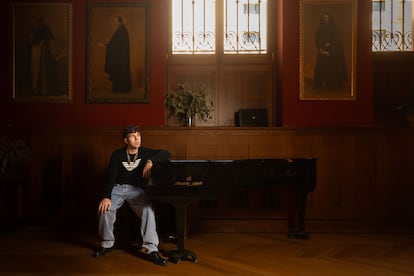

“Me contradigo todo el rato, pero me hace sentir vivo” (I contradict myself all the time, but it makes me feel alive), sings 24-year-old Pedro Quevedo in El Baifo, his most anticipated album. Upon its release, it has once again topped the charts. The 10 most-streamed songs in Spain on Spotify are all his. But these are just numbers: “My goal is to see them stand the test of time.” His life is also a constant duality. He is Pedro and Quevedo. The ordinary guy who appears and disappears from his home in the Canary Islands, and the international star. The twenty-something swept up by fame, and “the boss” of his songs. The arrogant one and the humble one. The introverted one and the sweet one. The artist who looks you in the eye and answers every question without hesitation or restraint, and the one who shows up surrounded by his manager, a press officer, a videographer, a stylist, and a makeup artist.
Question. Do you deserve so much success?
Answer. It’s too much. I haven’t done anything that good in my life. I don’t know if I’m better or worse than anyone else, but I’m different. Because of my voice, because of how I write, or because of my intuition about my career, what I want to happen with music in the [Spain’s Canary] islands, and what I can contribute.
Q. In El Baifo you talk a lot about managing money and fame, and yet kids of all ages connect with your songs.
A. These are distant things for them, but they perceive them as close because what I talk about is real. My audience has grown with me and has seen me evolve these four years. I reveal a lot of Pedro in Quevedo’s lyrics.
I had a terrible bout of depression, now my stability is my priority.”
Q. The car, the mansion, the Cartier, the trips, the diamonds... What’s with that obsession with showing off?
A. Urban music and reggaeton are born from the streets and from necessity. They speak of overcoming adversity through the message of “I used to have nothing, and now I have everything.” That’s what my songs are about. There are days when I love being rich, but other times I see it as a curse. And it’s all true within me.
Q. A curse?
A. It might sound arrogant, but it’s true. I used to chase money, like my family and friends, and suddenly, I jumped out of that game and lost track of what motivated me in life. Everyone else still has to get up on Monday in order to have a few drinks with their hard-earned cash on Saturday. I don’t need to get up. Not on Monday, not on Tuesday, not next month, not the month after. It’s complicated. It took me a long time to understand it; I had to find other motivations, but what a blessing those problems are!
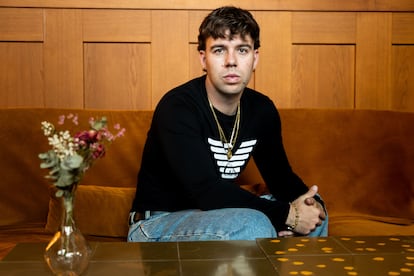
Q. What has been lost during this time?
A. I matured too fast. Suddenly, I found myself traveling the world, far from my pals, with a different budget... But now I’m a kid again. And I enjoy meeting up on a park bench, saying a few silly things, and going home.
Q. Are you still sharing an apartment?
A. I share an apartment in the most posh way possible [laughs]. With friends, and because I want to. It’s a choice. I don’t like being alone in Madrid.
My voice is awesome, although I’m not the artist with the best vocal technique.
Q. At the peak of your career, you decided to stop. Did you fall into a depression?
A. One hundred percent. I had a terrible depression, for sure. I didn’t go to a psychologist even once during that time, but I struggled to get out of bed, to find motivation, I had very negative thoughts. I withdrew from my life completely. I preferred to put up with it, and once I fulfilled my commitments, I stepped away from it all to focus on getting myself together.
Q. Such maturity...
A. Do you think so? I think it’s immaturity because I put myself last. Now, if I feel bad, my health and stability come first.
Q. Not all artists can afford to do that.
A. Being at the mercy of the industry’s pace and not being able to choose your own schedule is a real bummer. Also, social media is demoralizing. If you’re not ready, they’ll eat you alive.
“Talking about explicit sex in songs shouldn’t be confused with disrespect.”
Q. How do you handle the criticism of your raspy voice?
A. For me, my voice is awesome, although I’m not the person with the best vocal technique in the world. My project isn’t about that. I get criticized for everything, but compared to my other albums, this is the one that’s received the most positive reviews so far.
Q. Does the urban genre lack social prestige?
A. We live in an age of moral superiority. Every genre has its own complexity. Urban music was born to avoid pleasing the privileged person who claims other music is better.
Q. Lyrics that seem to objectify women don’t help...
A. There’s a huge difference between talking about explicit things and crossing the line and disrespecting women’s integrity. Talking about sex shouldn’t be confused with disrespect. In my case, I feel I do it from a context of consent and respect, but I understand that there’s a debate about it. I like that the clichés are fading away.
I walk around the center of Madrid wearing my cap and nobody stops me.”
Q. Do you feel that the men of Generation Z are becoming radicalized against feminism?
A. Well, there will always be stupid people, and a lot of nonsense is said on the internet. My generation has grown up with a lot of awareness. I went to a Catholic school, and in my class there were two trans girls.
Q. I get the feeling that you find it hard to go on tour.
A. I’m a studio artist. Before this last tour, which I really enjoyed, it was difficult because I never dreamed of filling stadiums as a kid. It’s taken me a while to get the hang of it and enjoy the travel. There comes a point when you just can’t take it anymore. It’s many months away from home, but then I come back and it’s worth it.
Q. Can you live a normal life here, like you do on your island?
A. Yes. I walk around downtown Madrid wearing my cap and nobody stops me. People couldn’t care less. I don’t know if my face is that recognizable. Although, when someone does stop me, it’s crazy.
“There’s no way for people from the Canary Islands to get a start in music there.”
Q. Why have your idols fallen?
A. Great artists are real people with issues, family problems, worries... That freaked me out when I met them. I thought that when you reach that level of success, the rest of your life is smooth sailing. That’s why I don’t want anyone to idealize me. One day I can be the nicest guy in the world, and another day I’m having a bad day. You ask me for a photo, and I tell you to leave me alone. And I don’t want you to think I’m unfriendly. I just want to be normal.
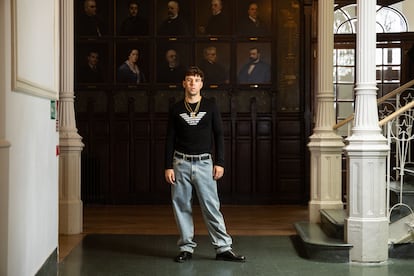
Q. Without the internet, could a kid from the Canary Islands who made songs in his bedroom have gotten this far?
A. No, impossible. There are very few resources there. There’s no way to get started in music. For people from the Canary Islands, being far away and poorly connected makes everything much more complicated... I’m an internet sensation.
Q. And yet, you feels that you owe everything to your homeland.
A. Yes, because in the Canary Islands people listened to me when I wasn’t playing anywhere else. The worst part is that it wasn’t because I was so good, but because I was a local guy who was really working hard for it.
Q. What would you say now to that earlier version of you?
A. Don’t stop, [his eyes shine], don’t let anything intimidate you, don’t even think about giving up on your dream because of that crap, the good stuff is just a little further on. Although maybe I’m still too young to give that Pedro advice.
Sign up for our weekly newsletter to get more English-language news coverage from EL PAÍS USA Edition









































