
The United States charges Governor Rubén Rocha Moya and nine other Sinaloa officials with drug trafficking
Washington has requested the extradition of the accused, but Mexico maintains that the US Department of Justice does not have evidence of their guilt
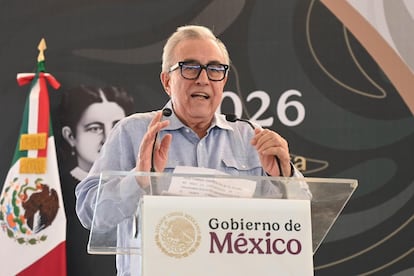

The United States dealt a major blow to its bilateral relationship with Mexico on Wednesday by formally accusing Rubén Rocha Moya, the governor of Sinaloa, of having ties to drug‑trafficking organizations. According to a filing made public by the Department of Justice, the U.S. Attorney for the Southern District of New York alleges that several state officials conspired with leaders of the Sinaloa Cartel to import large quantities of narcotics into the U.S. in exchange for political support and bribes. Among those charged is Senator Enrique Inzunza, who is a member of the ruling Morena party.
Mexico’s Foreign Ministry (SRE) responded that the U.S. has requested the extradition of the accused officials but argued that Washington has not provided sufficient evidence to establish their responsibility. Rocha has denied the allegations, calling them an attack on Mexico’s political project known as the Fourth Transformation.
The charges against Rocha, announced by U.S. Attorney Jay Clayton and DEA Administrator Terrance C. Cole, include conspiracy to import narcotics, possession of machine guns and explosive devices, and conspiracy to possess such weapons. The offenses carry a minimum sentence of 40 years, and prosecutors could seek life imprisonment. Senator Inzunza, a former secretary‑general of Sinaloa, faces the same charges and potential penalties.
The SRE said it received the extradition requests on Tuesday but maintains that the documents lack proof of the accused individuals’ involvement in the alleged crimes. For his part, Rubén Rocha Moya has reiterated his rejection of the accusations and maintains that they violate Mexico’s sovereignty. “They lack any truth or basis whatsoever. And this will be demonstrated conclusively at the appropriate time,” he posted on his X profile.
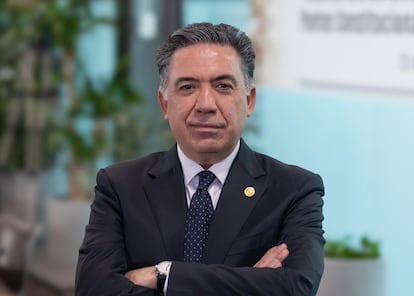
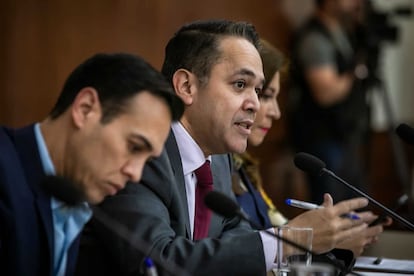
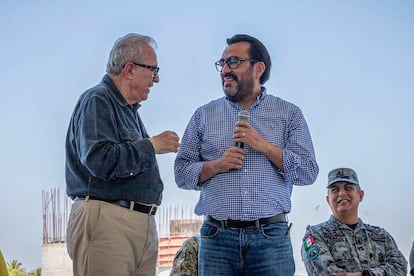
On the list of officials from Sinaloa, all accused of the same crimes and facing the prospect of those possible sentences, are also the former secretary of administration and finance for Sinaloa, Enrique Díaz Vega; the deputy attorney general for the Sinaloa State Attorney General’s Office, Dámaso Castro Saavedra; the former heads of the investigative police, Marco Antonio Almanza Avilés and Alberto Jorge Contreras Núñez; the former secretary of public security for Sinaloa, Gerardo Mérida Sánchez; the former deputy director of the state police, José Antonio Dionisio Hipólito; the mayor of Culiacán, Juan de Dios Gámez Mendívil; and the former high-ranking commander of the municipal police of Culiacán, Juan Valenzuela Milán. The latter is accused by U.S. authorities of participating in the kidnapping and murder of a DEA source and a relative of that person.
U.S. authorities argue that the Sinaloa Cartel has allied itself with “corrupt” politicians and officials, who “sold out their offices in exchange for massive bribes.” They also accuse Mexican police officers of participating in the group’s violence and reprisals through kidnappings and killings, as well as protecting drug shipments and allowing traffickers to carry out “brutal” acts of violence freely and without consequences.
Security forces allegedly received orders from politicians or prosecutors, who protected leaders of the Sinaloa Cartel from being investigated, arrested, or prosecuted. They are also accused of providing key information to cartel leaders about the army and security forces to facilitate their operations.
Terrance Cole, a senior U.S. official leading Donald Trump’s efforts against drug cartels, alleges that Sinaloa governor Rubén Rocha Moya won the 2021 election with help from Los Chapitos — the faction led by the sons of Joaquín “El Chapo” Guzmán — who allegedly kidnapped and intimidated his rivals. In return, Rocha is said to have met with cartel leaders and promised them protection.
According to the DEA investigation, state prosecutor Dámaso Castro Saavedra allegedly received about $11,000 a month to tip off cartel members about upcoming law‑enforcement operations coordinated with the United States. Meanwhile, Culiacán municipal police commander Juan Valenzuela Milán allegedly earned around $1,600 a month for giving the cartel unrestricted access to his officers, who were then used to “maintain their control over Culiacán” through arrests, kidnappings and killings.
“The Sinaloa Cartel is not just trafficking deadly drugs, it is a designated terrorist organization that relies on corruption and bribery to drive violence and profit,” said Cole in a statement. “This indictment exposes a deliberate effort to undermine public institutions and put American lives at risk. The defendants allegedly used positions of trust to protect cartel operations, enabling a pipeline of deadly drugs into our country. No one is above the law. We are grateful for our U.S. and Mexican partners who choose integrity every day and stand with us to safeguard our communities.”
The U.S. ambassador to Mexico, Ronald Johnson, expressed support for the newly announced charges and emphasized the shared commitment between both countries to combat drug trafficking.
The formal charges have further strained an already tense bilateral relationship, which has deteriorated since Donald Trump took office. Tensions have been heightened by the deaths of two CIA agents in Chihuahua, amid suspicions that they were involved in a security operation without the knowledge of Mexico’s federal government.
Sign up for our weekly newsletter to get more English-language news coverage from EL PAÍS USA Edition









































