
Mexico’s president visits Sinaloa following spike in factional cartel fighting
Claudia Sheinbaum is preparing a two-day visit to the Mexican state caught in the crossfire between Los Chapitos and La Mayiza
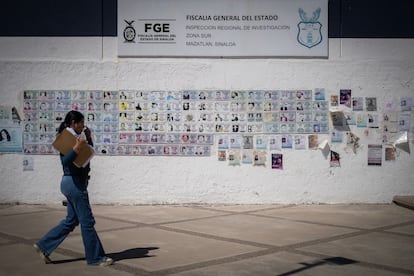
Many local wars between drug cartels are being fought in Mexico. At times, one of these battles overshadows others, which continue to rage in the background. The unexpected fall last weekend of Nemesio “El Mencho” Oseguera, the head of the Jalisco New Generation Cartel (CJNG), shifted attention away from the drug war that has been raging in the neighboring state of Sinaloa.
The conflict began more than 18 months ago, following the split between Los Chapitos and La Mayiza, the two major factions of the Sinaloa Cartel. In this period, hundreds of people have been killed or disappeared, the local economy has collapsed, and entire families have moved to other states in an attempt to continue their lives.
The fighting between Los Chapitos (the heirs of Joaquín “El Chapo” Guzmán) and La Mayiza (the supporters of Ismael “El Mayo” Zambada) has become part of the everyday landscape in Sinaloa. Violence only grabs broader attention during particularly shocking events, such as the recent discovery of a mass grave, the disappearance of 10 workers from a multinational mining company, or the shooting of two deputies from the political party Movimiento Ciudadano (Citizens’ Movement). The fall of one or even several cartel leaders does little to slow down this cycle of death.
This is the scenario that Mexican President Claudia Sheinbaum will visit this weekend. On Friday, the president will lead a meeting of her Security Cabinet at a military zone in the port of Mazatlán. There, she will also hold her daily press conference. In the afternoon, she will attend a rally. On Saturday, she will preside over the groundbreaking ceremony for a hospital in Culiacán, the state capital. Her presence in Sinaloa is an attempt to show that her government has not forgotten what is happening in the state, just days after the death of El Mencho.
When Sheinbaum and her team travel outside Mexico City, it is common for the presidential press conference to focus on the results of the government’s security strategy in the state they are visiting and on homicide statistics. A look at the numbers reveals the scale of the tragedy in Sinaloa. Since September 2024, there have been at least 2,400 murders and nearly 3,800 disappearances, according to figures from the State Attorney General’s Office obtained by EL PAÍS. Last year was the most violent year for Sinaloa in a decade.
The federal government has launched an unprecedented offensive against the two rival factions of the Sinaloa Cartel. The historically large amounts of drugs and weapons seized, along with the number of arrests — including commanders, lieutenants, cell leaders, and hitmen bosses — have led Omar García Harfuch, head of the federal crusade against organized crime, to claim that the power of Los Chapitos and La Mayiza has waned. However, the official account clashes with recent violence in the state and raises questions about the real impact of removing — through arrest or even elimination — specific individuals in the cartels, from mid-level leaders to top bosses.
The violence in Sinaloa is concentrated in the south, particularly in the municipalities of Escuinapa, Mazatlán, and Concordia, which have seen road blockades, drone attacks on military camps, and the disappearance of at least 10 workers from the Canadian company Vizsla Silver. Two other municipalities in the region also show high levels of violence: Elota and San Ignacio. In Elota, attacks by armed men have affected civilians, including Mayor Richard Millán, who was caught in crossfire on February 13 while leaving the Municipal Palace. “I was in the wrong place at the wrong time. It wasn’t directed at me,” the official reflected.
Insecurity in Elota has led to the closure of sport-fishing tourism projects at El Salto Dam, a site traditionally visited by U.S. and Canadian vacationers.
At the same time, however, Elota has become a refuge for people displaced from towns in the neighboring municipality of San Ignacio. EL PAÍS has documented that the towns of Acatitán, Aguacaliente de los Yuriar, Ejido Gabriel Leyva Velázquez, Paredón Colorado, El Salto Chico, and El Chirimole — all located around El Salto Dam — have been attacked by criminal groups, forcing mass displacement of residents.
“Most of them went to Elota. Some are receiving financial assistance from the city council there,” says a representative of those families.
Other displaced people have moved to Culiacán, or outside Sinaloa, to Durango and Mexico City. Added to this are self-imposed curfews starting at 6 p.m. as in the towns of La Labor, El Tule, and Los Mecates. “They are left to God’s mercy. I tell them to leave, that this isn’t a life,” a resident of La Labor tells EL PAÍS.
The municipality of San Ignacio has long been plagued by violence, even before the conflict between La Mayiza and Los Chapitos erupted. Since 2022, residents of Rosendo Nieblas, El Patole, and Dimas have reported illegal mining activities in beach areas to the authorities, carried out by criminal groups. The excavations stretch nearly two miles in a protected natural area that serves as a nesting ground for sea turtles. The federal government — now focused on curbing the internal war within the Sinaloa Cartel — has not addressed these complaints, meaning illegal mining continues, according to residents interviewed by this newspaper.
The infighting between the Sinaloa Cartel factions — triggered by El Chapo’s sons’ alleged betrayal of El Mayo — has required enormous efforts from the Sheinbaum administration, at a time when the United States is pressuring Mexico for results in the fight against drug trafficking.
The major blow to the Jalisco New Generation Cartel served as a reminder of the other fronts that remain open in Mexico’s struggle to shake off organized crime, which has proven capable of taking root, surviving, and adapting. The 18 months since the start of the war in Sinaloa — despite Mexico’s massive offensive and the United States clampdown, which froze millions in cartel assets — demonstrate just how resilient and entrenched these criminal networks are.
Sign up for our weekly newsletter to get more English-language news coverage from EL PAÍS USA Edition









































