
New rift in US-Mexico relationship over CIA presence and pressure on corrupt politicians
To the specter of American interference in Mexican affairs is now added a US campaign against alleged ties between Mexican officials and organized crime
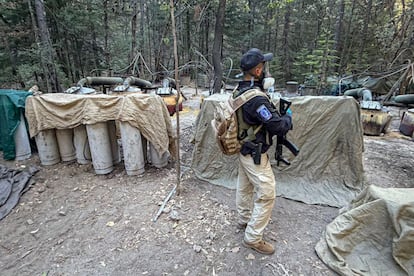

With the dust still settling from the deaths of two CIA agents in Mexico, a fresh controversy has opened up another front in the bilateral relationship. Just over a month before the crucial negotiations to review the US-Canada-Mexico free trade agreement (USMCA), Mexico and the United States are experiencing a rough patch that threatens to be long-lasting. The dispute over exactly what the two CIA agents, killed in an accident in the mountains of Chihuahua on April 19, were doing led to the resignation of the northern state’s attorney general on Monday. But while President Claudia Sheinbaum was pressing for clarification, the U.S. ambassador issued strong statements last Friday. Speaking from the state of Sinaloa, Ronald Johnson demanded certainty, security, and a corruption-free environment for U.S. investments. He concluded his remarks by saying, “We may soon see significant action on this front.”
Based on that final sentence, both prophetic and threatening, an article in Sunday’s Los Angeles Times asserts that the Trump administration has launched a campaign targeting Mexican politicians with ties to organized crime. This is not the first time that corruption, with its economic and security ramifications, has been a focus of attention from across the border. But in this case, the offensive takes on greater significance, as Mexico and the United States are already engaged in preparatory talks for the renegotiation of the USMCA, which officially begins at the end of May.
Renewing the trade agreement is a top priority for Claudia Sheinbaum’s government, which is staking its efforts on protecting three-quarters of its exports amidst a turbulent global economic landscape threatened by Trump’s protectionism and the energy crisis caused by the war against Iran. In fact, on the same day that the ambassador was railing against legal uncertainty in Mexico, the governing Morena party’s majority in Congress introduced a bill to postpone the election of judges, currently scheduled for June of next year, until 2028. These elections are another source of criticism from both domestic and foreign business leaders, who question the capacity and independence of the newly elected judges to handle the complexities of commercial and mercantile processes.
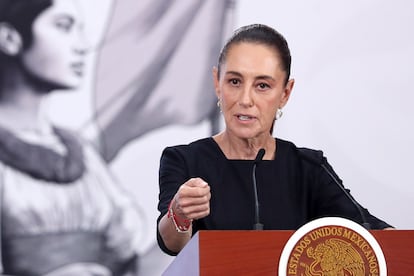
Following the ambassador’s demands for greater effectiveness against corruption, Sheinbaum was the first to respond, offering a half-smile: “That’s what we’re doing.” She also reacted this Monday to the alleged campaign launched by Washington: “If there is an investigation by any prosecutor’s office against any government employee in Mexico, there must be clear proof and evidence. We are not going to cover up for anyone against whom there is evidence of corruption,” she stated during her morning press conference, concluding with a message that sounded like a counterattack: “And also, they have to review cases in the United States.” In fact, the president took the opportunity to announce that Mexico has requested Washington to extradite two businessmen with dual citizenship who are involved in the fuel theft fraud. Sheinbaum closed the topic with a message: “We don’t want to have a bad relationship with the United States government, but they have to respect us.”
The Los Angeles Times reports that the U.S. government is taking a harder line in its investigations into possible links between Mexican politicians and organized crime. According to the newspaper, this would not only involve canceling the U.S. visas of suspects, including the current governor of Sinaloa, Rubén Rocha Moya of the Morena party, but also preparing criminal complaints in U.S. courts, including against members of Morena. If these complaints are filed, they would strike a blow to the Morena party, which was founded on the principles of political reform and combating corruption.
The wave of visa cancellations began last year, affecting at least fifty Mexican politicians and officials, according to sources cited by U.S. media. The Mexican government has since tried to downplay the impact, claiming to have no record of who is affected and accusing Washington of not sharing this information. The names of Governor Rocha and former governor of Tabasco Adán Augusto López have been circulating frequently in political circles. One of the few confirmed cases is that of Baja California Governor Marina del Pilar Ávila, of the Morena party, and her husband, the politician Carlos Torres, who was formerly with the opposition PAN party before joining Morena.
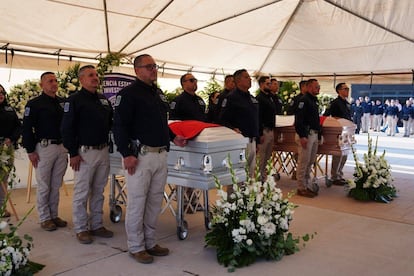
Meanwhile, the controversy surrounding the CIA agents killed in Chihuahua continues. The government reported this weekend that the two CIA agents who died in a car accident returning from a mission in Chihuahua entered the country respectively as a tourist and with a diplomatic passport. The Security Cabinet reiterated in a statement that the federal government was neither informed nor aware that the two foreign agents were in the country to participate in joint operations with the Chihuahua state government, which is run by the opposition PAN party. The Chihuahua state government initially asserted that the agents were only carrying out training duties for Mexican police officers.
Following an internal investigation, the state attorney general, César Jáuregui, has resigned, acknowledging that the information they had “was inconsistent and warranted an investigation.” Similarly, the pressure has forced Governor Maru Campos to announce that she will appear before the Senate this Tuesday. The specter of U.S. interference, a constant since Trump’s return to the White House, has resurfaced with force, now combined with the specter of the hunt for corrupt politicians from north of the border.
Sign up for our weekly newsletter to get more English-language news coverage from EL PAÍS USA Edition









































