
The United States claims that the Sinaloa Cartel helped install Rubén Rocha as governor
Several political operatives were kidnapped during the 2021 elections and armed groups stole ballot boxes full of votes, according to the indictment filed by the US prosecutors
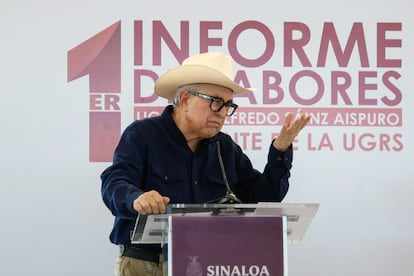
In 2021, Rubén Rocha vehemently denied any connection to organized crime in Sinaloa. He had just won the gubernatorial election, but election day had been a disaster. Local media documented that several election workers — mostly from the Institutional Revolutionary Party (PRI), but also from Morena, his own party — had been kidnapped, beaten, and threatened by criminals. Some candidates withdrew from the race, and armed groups looted ballot boxes full of votes. Rocha, who emerged victorious amidst the chaos, said that he and Morena had been victims of the violence and claimed that the PRI, which had governed the state for years, had ties to the Sinaloa Cartel. Now, the United States indictment alleges that this criminal organization helped Rocha win the election in exchange for political protection.
“The PRI has always been the party that organized crime has worked with. Who else could they possibly reach an agreement with? Where are we supposed to find the deep-rooted history that PRI governments have, particularly in this part of Sinaloa and along the Pacific coast? That’s the reality. Who have they made deals with? Them. Not us!” an angry Rocha said in an interview with Animal Político back in 2021. This Wednesday, the United States accused the governor of working for Joaquín “El Chapo” Guzmán’s cartel, and particularly for Los Chapitos, the faction led by his sons. Rocha and several senior members of his state government are accused of participating in a criminal conspiracy to import narcotics on behalf of the cartel since 2021.
In other words, the United States claims to have evidence that Rocha has helped “protect and grow this drug trafficking empire” since the start of his term, and wants to imprison the sitting governor. Mexico’s Foreign Ministry has responded that it needs to see the evidence before considering any extradition request, while Rocha insists the accusations are a political attack on Mexico’s political project known as the Fourth Transformation.
The U.S. indictment categorically states that “the defendants” — including Morena party senator Enrique Inzunza, the mayor of Culiacán, and several high-ranking security officials from the Sinaloa attorney general’s office and police — protected the leaders of the Sinaloa Cartel from justice and even ordered the police tasked with targeting drug trafficking to protect shipments of “fentanyl, heroin, cocaine, and methamphetamine,” receiving in return “millions of dollars in drug money from the cartel.”
Regarding Governor Rocha specifically, the indictment alleges that early in 2021, while campaigning for the governorship, he met with Sinaloa Cartel leaders at a gathering guarded by gunmen armed with machine guns. The document says that Iván and Ovidio Guzmán — two of El Chapo’s sons — assured him he would win the election if, once in office, he appointed officials loyal to Los Chapitos and their drug‑trafficking interests. It also claims that before the vote, Rocha provided cartel leaders with a list of his opponents and their home addresses so they could intimidate them and force them out of the race.
The day before the June 6, 2021 election, at least nine PRI and Morena campaign workers were kidnapped in several municipalities in Sinaloa, primarily in Culiacán and Badiraguato, in an effort to stop them from carrying out their duties. One of these cases led Guadalupe Iribe Gascón, the PRI candidate for mayor of Badiraguato, to withdraw from the race on June 6, as her brother was among the victims. He was released hours later, showing signs of torture and with a threatening message. Other prominent victims included José Alberto Salas, the PRI’s state organizing secretary, and Martha Yolanda Dagnino Camacho, a Morena councilwoman in Guasave.
In addition to the kidnappings, groups of armed men in pickup trucks, wielding sticks, patrolled polling places to discourage voters. By the end of the day, authorities had documented the theft and destruction of dozens of ballot boxes already filled with votes. PRI candidate Mario Zamora conceded defeat but suggested that the numerous attacks reported throughout the day had a direct beneficiary: Morena. He also called for the release of the kidnapped PRI members. “The election is over, we have the result they were apparently expecting, please bring them back; they are good men and women who were just trying to do their job,” he said. Although Rocha said that Morena members had also been affected, the evidence available at the time indicated that the primary targets had been their political rivals. Washington’s accusation adds a new dimension to these events.
The alleged ties between Rocha and the Sinaloa Cartel were also evident during the kidnapping and release of Ismael “El Mayo” Zambada in July 2024. According to a letter Zambada sent from the United States, the Sinaloa Cartel founder and drug lord himself recounted that he was ambushed by his godson, Joaquín Guzmán López, another of El Chapo’s sons, who kidnapped him and put him on a plane bound for the United States. There, both were arrested outside the border city of El Paso. To lure him into the trap, Guzmán López told Zambada he needed his help to mediate between two political leaders: the governor of Sinaloa, Rocha, and Héctor Melesio Cuén, former mayor of Culiacán. Mexico’s Attorney General’s Office revealed shortly afterward that Cuén was murdered at the same location where Zambada was kidnapped. Governor Rocha said that he was in Los Angeles at the time. Three months later, a civil war erupted within the Sinaloa Cartel, unleashing a wave of killings, disappearances, thefts, and sabotage across the state.
For President Claudia Sheinbaum, this crisis is one of the most damaging legacies of Andrés Manuel López Obrador’s administration, which had publicly backed Rocha. Sheinbaum, however, soon learned of the governor’s actions and, through high‑level intermediaries, asked him to resign. Mexico’s security cabinet had documented attempts by Rocha to steer federal operations exclusively against the enemies of Los Chapitos. He was repeatedly urged to step aside but refused, insisting he owed his position to the people of Sinaloa — and, more pointedly, that he became governor because López Obrador personally supported him. He was not the only one.
Sign up for our weekly newsletter to get more English-language news coverage from EL PAÍS USA Edition









































