


A year of terror in Sinaloa: Inside the war between Los Chapitos and Los Mayos in Mexico’s drug heartland
EL PAÍS reports from the northwest region of Mexico, documenting a bloody cartel conflict that has claimed thousands of lives and shaken the community
When the war came to Culiacán, the city had sensed it for weeks. Everyone expected it to fall on a Thursday: it was a local joke, even at the home of Heidy Mares and her family — daughter, sister, mother, all living under the same roof — who had etched in their memory the fateful Thursdays of recent times: the Culiacanazo, the arrest of Ovidio Guzmán, the kidnapping of Ismael “El Mayo” Zambada… All those Thursdays also shared the tremendous violence of local armed groups linked to the Sinaloa Cartel, the major drug-producing and exporting machine in northern Mexico.
So that morning of September 9, 2024, a Monday, Heidy and her sister Mariana were calmly having breakfast before going to work. The former at the institute that manages public school teachers’ pensions; the latter at a downtown flower shop. It was around 6:45 a.m., the golden hour. The Mercadito neighborhood, rowdy, noisy, with streets lined with small shops and drug dens, decadent brothels and shady money exchanges, was waking up to a golden calm. And then, suddenly, the gunfire started. One burst, another, and then another. They didn’t know it yet, but life was splitting in half again, a chasm opening up beneath the aroma of hot coffee.
It was the beginning of the latest war between cartel factions, the end of a “tense calm,” as 32-year-old Heidy Mares calls it, that feeling that something was about to happen, something serious. At the end of July one of the factions, Los Chapitos, had organized the kidnapping of one of the historic leaders of the local drug trade, El Mayo Zambada. That was only the preamble to a greater betrayal: his captors put him on a small plane to take him north of the border, where they handed him over to U.S. authorities eager to get their hands on him. The identity of the kidnappers made matters even worse. In a letter he released days later from prison, Zambada blamed his own godson, Joaquín Guzmán López — one of the sons of his longtime partner in crime, Joaquín “El Chapo” Guzmán — for organizing the kidnapping.
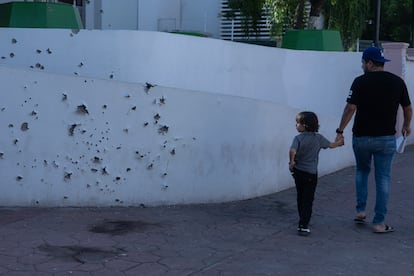
So the question wasn’t so much whether there would be war — as there had been, eight years earlier, between El Chapo’s family and that of his former lieutenant, Dámaso López; or earlier, back in 2008, between the Guzmáns and their neighbors, the Beltrán Leyvas; or even before that, between the former and the Arellano Félix family; or the countless mountain battles that the ranches of Sinaloa, Durango, and Chihuahua have witnessed — but when it would start, where it would occur, and how long it would last.
The first Culiacanazo had become a unit of measurement. In October 2019, hundreds of armed civilians had taken over the city in broad daylight, the response by El Chapo’s sons to the attempted arrest of Ovidio Guzmán, one of the brothers. There were blockades, clashes, and shootouts in dozens of neighborhoods. Everything was captured on video. Would what was coming next be like that, or even worse?
One afternoon, a year later, Heidy Mares recalls that day with another cup of coffee in her hand. She and her family no longer live downtown; they moved to a neighborhood in the northern part of the city. They did so a few months after the war began. “My neighbor was a small-time drug dealer,” she explains, “and he had two daughters, my age and my sister’s. Everyone confused us: the people at the market, other neighbors... It had become a problem. Even he had disappeared for a few days,” she says. Zambada’s kidnapping and capture struck like a neutron in the nucleus of a heavy metal. A shared space, Culiacán fissioned. It split in two: La Mayiza, or Los Mayos, loyal to Zambada, on one side, and Los Chapitos, led by El Chapo’s sons, on the other, releasing an extraordinary amount of chaotic energy.
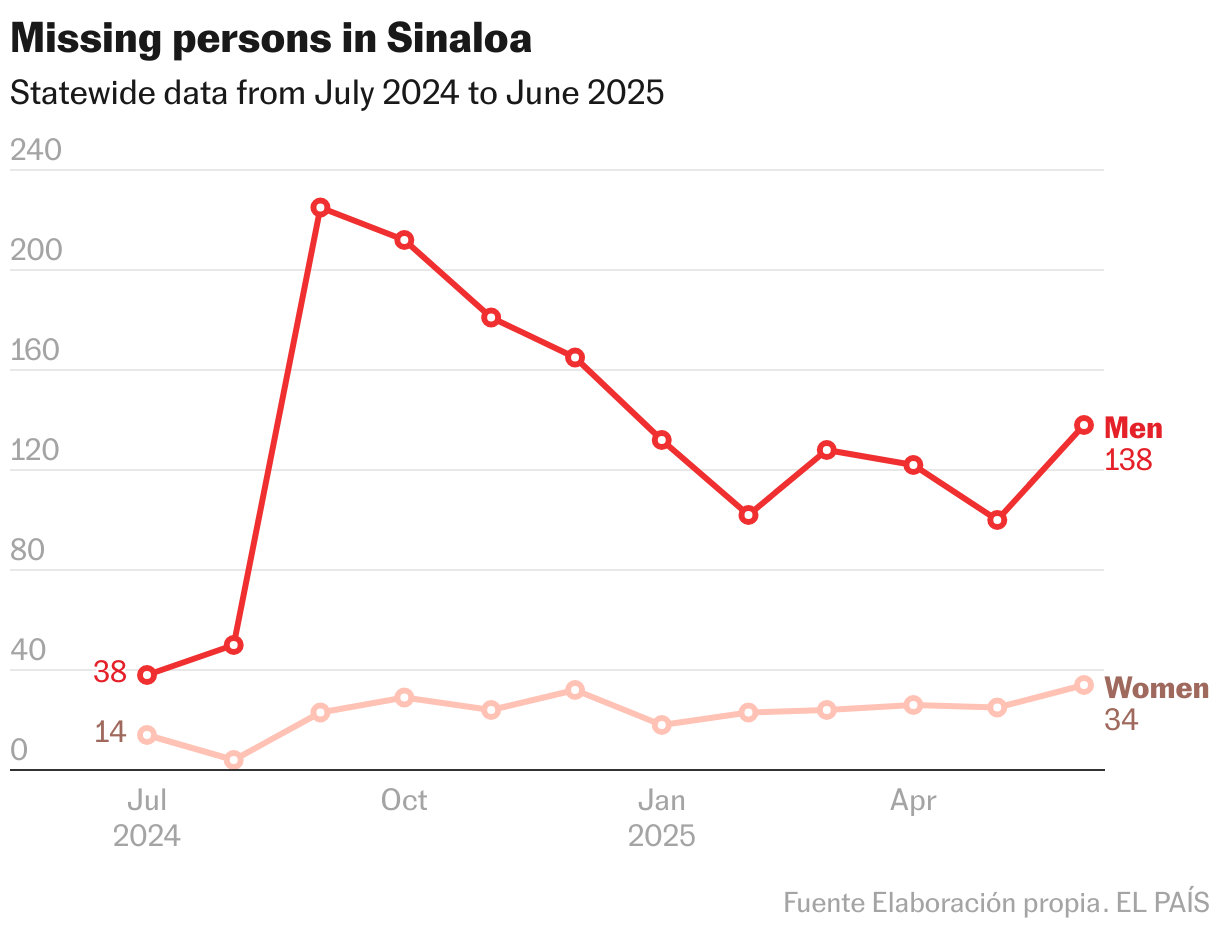
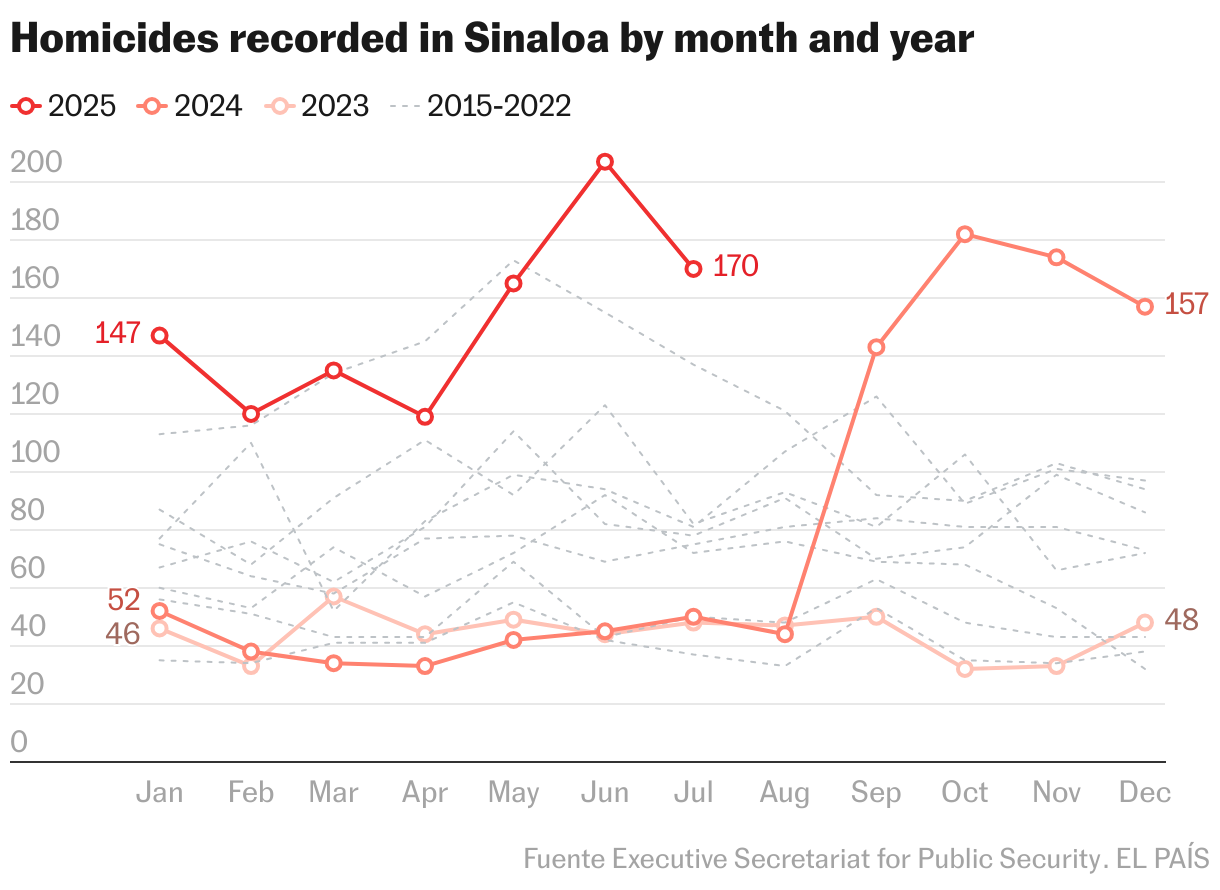
In recent months, murders in Sinaloa have increased by more than 200%. From September 2023 to August 2024, they numbered just over 600, but in the same period the following year, they exceeded 1,800. Missing persons cases have similarly soared to more than 2,000. And many people remain unaccounted for. One faction attacked the other’s businesses, both legal and illegal, and their homes. Also their dealers.
It began in Culiacán, but then spread to its extensive network of rural communities. And from there, to the rest of the municipalities, even the tourist city of Mazatlán, where reports of forced recruitment have multiplied exponentially. Meanwhile, the political establishment has downplayed the issue. Many still remember Governor Rubén Rocha in those early days of the war, strolling along the river in Culiacán, remarking on the prevailing tranquility while the city burned.
Throughout this time, Mexican authorities have been unable to regain control, despite the deployment of thousands of troops. The consequences of all this are still incalculable, especially on a psychological level. Heidy Mares says that, for a few months now, she and other friends have built a small space, the Crying Culichis Club, a collective therapy group where each person embraces their pain and transforms it into something different.
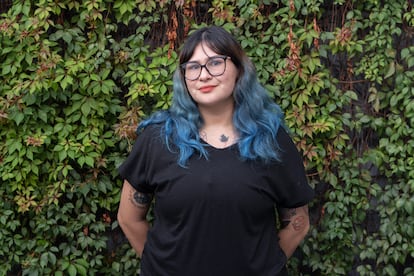
“There’s a girl who owns a beauty salon in Cuatro Ríos, and the day it all started, she had to lie on the floor with her clients because of the shooting. The wax got too hot. When it gets too hot, it ends up smelling like a sewer. And it was a smell… It made her want to throw up. And now she says that whenever she hears a noise like bullets,” Mares says, such as a motorcycle exhaust, or the steel shutter of a store being lowered, “she feels the same thing, she wants to throw up.”
On the northern ridge of Culiacán, a handful of battered and rickety houses rise under the shadow of a huge mountain of garbage. They are the refuges of newcomers to the basurón, the municipal landfill, a mammoth space where men and women collect materials that they sell by the kilogram. María Piña is one of the cooks at the local community kitchen. She arrived here on July 28, 2024, three days after the arrest of Zambada. Most of the residents of this neighborhood — so new that it lacks a name — have been here for roughly the same amount of time. They came here due to similar problems: violence in the mountains, a constant theme, accentuated since the capture of the drug lord.
The recent rains in Sinaloa have turned an inhospitable space into a relatively pleasant, rugged, green little valley. On the opposite hill, a little further from the garbage dump, rises the Ampliación Bicentenario neighborhood, founded by displaced people from one of the cartel’s previous wars, battles steeped in state repression: the history of the Sinaloa mountains rests its weight both on drug trafficking, its crops and genealogies, and on the persecution of the Armed Forces, violent and despotic, especially in the past, which is always present. Up there, at the top of the hill, lies the community kitchen, a place of salvation for dozens of families who arrived here with nothing.
María Piña is 52 years old and remembers the day she had to flee her ranch in Badiraguato, a name loaded with meaning in Mexican history. A sprawling municipality neighboring Culiacán, it was there, in its mountains, that mass poppy cultivation began in the first half of the last century, serving as the basis for the production of opium and heroin. Before the emergence of fentanyl, the mountains of Badiraguato and the neighboring municipalities of Chihuahua and Durango produced much of the opium that reached the United States, converted into heroin. They also produced marijuana, a crop that eventually declined due to the wave of legalization in the U.S. Badiraguato is also home to the royalty of Sinaloa’s drug trafficking cartels, such as El Chapo Guzmán and the Beltrán Leyva brothers. The heavyweights, as they are known on the ranches.
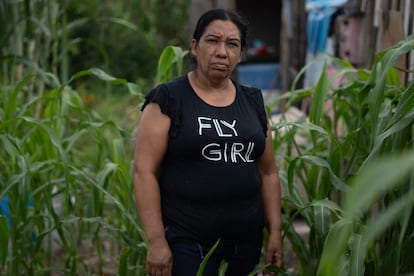
María Piña recalls fleeing her home, El Mezcal, in the northern part of the mountainous slopes of the municipality. “A gang came and killed a young man,” she says, standing at the door of her house, a room and a half made of brick, its roof propped up with perforated plastic sheeting. El Mezcal, she explains, is an isolated ranch. It’s impossible to get there by car. Residents must cross the Humaya River to find a vehicle that will take them to a larger town. In total, according to Piña, there are no more than 12 houses. Those who weren’t family acted as if they were. Formerly a poppy ranch, most of the farmers had recently joined the government program Sembrando Vida (Sowing Life), which gives each family 6,500 pesos a month, just over $300, to grow fruit and timber trees.
“We didn’t look at the thugs or find out who did it, nothing, we were just scared,” the woman says. “First, a few of them left, and then there were about two or three of us left. We felt sad and left as well. We had lived there for 30 years, and now, the ranch doesn’t have a soul, not a single person in it,” she explains. Her neighbor comes out. Her name is also María, María Saucedo. She’s 58 years old, and she’s been working at the dump for 25 years, although she bought her land in the new neighborhood just four months ago. “Right now, it’s a world of people up there,” says the woman, who estimates that, since the war began, the number of workers at the dump has increased from 40 or 50 a day to more than 400.
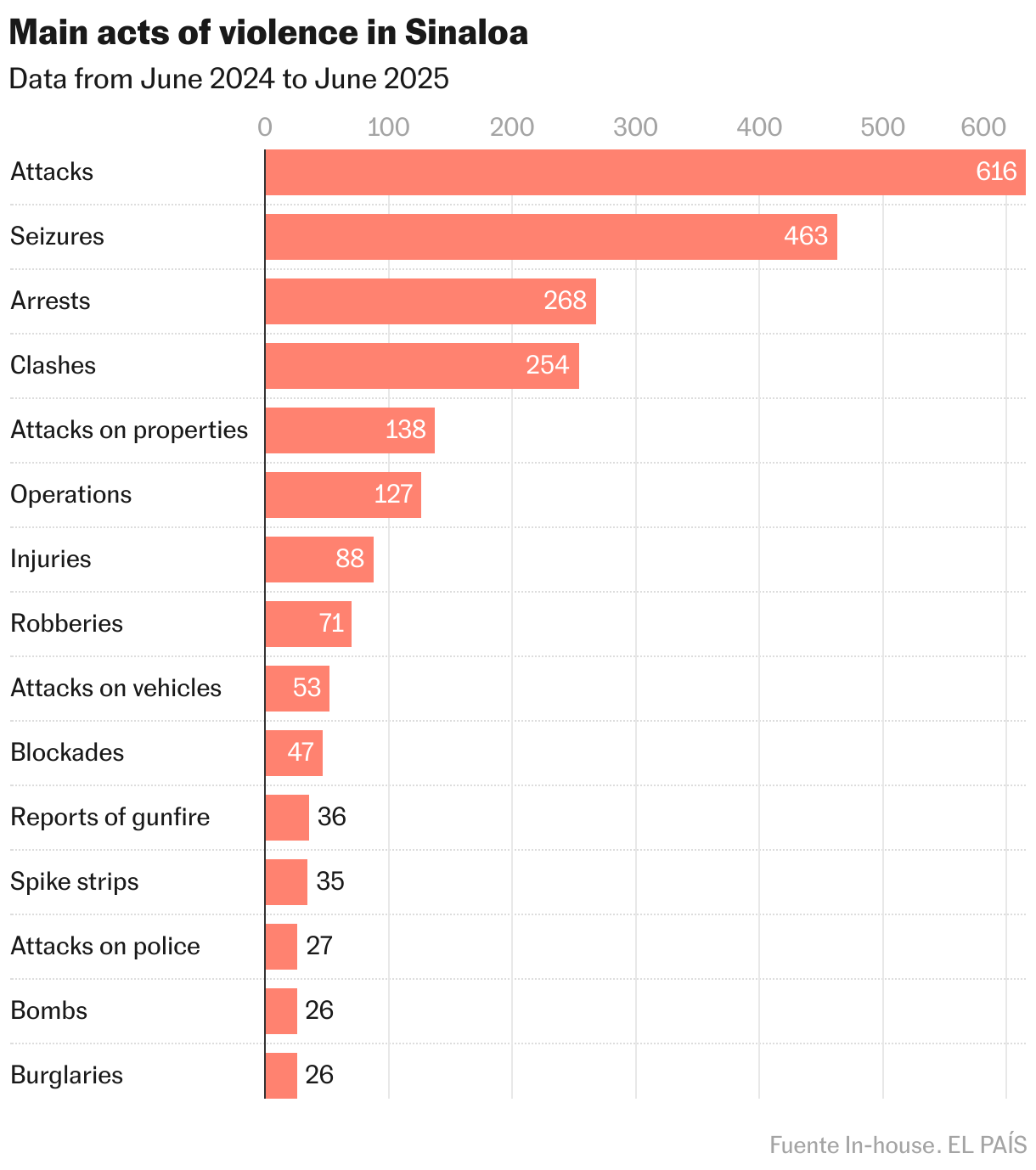
Main acts of violence in Sinaloa
Data from June 2024 to June 2025
Near their home lies the meager plot of land purchased by Mr. Juan, the assumed name of a man in his 70s who prefers to remain anonymous. “Otherwise, they’ll smash your head in,” he says, sitting in a chair, contemplative, oblivious to any alarm or drama. That’s how things are where he lives, in Junta de Bagrecillos, a ranch in the same mountains, although a little further south, on the northern border of Culiacán. Bagrecillos and other mountain localities such as Tepuche have become one of the fronts in the war between the factions in recent weeks. Originally there were two — Los Mayos and Los Chapitos — but as the months passed and other regional drug barons, such as El Chapo Isidro and “El Guano” Guzmán, El Chapo’s brother, invaded the region, the situation became more complicated.
Mr. Juan and his wife fled the ranch about two or three months ago. Nothing special happened, he explains. “At first, we heard there was something, there was something,” he says — something being a euphemism for the war. “I didn’t know when the violence would come, but two or three [neighbors] were coming here, and I said, ‘I’m leaving now too,’” he says. It was the second time in five years that he had to flee the mountains. This will be the final one. The man has built a roof on four poles on his 40-square-meter plot of land, a miracle considering his battered knees. For now, he and his wife live “huddled together” in the home of some relatives, which makes him uncomfortable, since the house in question isn’t very large either, and huddling together, for a country man used to pine trees, blue skies and open spaces, is nothing short of an ordeal.
Missing persons in Sinaloa
Statewide data from July 2024 to June 2025
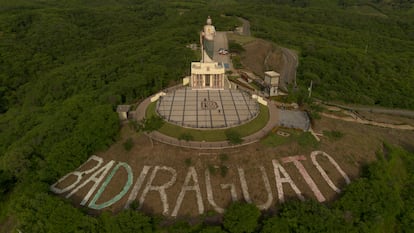
These days, the city center of Badiraguato resembles the vast lobby of a boutique hotel, looking carefully curated, squeaky clean and a vibrant green. A huge and enigmatic statue of Saint Jude Thaddeus, the patron saint of impossible causes, presides over the main entrance from a hill on the other side of the river. The statue of the saint, donated by unknown “entrepreneurs,” as local authorities explained a couple of years ago when it was installed, presides over a small leisure center, with a gift shop and an altar for offerings. It is the intended image of the new Badiraguato, a facelift.
In a downtown café, the local Director of Social Welfare, Raquel Vizcarra, smiles. According to her, things have improved. Years ago, Vizcarra coordinated the Sembrando Vida program in the municipality. Little by little, the conversation turns to the program’s experience — how they managed to convince opium farmers that orange and lemon trees were better than poppies.
Vizcarra listens to the story of Mrs. María Piña and her flight from the ranch to the garbage dump of Culiacán. As part of Sembrando Vida, Piña and her neighbors attended workshops and grew trees, which they later planted in their plots. The experience spread to other ranches in the area. “The program’s census reached 2,000 producers,” says Vizcarra. “I estimate that of those 2,000, around 60% to 70% were previously engaged in illicit crops,” she adds.
Unable to compete with its synthetic relative, fentanyl — far more potent and cheaper to produce — the price of opium gum in the region plummeted from 30,000 pesos (about $2,000) in 2013 to just over 4,000 pesos today (around $200). Similarly, the price of marijuana dropped from 6,000 pesos to 250 pesos. Criminal groups are exploiting the inaccessibility of the mountains to innovate, according to sources familiar with the region consulted by EL PAÍS. Now, traffickers produce marijuana in greenhouses to compete with the U.S. market and use the mountain wisdom and its hideouts to set up methamphetamine and fentanyl labs.
María Piña and her family reached an agreement with their neighbors from a nearby ranch, who remained in their homes, and with the coordinators of Sembrando Vida. Although she and her family had been displaced, they would continue to collect their monthly salary of 6,500 pesos, but would give 1,000 pesos to the neighboring ranchers so they could keep producing trees and tending their plots. It was a way of coping with the war, Vizcarra explains. “Families have been displaced from several communities because of this situation,” says the official. “There are communities left completely empty. All these farmers have been caught in the middle of the fight.”
The war began in the cities a year ago but has since spread to the countryside. It spilled out of Culiacán and its communities and reached towns such as Guamúchil and Mocorito in the north, or Cosalá and San Ignacio in the south. And now, in recent months, it has struck the mountains of Badiraguato and nearby areas in Chihuahua and Durango. According to the sources mentioned earlier, there are armed groups in that area whose ties to Los Mayos and Los Chapitos are not entirely clear. On one side is the group known as Los 22, as well as the Salazar group, which has a strong presence in the mountains of Chihuahua. In the town of Tameapa, a little further down, is Óscar “El Músico” Gastélum, whom the U.S. government has just charged with terrorism and drug trafficking.
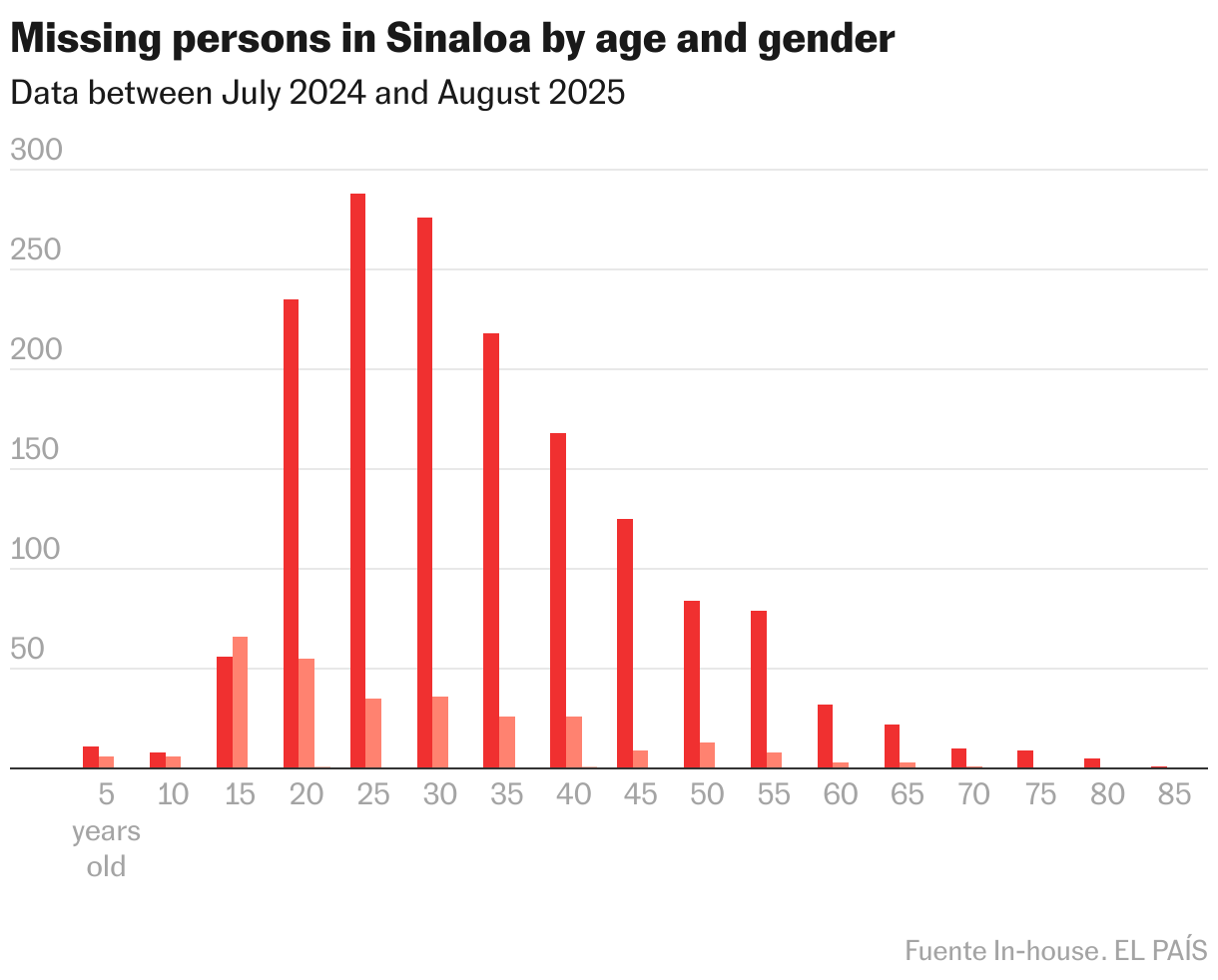
Missing persons in Sinaloa by age and gender
Data between July 2024 and August 2025
- Men
- Women
- Trans women
“They got El Chapo’s sons out of there, especially from San José del Llano,” says one of the sources, “but now they’re all fighting each other.” This person does not believe, for instance, that El Chapo Isidro — powerful in Guasave and the northern municipalities, also wanted by the U.S. government and close to El Músico — is a steady ally of Los Mayos, as has been reported in recent months. Nor is the role of “El Guano,” El Chapo’s older brother, who remains in the ranches between Sinaloa and Durango, entirely clear. Normally, one would expect him to support his nephews, but given the Sinaloa Cartel’s history of betrayals and sudden shifts, nothing can be ruled out.
Meanwhile, the death toll continues to rise. The question is how long the war will last. Just on the last weekend of August, more than 30 violent incidents were recorded in the center of Sinaloa, including murders, shootings, and chases, with dozens of victims. Most occurred in Culiacán, and a few more in Navolato, a nearby municipality between the city and the coast. The exact number of casualties among the warring factions remains uncertain, but between arrests, disappearances, and killings, the toll cannot be fewer than several hundred. A high-ranking member of the federal security forces deployed to the city describes the vast size of the criminal hydra. “There have been seizures like never before, arrests, but that’s enormous,” he says, referring to the drug trafficking groups based in Sinaloa.
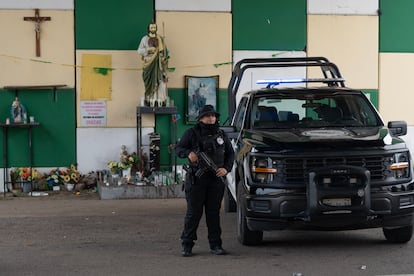
Today, it is striking to see the number of federal security vehicles driving through Culiacán, especially from the army. The same is not true in other parts of the state — certainly not in Mazatlán, or even in municipalities close to the capital. “The priority is Culiacán,” says the security official, who participated in operations in the city during previous administrations. “There’s never been a joint strategy like this. There were fleeting collaborations, a lot of small talk, drinking coffee... Now we’re working, but organized crime is very strong. It’s been weakened, but it’s going to take time. The economy has revolved around drug trafficking for years. Everyone was squandering money. It was a bonanza here.”
“Is it true they’re taking the boys?” That was the question Rosalba Cruz, 51, heard a week before her son was taken from the rehab center where he was admitted, in Mazatlán. The question had come from the mother of another young man at the facility. A staff member replied with a touch of disdain. “No, but that happened in Marmol,” Cruz recalls her saying, referring to a neighboring town. “They come and ask who wants to leave, but if you’re not interested, you don’t leave. Anyway, that doesn’t happen here; the port is locked down,” she concluded. At the time, Cruz didn’t think much of it, but later she did. Yes, they were taking them.
The beauty of the port city of Mazatlán — the joy of its brass bands and its people dancing — contrasts with Cruz’s face, crumpled in tears. The factional war had only just begun when criminals took her son, Alejandro Trujillo, who was 30 at the time and had spent the past six months in therapy. It seemed he was close to leaving, when, on September 22, 2024, a group of armed men arrived at the center in several trucks and took him away. His case reflects the tragedy of a country that counts its disappeared in the tens of thousands, but it introduces another grim factor in the war: forced recruitment.
There are no clear figures on this phenomenon in Mexico, and even fewer when it comes to adults who are forcibly recruited. Only this year did Congress begin debating an amendment to the penal code to formally classify it as a crime, following the scandal over forced recruitment in Jalisco earlier in the year. The war in Sinaloa has forced authorities to keep at least a minimal record. Given the violent surge in recent months, authorities have been forced to keep more detailed statistics. Data from the State Attorney General’s Office indicates that at least 50 people have been taken from rehabilitation centers, while another 24 were injured and 17 were killed for refusing to go with criminal groups.
Cruz has no doubt her son was taken for the war. Over these months, she has fought a double battle to try to find him — first with the owner of the rehab center, a man named Pablo Inzunza, who in recent times seems to have vanished. And then with the State Attorney General’s Office, apparently oblivious to its duty to investigate cases of missing persons. The agency has logged more than 2,300 reports in the past year, of which barely a quarter have been found, alive or dead. Once, the investigator assigned to her case, a man named Fredy, even told her — offering his own explanation for what had happened — “It means they saw some talent in him.”
Alejandro Trujillo, a young man who had struggled — his father, a violent man, as Cruz puts it, abandoned the family, only to return 27 years later seeking help for his medical problems — was taken at dawn. Cruz has never been sure how, because each witness said something different. Some claimed he was dragged from his bed; others said he had been standing guard at the rehab center’s entrance. What is certain is that he was taken. Alerted that same morning, Cruz confronted Pablo Inzunza. But he said the cameras weren’t working, that he hadn’t seen anything.
“Armed men called him by his name,” Inzunza defended himself. “They pulled him out, gun pressed against his ribs. By force,” he added. The owner also said the criminals had gotten out of two trucks — a version he changed the next day, insisting it had been five, and that he had also seen “people tied up” inside some of them. None of this, nor the issue of the broken cameras, seemed to interest the Attorney General’s Office. They were content with taking Inzunza’s statement over the phone and with collecting DNA samples from Mrs. Cruz — samples that would never be of any use, since there was no forensic expert to compare them with the human remains that, as the months passed, kept turning up across the region.
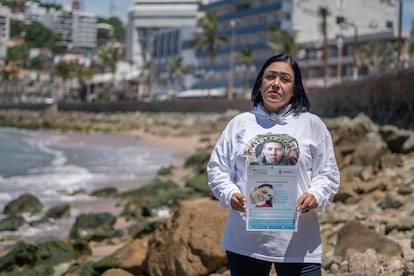
Months later, Rosalba Cruz joined a collective of families of the disappeared, after a phone call alerted her that her son had been buried in a mass grave on a beach near Mármol. Taking on the work of investigators in a national tragedy, she and the others went to the site one April day, armed with shovels and pickaxes. Within a short time, they found eight skeletons in several graves. Cruz felt her heart leap out of her chest, and not only because of the bones. Next to the pits, she saw deep tire tracks. She calculated, thinking that since it hadn’t rained since September, those tracks had to be recent. “That’s when I thought, they must have come here to dump my son,” she recalls.
The State Attorney General’s office collected the skeletons from that beach in Mármol. Five months have passed, and it’s still not known who the remains belong to. Marisela Carrizales, leader of the relatives’ collective that Cruz joined, says that out of the roughly 50 sets of remains recovered “since October,” forensic experts have identified just two. She recalls a story that has been repeated by the few young people found alive in recent months. In the municipality of Concordia, up in the mountains, it’s full of the bodies of recruited youths, many taken from rehabilitation centers. One of the young men who returned spoke of a group of “around 600 people” transported in several trucks. “But who’s going to go after them? The authorities know what’s happening, but they’re leaving them up there,” says Carrizales.
Homicides recorded in Sinaloa by month and year
Data between July 2024 and August 2025
In a funeral home in Culiacán, the morning drags by, thick and slow. The heat has been brutal in recent days, with isolated storms only adding to the heavy atmosphere. Funerals seem to be one of the few businesses thriving in a city that has shed more than 10,000 jobs this year, according to economist Cristina Ibarra of the Autonomous University of Sinaloa. Everywhere you go, businesses are shuttered — especially car dealerships and restaurants. Funeral homes, however, are an exception. Some even display gold-plated coffins, valued at over one million pesos.

Funeral homes like this one have received the latest victims from Culiacán: a municipal police officer finishing his shift — bringing the total to 47 killed since September last year — a Civil Protection worker from Navolato who enjoyed dune racing, and six victims of attacks carried out in hospitals during the last weekend of August, which began with bursts of machine-gun fire in the waiting area of the Civil Hospital — killing four — and ended when a pair of criminals dressed as nurses finished off a gunshot victim in the new General Hospital.
“This year has been a mess,” says a worker, sitting on a bench in the funeral home. Two colleagues join him. “This isn’t over yet,” he adds, referring to the war. “It will calm down, then they’ll start working again, making money, and soon another little clash will happen and it will start all over again,” he predicts.
The three recall funerals of major criminal figures over the past few years. They can name two or three easily. “Some lasted for days, with bands, barbecue, dancing… it was like a livestock fair,” one says.
The conversation drifts to the hills of war and possible future scenarios: who is winning, who is losing, whether alliances are real, whether there are still only two factions or more, as some say these days in the region, and who the dead are — “there are all kinds of people, but I’d say 60% or 70% come from ranches,” one notes. In other words, of humble origins. After going back and forth, another funeral worker tries to sum it up with a comparison anyone could understand. “Have you seen Game of Thrones? It’s the same — capital versus north, capital versus south, secret deals, strategies, alliances and betrayals. And a lot of money spent,” he concludes.
Methodology
To collect data on violence in Sinaloa, newspaper records were gathered and on-the-ground reporting was conducted in the state.
Information on disappearances was compiled from missing-person reports created and published by the collectives Sabuesos Guerreras, Rastreadoras El Fuerte, Por las Voces sin Justicia, Madres en Lucha and the Attorney General's Office of Sinaloa, as well as the State Search Commission and Amber Alert Sinaloa.