
The ‘Rocha case’ and the CIA agents crisis open the first crack in the US-Mexico security relationship
The good feeling that existed between the Mexican security cabinet and US law enforcement agencies has soured due to the clashes of recent weeks
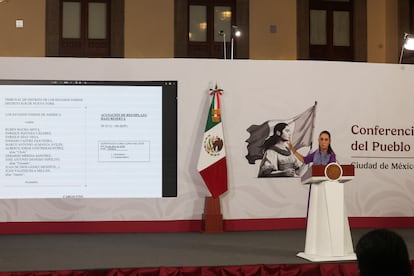

A major crack has appeared in the least expected place: the newly established foundation of the security relationship between Mexico and the United States, a sacred space during the 14 months that Claudia Sheinbaum and Donald Trump have spent at the helm of their respective governments. The political crisis in Mexico stemming from the presence of CIA agents on the ground in Chihuahua, coupled with the U.S. indictment of a governor and a senator in Sinaloa on drug trafficking charges, are the backdrop for a rupture whose magnitude and consequences are yet to be fully realized. The political chess game is progressing; bishops and knights are getting ready. A false move by either side could further complicate the situation.
The coordinated work of both administrations on security matters seemed safe from the storm that constantly batters other aspects of the bilateral relationship, mired in the endless trauma of tariffs. Moreover, the work of the Mexican security cabinet in recent months was a source of pride for Sheinbaum’s administration, providing ample ammunition to counter the rhetoric of its American counterpart. Trump had begun his term by identifying fentanyl trafficking from Mexico as one of the main problems facing the United States. Sheinbaum had responded accordingly, with blows against drug trafficking organizations and the mass transfer of more than 90 prisoners to the United States, circumventing the bureaucratic hurdles of the extradition treaty.
The overtures to Washington continued. Arrests and deaths of criminals fueled a choreography rarely seen in the last decade. Omar García Harfuch, spokesperson for the Security Cabinet, played the leading role with ease. He traveled to Washington regularly and met with the directors of the FBI, the CIA, and even the DEA, which had been vilified since the first two years of Andrés Manuel López Obrador’s presidency (2018-2024) following the arrest of former Mexican Secretary of Defense General Salvador Cienfuegos in Los Angeles. Everything was going smoothly; the security collaboration also strengthened Mexico’s negotiating position in other areas, always with an eye on the USMCA, the North American trade agreement.
But on Sunday, April 19, a pickup truck carrying four people crashed in the mountains of Chihuahua, in northern Mexico. All the passengers died. As the hours passed, it was learned that two of the four were agents of the State Attorney General’s Office and the other two were U.S. citizens. It wasn’t long before media outlets in both countries revealed that the Americans were actually CIA agents. Days later, the Chihuahua Attorney General’s Office acknowledged that these agents and two others had participated in an operation in the mountains, in which local authorities had dismantled a large synthetic drug lab.
The stage was set for controversy. The legislative wing of Morena, the ruling party, demanded explanations from the Chihuahua Attorney General, César Jáuregui, and the governor, Maru Campos, of the National Action Party (PAN), part of the opposition. García Harfuch stepped into the fray and clarified that, in theory, the binational collaboration was based on the exchange of information, not joint operations. Congress summoned Governor Campos. On April 25, the Security Cabinet stated that neither of the two agents had permission to participate in “operational activities in Mexico.” One of them, they said, had entered the country as an ordinary tourist...
The case escalated. Attorney General Jáuregui, under pressure, resigned. Sheinbaum accused Campos of harming national sovereignty. The Senate insisted on summoning the governor, and she tried to resist. García Harfuch attempted to defend Campos, stating that she had told him she was unaware of the presence of CIA agents in the state. In recent days, Sheinbaum raised her voice. She sent a diplomatic note to Washington, demanding explanations for the operation, and engaged in a heated exchange with the U.S. ambassador, Ronald Johnson, regarding his claims of corruption in Mexican public life. This Thursday, the president indicated that the U.S., in response to her diplomatic note, had committed to “acting with respect for the law and the Constitution of Mexico.”
And then the rift opened completely. Hours after Sheinbaum addressed the crisis again, the U.S. Department of Justice dropped a bombshell in Sinaloa, releasing a drug trafficking indictment against the state’s acting governor, Rubén Rocha Moya, of the Morena party, along with several officials in his administration and a senator from the same party, and requesting their extradition to the U.S., where they face potential sentences of up to life imprisonment. The salvo reached the National Palace, which delegated the response to the Ministry of Foreign Affairs and the Attorney General’s Office in an effort to buy time and establish a clear position.
In just 11 days, Mexico and the United States had become embroiled in two diplomatic conflicts over Mexican sovereignty: one originating south of the border with the CIA agents, and the other north with the judicial bombshell aimed at Sinaloa. From the United States, the narrative has omitted the sovereignty issue and focused on the emotional aspect of the incident—the White House press secretary even criticized Sheinbaum for her lack of empathy for the deceased agents. The bombshell has sparked numerous interpretations south of the border, with many pointing to parallels and differences with the Cienfuegos case and with the government’s perennial villain, Genaro García Luna, security czar during the presidency of Felipe Calderón (2006-2012) of the PAN party.
The comparison stems from the rank of the accused. Cienfuegos was Secretary of State, as was García Luna; the former a military officer, the latter a civilian. Rocha has been a senator and is now governor. The differences lie in geography and time. The United States justice system apprehended the first two on its own soil and then made the indictment public. Moreover, both had already left office. Their arrest posed no difficulties, beyond the political ones, which interfered in the Cienfuegos case. Then, during Trump’s first term, his Department of Justice felt compelled to release Cienfuegos, who faced drug trafficking charges, and send him to Mexico.
The case of Rocha and his co-defendants is different. In office until next year, the governor is in Mexico, where he cannot be arrested due to the protection afforded by his position, a fact well known to the U.S. justice system. Furthermore, the Department of Justice chose to release the indictment before taking the defendants into custody. Morena and its various factions—the executive, the legislative, and the partisan—have based their position on this. The ruling party interprets the U.S. Attorney’s move as a political action, a growl, a threat. The question is why.
Sign up for our weekly newsletter to get more English-language news coverage from EL PAÍS USA Edition









































