
The return of premature babies evacuated to Egypt from Gaza: ‘I will never forget that message saying my daughter was alive’
A group of 11 babies transferred to Egypt in incubators at the end of 2023 have returned to the Strip, where they were met by parents and siblings they had never met
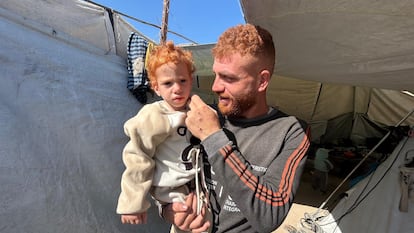
Ibrahim Badr runs, oblivious to the misery and uncertainty surrounding him, among the tents of displaced families set up in a courtyard of the Islamic University of Gaza City. He is two and a half years old and has an unmistakable Egyptian accent that reveals he learned to speak in the neighboring country, far from his entire family and Gaza.
The little boy is one of 30 premature babies evacuated from Al Shifa Hospital in Gaza in November 2023 and one of the 11 children who have just returned to the Strip, where he was born, after spending two years separated from his family in Egypt.
“He’s just like me, we look so much alike,” his father, Jabri Badr, 27, muses aloud, holding his only son in his arms and pointing to his reddish hair and mannerisms. “I didn’t need a piece of paper or to see the bracelet he was wearing to know he was my son. As soon as I saw him, I was sure,” the man affirms.
The little boy’s family believed for a time that he was dead. His mother, Israa Marzouk, went into labor at eight months pregnant when the Israeli army approached her home in the Jabalia refugee camp in the northern Gaza Strip. She gave birth in an ambulance while they were trying to reach a medical center. She and the premature baby were taken to Al Shifa Hospital, the largest in the Palestinian territory, and little Ibrahim remained in an incubator.
Shortly afterward, Israeli troops surrounded and stormed the hospital, claiming that the Islamist movement Hamas was using the facility’s basements for military purposes. However, the Israeli army never proved this, although they did display some tunnels found within the complex. Hamas has always denied using medical facilities as bases.
I didn’t need a piece of paper or to see the bracelet he was wearing to know he was my son. As soon as I saw him, I was sureJabri Badr, Palestinian father
At that time, a mission led by the World Health Organization (WHO) evacuated the babies in incubators to a neonatal intensive care unit at the Emirati Hospital of Rafah, in the south, and subsequently crossed the border into Egypt, without their parents being able to accompany them. Seven of the babies died in the neighboring country, according to medical sources at the time. This race against time to save the lives of the infants meant that many families lost track of their children for months.
“Communications were cut off, the mass displacements complicated everything, and the phone numbers I tried to call weren’t working. My anxiety multiplied,” explains Ibrahim’s father. Meanwhile, his wife’s health deteriorated drastically. She searched for information and photographs online, trying to find her son among the evacuated babies. At the shelter where they were staying, there was no food or warm clothing suitable for her, as she had been left very weak after giving birth.
“She urgently needed medical attention, food, warmth, and physical and psychological rest, and none of that was available,” recalls Azhar Badr, her mother-in-law. “Her health deteriorated so much that she could no longer walk.”
A doctor diagnosed Marzouk with severe postpartum depression and advised her to seek mental health specialists, but her condition deteriorated rapidly. One day, Badr found her bleeding from her nose and mouth. They tried to take her to a hospital, but none could admit her at that time due to the overwhelming number of bombing victims. The mother died without knowing what had become of her baby. “Ibrahim has returned to the family, but he will grow up without a mother,” the little boy’s grandmother sobs.
Badr doesn’t know how they will raise Ibrahim. Before the war, he was employed as a blacksmith, but now there is no work. “We don’t have the money to cover his needs and we depend on humanitarian aid, but I will do everything to make up for the two and a half years he spent away from us,” the father says.
Among the more than 72,000 people who have been killed in the war in Gaza since October 2023 were over 20,000 children, according to figures from the Gaza Interior Ministry, cited by the UN. This tally does not include, for example, those who died from chronic illnesses — which were completely neglected due to the war — or those who disappeared under the rubble.
They called her Farida
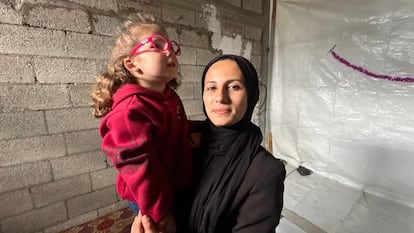
In northern Gaza City, Bissan al-Kurd runs around with her parents in a small apartment with no doors, windows, or tiled floor. The two-and-a-half-year-old girl wears a red blouse, jeans, and shoes she received in Egypt, just before returning to Gaza.
Bissan was born on October 22, 2023, the same day an Israeli strike destroyed her parents’ house in Beit Lahia, in northern Gaza, killing her three-year-old sister, Habibat, and her 19-year-old aunt, Bissan. She bears both their names, although at the Egyptian orphanage where she grew up they called her Farida, because they didn’t know her name.
“They started calling her by her real name when we found her. They also taught her our names,” says her mother, Sundus al-Kurd, 29, who was seriously injured in the attack and gave birth by cesarean section.
For seven months, the woman didn’t know if her daughter was still alive. Because she required surgery for her injuries, she couldn’t even see her when she was born. Finally, she discovered her whereabouts by chance when she commented on a Facebook post from a family with a similar story and was able to get in touch with the orphanage.
They started calling her by her real name when we found her. They also taught her our namesSundus al-Kurd, Palestinian mother
One day, her husband received a message confirming that their daughter was there. “I will never forget that message. My daughter, whom I thought was dead, was alive,” the mother recalls, sobbing with joy and kissing Bissan.
“Every time I look at her, I thank God,” says Musab, her 34-year-old father. “I had been told that all the premature babies in intensive care had died at Al Shifa,” he explains, adding that he only has words of gratitude for the people who cared for her during this time “as if she were their own daughter.”
Bissan is afraid when she hears the sound of Israeli drones or the roar of the bombings that continue in Gaza despite the ceasefire, in effect since October 2025. Since then, more than 700 Palestinians have lost their lives violently, most of them in Israeli airstrikes. “She’s not used to it because she grew up in peace. Here, things are different,” laments her mother, who needs medical treatment outside Gaza due to injuries sustained in the bombing and during childbirth, but doesn’t want to be separated from her daughter again.
Difficult adaptation
Malik Ghabun was born with breathing difficulties and fluid in his lungs and began his life in an incubator at Al Shifa Hospital before being transferred to Egypt. His return to Gaza has been complicated by another challenge: an autism diagnosis. The boy lives with his family in Deir el-Balah, in the central Gaza Strip, in a school overcrowded with displaced people. There, the little boy accompanies the other children, silent and with a fearful air, and his mother, Israa Ghabun, is very attentive to him, worried that he will get lost or “be kidnapped,” she says.
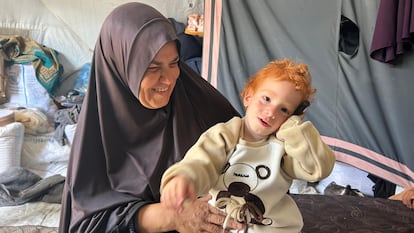
But his return has brought immense joy to his family, who learned he was alive five months after his evacuation. In his case, his caregivers in Egypt called him Adam. “They started calling him by his name and introducing him to us through photos and videos. But his autism limits him greatly. He only wants to be with me and can’t adapt to this environment,” explains Israa. “I will do everything I can to make up for what he has had to endure,” his mother promises.
Sign up for our weekly newsletter to get more English-language news coverage from EL PAÍS USA Edition









































