
Israel applies Gaza‑style tactics in Lebanon and accelerates ethnic cleansing
Despite the ceasefire, the Israeli army is razing dozens of villages to drive out Hezbollah in a project that experts denounce as disproportionate and contrary to international law
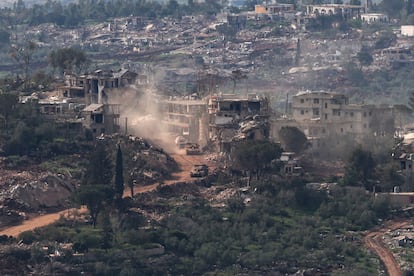
The Israeli army has tried out several names to refer to the territories it occupies in southern Lebanon: “advanced defense line,” “security zone.” It has finally settled on the one that most clearly reveals its intentions there: “Yellow Line.” In Gaza, the Yellow Line designates a supposedly temporary dividing border that separates the 52% of the Gaza Strip — now a depopulated, ruined territory — under Israeli control from the remaining 48%, held by Hamas.
This is the plan the government of Benjamin Netanyahu has adopted to keep Hezbollah away from the Israel-Lebanon border. It amounts to a kind of reprise of past failed experiments — the map resembles the 6% of Lebanon that Israel occupied for 15 years until its withdrawal in 2000 — but now in a version marked by displacement and under the cover, at least on paper, of a ceasefire that was recently extended for three weeks.
Israel has deployed tens of thousands of soldiers and naval forces to southern Lebanon, but not throughout the entire area. The army keeps the rest under surveillance, with the capacity to strike it. Israeli Defense Minister Israel Katz openly acknowledges that the objective is to wipe the border villages off the map, demolishing all the houses so that Hezbollah fighters have nowhere to hide. He said they would follow the model of Beit Hanoun and Rafah in Gaza, where the army left 90% of homes in ruins.
Beyond the first line of border villages — which Israel already flattened in 2024, mainly after the signing of a ceasefire that, like the current one, neutralized Hezbollah’s opposition — the new Yellow Line prevents Lebanese residents from returning to 55 southern municipalities, forcing them to watch from afar as fire consumes their homes and their history.
These actions, says Ben Saul, the United Nations Special Rapporteur on Human Rights and Counterterrorism, are “manifestly disproportionate” and illegal. “The forced and arbitrary displacement of civilians is a war crime, as is the mass destruction of civilian property without justification by military necessity,” he tells EL PAÍS by telephone from Sydney, Australia.
On the eve of the ceasefire, Saul and other U.N. experts signed a statement denouncing Israel’s operations in southern Lebanon, where Hezbollah receives support. “The deliberate destruction of homes is a weapon of war and a form of collective punishment, particularly in Shiite areas in the rural south of the country. It also points to ethnic cleansing,” the experts warned.
“It’s a repeat of what’s happening in Gaza,” Saul told EL PAÍS. “The scale of devastation, which is unnecessary, and the inability of a large number of residents to return, potentially point to war crimes.”
Companies charging for demolishing buildings
The Netanyahu government is pursuing such extensive destruction that, as it did in Gaza, it has hired private companies to rapidly bring down infrastructure — houses, schools, and more — using controlled explosions. They are paid per building demolished. The army is even transporting heavy equipment from the Gaza Strip to southern Lebanon.
The lack of access makes real‑time monitoring difficult. Lebanon’s National Council for Scientific Research, a public body, told AFP that Israel destroyed or damaged 500 homes in the first three days of the ceasefire, which began on Friday, April 17. Before that, since March 2, the Israeli offensive had hit 50,000 homes in a country of five million residents, more than a million of whom are forcibly displaced.
Satellite images obtained by CNN show excavators and bulldozers operating on Wednesday in Jiam, a municipality three miles from the border that has been completely leveled. The same is happening in places like Qantara, Beit Lif and Bint Jbeil, where widespread devastation had not yet arrived.
Widespread looting
The Israeli newspaper Haaretz revealed that Israeli soldiers are routinely stealing motorcycles, televisions, paintings, sofas, and carpets from homes and businesses. According to military testimonies gathered by the newspaper, commanders are aware of the phenomenon but are not taking disciplinary action. “Soldiers tell themselves, ‘What difference does it make if I take it? It’s going to be destroyed anyway,’” said one commander. The same situation was happening in Gaza, according to earlier reports.
A week ago, the Israeli army allowed military correspondents from Israeli media into the area. Their reports describe a process of systematic destruction in roughly 20 Lebanese villages closest to the internationally recognized dividing line, which is monitored by U.N. peacekeepers. Israel and Lebanon have no diplomatic relations and no agreed border.
The army warns that anyone approaching villages inside the Yellow Line is risking their life — in some cases because troops occupy them directly, in others because they open fire from a distance. Israel’s defense minister has made clear that residents will only be allowed to return to whatever remains once people in northern Israel feel their “full security” is guaranteed.
Indeed, the wording is so vague that it leaves the door open to a permanent occupation. Israel’s plan for southern Lebanon comes despite the fact that Hezbollah has launched most of its projectiles from north of the Litani River, miles away from the new “safe zone.”
Mohanad Hage Ali, deputy director of research at the Malcolm H. Kerr Carnegie Middle East Center, argues that the Israeli government’s objective with this depopulation policy is “to avoid negotiating with Lebanon the future of the areas in the security zone,” within the dialogue process promoted by Washington, which held its second meeting last Thursday.
For Saul, the scorched‑earth tactics Israel is applying in Gaza and Lebanon recall the colonial wars waged by the British in South Africa or by the United States and France in Indochina, as well as the more recent conflict in Sudan. The expert points to the military and financial support from Washington that enables these offensives — and also to the diplomatic backing, which “shields” Israel at the U.N. Security Council, a body that he says “should be doing its job and preventing Israeli violations of Lebanese territorial integrity.”
Population and energy control
The new Lebanese Yellow Line — which, unlike the Yellow Line in Gaza, was not mentioned in the truce — stretches from the Mediterranean to the Syrian border, according to the map released by the Israeli army a week ago. It doesn’t follow a straight line, but rather moves between two and five miles in depth depending on terrain, strategic value or demographic makeup. Most villages are Shiite, where Hezbollah has support, but there are also Christian villages — such as Debel, now famous for the photo showing an Israeli soldier destroying a statue of Jesus Christ — as well as Sunni, Druze and even mixed ones.
The exception in the depopulation plan is the Christian villages, such as Rmeish, Debel and Ain Ebel. That is the religion of Michel Issa, the U.S. ambassador to Lebanon — who requested they be spared — and of the militias that allied with Israel during the Lebanese civil war and the occupation of the 1980s and 1990s.
Authorities are now trying to rebrand that old security zone to avoid the stigma, since Israelis remember it as a quagmire where, during the occupation of the 1980s and 1990s, 675 soldiers returned in coffins. They also envision the area as a “sterile” zone — one of the Israeli military’s euphemisms — with minimal static troop presence that could become a target for Hezbollah.
The Israeli army, which has maintained five positions in southern Lebanon since 2024 — in violation of the ceasefire agreement requiring a full withdrawal — has established 10 more since March. The idea, however, is to control the devastated area mainly through artificial intelligence and surveillance drones, according to military correspondents.
Another contentious element is that the Yellow Line reaches the Mediterranean, where Israel would gain full control of the Qana gas field. Beirut’s exploitation rights are guaranteed in the important maritime border demarcation agreement it signed in 2022, when Yair Lapid was in power in Israel. That agreement granted Israel the right to exploit another field, Karish.
Israeli Finance Minister Bezalel Smotrich, a religious ultranationalist who supports occupying neighboring territories to approximate the biblical Greater Israel, argues for going further. The Litani River, up to 19 miles from the dividing line, should be Israel’s new border with Lebanon, he says.
Sign up for our weekly newsletter to get more English-language news coverage from EL PAÍS USA Edition









































