
After a month of war with Israel, Hezbollah emerges strengthened amid the pain of Lebanese civilians
The Israeli army, which has caused the displacement of more than a million people in Lebanon, is facing unexpected capabilities retained by the Shia militia
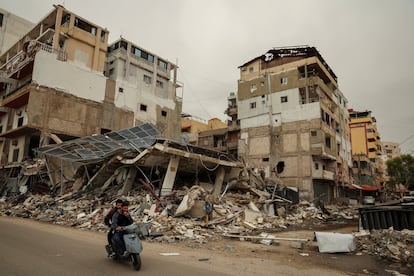

Until a month ago, the Lebanese Hezbollah militia was in a seemingly inescapable predicament. The previous war with Israel, which a ceasefire effectively ended in 2024, had left its armed wing decimated and its leadership severely weakened. Furthermore, the Israeli army maintained pressure during the ceasefire with almost daily attacks against its members and their families, while the Lebanese government decreed and initiated its disarmament process, signaling a historic turning point and the potential decline of the powerful armed group. Although with devastating consequences for the Lebanese people, the unexpected firing of missiles at Israel finally ended the deadlock.
On March 2, the Lebanese group ended its 15-month unilateral ceasefire. It did so in response to the U.S.-Israeli assassination of Ali Khamenei, Iran’s Supreme Leader, though it later presented it as a reaction to Israeli violations of the truce. In Lebanon, the decision was met with widespread disapproval: Hezbollah supporters criticized the fact that the action hadn’t come sooner in defense of the 397 people Israel had killed during the ceasefire. The rest of the country watched helplessly as the second war with Israel in three years began.
The pro-Iranian militia has since demonstrated that Israel did not eradicate its military capabilities in 2024 and that doing so is difficult at present. “Promises of a decisive victory over Hezbollah do not correspond to the reality on the ground,” wrote analyst Amos Harel in the Israeli newspaper Haaretz on Thursday, after the militia fired 100 rockets and drones at Israel and killed 10 soldiers fighting to expand the Israeli occupation in southern Lebanon.
On October 9, 2023, the day after Hezbollah opened a “solidarity front” against Israel with Gaza following the Hamas-led attacks two days earlier that left nearly 1,200 people dead, Prime Minister Benjamin Netanyahu vowed that Israel would “change the face of the Middle East.” It would do so by dismantling the so-called Axis of Resistance, a network of actors hostile to Israel that Iran promotes in the region and of which Hezbollah is a part.
Netanyahu repeated the message on Saturday, claiming that the occupation of “safe zones” in Gaza, Lebanon, and Syria demonstrates the mission’s success. Harel disagrees: while the Islamic Republic is withstanding the onslaught from the United States and Israel, the analyst believes that Hezbollah’s entry into the regional war undermines the narrative that Israeli authorities “had sold to their public,” in which “it was claimed that the militia had been defeated.”
Israel, however, remains unchanged in both its modus operandi and its rhetoric. After killing more than 1,340 people in Lebanon — of whom it claims, without evidence, that over 900 were Hezbollah members — a massive bombing raid on a densely populated area outside Beirut killed militant Yousef Ismail Hashem on Wednesday. The Israeli army presented him in a statement as the commander of Hezbollah’s southern front and described his elimination as “a major blow” against the organization. The statement thus claimed a victory similar to those it has asserted in previous wars, including the one in 2024. Afterward, Hezbollah — which has hundreds of thousands of followers — demonstrated its remarkable capacity for regeneration, the same capacity that makes it likely the current conflict is just another episode in a cycle of violence with a future trajectory.
Occupation and eviction
The Lebanese government — whose decision to disarm Hezbollah in 2025 made that project a Lebanese demand rather than an Israeli one — outlawed the party’s armed wing hours after the war resumed. In a society where the majority rejects the recognition of Israel, Beirut called for negotiations with the Jewish state to find alternatives to a repeat of the conflict.
Netanyahu’s government, which accuses Beirut of acting too late after decades of acquiescence to Hezbollah, has ignored the offer and insists on a military approach. Defense Minister Israel Katz, who on Thursday asserted that Hezbollah “will pay a heavy price” for increasing its attacks during Passover, has ordered the indefinite occupation and evacuation of 10% of Lebanon. The aim is to push Hezbollah northward to protect northern Israel. Furthermore, Katz has announced the complete destruction of border villages, “following the Gaza model,” to obliterate the urban landscape that he claims the group exploits for military purposes.
After years of offensive in the Gaza Strip, which have led to an international arrest warrant being issued against Netanyahu for possible crimes against humanity and the opening of an investigation into Israel for genocide, the Israeli campaign in Lebanon is now targeting civilian and healthcare infrastructure daily. Firass Abiad, the former Lebanese Minister of Health, sees these attacks as a way to encourage the forced displacement of the population by “breaking down the welfare systems that allow life to continue.”
Although Hezbollah has tens of thousands of fighters, the Israeli army has ordered the evacuation of a large tract of Lebanese territory and the country has more than one million internally displaced persons in a population of five million. Social Affairs Minister Haneen Sayed told Reuters this week that the government is preparing for the situation to continue for some time. She also lamented that the international community has contributed only $30 million through the UN, compared to $700 million in 2024, a figure she partially attributes to the Iran conflict affecting Gulf donors.
Exhausted and without a horizon
Residents of southern Lebanon, who maintain that the war never truly ended after the 2024 ceasefire, are experiencing a second forced displacement in three years. This has led a predominantly Shia population, popularly associated with Hezbollah, to seek safety in territories inhabited by other communities amid escalating political and social tensions. Overcrowding in apartments, shelters, or public spaces without adequate access to toilets or hygiene products is creating a public health crisis.
This, coupled with the potential loss of their homes to the shelling, has also triggered a mental health crisis. “When five or six families are in the same room, misunderstandings and arguments arise,” explains Abeer Shaheen, a psychologist with a Doctors Without Borders (MSF) team assisting displaced people at an emergency center near Sidon in southern Lebanon. Shaheen, herself displaced, says the new escalation has been a breaking point for many, following years of suffering. “I see a lot of people with high levels of stress, anxiety, and fear.” Many, she concludes, are considering suicide rather than having to face what is coming: “They can’t bear it.”
Since 2023, Israeli actions against Hezbollah have resulted in the destruction of dozens of southern towns. A couple who prefer to remain anonymous explained to this newspaper by phone that half of their home in Kfar Kila, a town bordering the frontier, was demolished in 2024. This caused one of them to become depressed and lose weight, after having spent years financing the construction of additional floors to accommodate their children.
The new Israeli offensive, they lament, has finally destroyed their home, while also damaging another the family owns in Qantara, a town on a third border line. While Israel refuses to speak to Beirut and the Lebanese plan to disarm the militia remains uncertain, a third generation of Hezbollah commanders is fighting in the area against the children of the Israelis who seized those villages at the end of the 20th century.
Sign up for our weekly newsletter to get more English-language news coverage from EL PAÍS USA Edition









































