
Nawaf Salam, Lebanese prime minister: ‘The disarmament of Hezbollah is the goal, not the starting point’
The new government in Beirut is seeking peace while trying to rebuild the state and the country’s economy
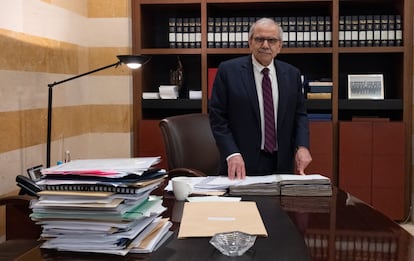

“The disarmament of Hezbollah and the complete withdrawal of Israel from Lebanese territory [whose troops still occupy five strategic border towns] must be achieved through negotiation,” says Lebanese Prime Minister Nawaf Salam, a former president of the International Court of Justice, aware of the risk of a descent into civil war if his adminstration attempts to do so by force. Three months have passed since he formed a new government of 24 ministers — including five women — who today face a colossal task, the first aspect of which is precisely that: to extract the country from the destructive war waged since October 8 by Israel and the Shia Islamist party-militia Hezbollah, which they must attempt to disarm. Then, or rather simultaneously, they must rebuild parts of southern Beirut and Lebanon devastated by Israeli air strikes, revive an economy in free-fall, and provide jobs and services to lift nearly three-quarters of the Lebanese population out of poverty.
To achieve this, they will have to navigate the resistance posed by the traditional, religiously-oriented political class and the all-powerful bankers to the reforms undertaken domestically, and the intense pressure from the United States to disarm Hezbollah as soon as possible and expel it from the area south of the Litani River to the border with Israel — or what amounts to the implementation of UN Security Council resolutions 1559 and 1701, respectively.
Salam received EL PAÍS last week in his office in the Seraglio district of Beirut. With Hezbollah politically weakened and militarily crippled by unprecedented attacks from Israel — which has assassinated its military leadership — he is working tirelessly to deploy the Lebanese Armed Forces (LAF) throughout its territory and to regain its arms monopoly. “The disarmament of Hezbollah [whose armed wing is considered a terrorist group by the EU] is the goal, that’s the goal now. It’s not the starting point,” Salam clarifies, evasive when asked about the current impasse.
Israel continues to bomb Lebanon almost daily despite the ceasefire in effect since November 27, while the leader of the fundamentalist militia, Naim Qassem, makes any negotiations conditional on a prior cessation of attacks and the complete withdrawal of troops from the neighboring country.
“The government’s position is clear. Israel must withdraw from all Lebanese territory, which obviously includes the five points [still occupied by the IDF], or even if they become four, three, or two. And as for Hezbollah, the issue of its arms monopoly is something that must be in the hands of the state. It is the only legitimate authority and the only actors authorized to carry weapons. So, I really don’t see the contradiction or the connection,” he argues. “South of the Litani, Resolution 1701 establishes a weapons-free zone. The United Nations Interim Force in Lebanon (UNIFIL) operates in that area. The weapons monopoly [by the LAF] applies to the south, north, east, and west of the country. And we are moving in that direction."
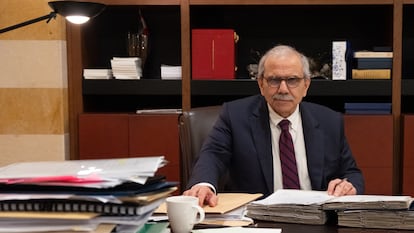
When will all this happen? “The date for Israel’s complete withdrawal has already passed. Israel was supposed to withdraw by the end of January. Then they got a sort of 15-day extension, and that also passed. The same thing happened with the full deployment of the Lebanese army, which is to exercise complete sovereignty according to the Taif Accords, which ended the civil war [1975-1990]. That deadline has also been passed for many years. What is the deadline? Should it be in a month, six months, or a year? I prefer to answer that the deadline has already passed. We have to move quickly,” he concludes.
For their part, Hezbollah’s supporters assert that, without the militia and its resources, the Lebanese army is unable to assume control of the country — Israeli attacks have already left more than 150 Lebanese dead since the start of the truce — and to provide aid, from the plundered state coffers, to the tens of thousands of displaced people in the south. “I understand where these criticisms come from. But what is the alternative? Do the critics propose any alternative? No. We have no choice but to mobilize all available political and diplomatic means,” Salam argues.
So far, the new Lebanese government has made significant achievements, such as the holding of municipal elections — the first since 2016 — and the proposed banking reform law. “In administrative reform, we are implementing a new mechanism for civil service appointments, to ensure a transparent, competitive, and open process. And we are already implementing it. It’s a milestone. Regarding financial reforms, the government adopted a bill to reform the banking sector. And we have taken a number of important decisions, reversing those of previous governments, for example, regarding coastal demarcation in terms of the use of the coastline for commercial purposes. And we are also working on a bill to strengthen judicial independence,” the prime minister explains.
However, the corruption and cronyism of which the Lebanese political elite that led previous governments are accused causes enormous distrust among both its citizens and the international community, from which Lebanon expects aid and investment to refloat its economy. What makes this government different from previous ones? “Commitment. It’s a government committed to carrying out reforms, and it’s implementing them. Committed to expanding state sovereignty over the entire country. Let me give you an example: we already have greater control over the Syrian-Lebanese border [which extends 205 miles to the east and north of the country] and we are actively combating smuggling. We also have greater control over the [Lebanese] port and airport,” he says, referring to areas where Hezbollah’s preeminence is denounced.
Efforts to lift Lebanon out of insecurity and the economic crisis inevitably involve regional reintegration. “We are very optimistic that the Saudis will lift the travel bans [on Saudi citizens visiting Lebanon] and on exports [to the Saudi kingdom] before the summer,” says Salam, who was received with full honors last April in Riyadh. Lebanon’s tourism industry, which previously accounted for one-third of state revenues, collapsed nearly 15 years ago. Hence, the first flights carrying Emirati tourists to Beirut airport have been greeted with roses and baklava, an Arabic delicacy. The government is working against the clock to ensure the country can boost tourism revenue this summer and win back not only “many Arab tourists” but also those from the Lebanese diaspora.
It is precisely Saudi Arabia — Iran’s archenemy and traditional supporter of the Sunni Muslim camp in Lebanon — that has mediated the resumption of negotiations between Lebanon and Syria for the demarcation of their borders, disputed for more than half a century. The abrupt political shift experienced last December in Damascus, which ended half a century of the Assad dictatorship and propelled Ahmed al-Sharaa, former Al-Qaeda leader in Syria, to the presidency, is also seen as a window of opportunity to improve Syrian-Lebanese relations fraught with historical toxicity.
A joint committee from both countries will address, among other issues, the smuggling of the amphetamine captagon from Syria, the 1.5 million Syrian refugees who have arrived since the civil war began in 2011 and who now make up a quarter of Lebanon’s total population, as well as the fate of the hundreds or thousands of Lebanese — there is no official data — who disappeared in the dungeons of the Assad regime during the 29 years that their troops occupied part of Lebanon (1976-2005).
“We are definitely very interested in the stability of Syria because it is linked to the stability of Lebanon, and vice versa,” emphasizes Salam, who advocates for the lifting of the international sanctions that are strangling Damascus, despite the fact that they were imposed on the previous regime. Brussels is considering the decision, while Washington announced Tuesday that it will lift all sanctions. The lifting of the sanctions would also allow “the acceleration of the return of refugees to their homes in Syria, but it will also help us with the energy issue, allowing us to connect to the so-called Arab grid in the region through Syria [Lebanon’s only border with its Arab neighbors]. And, of course, it will also be beneficial for us in terms of trade and investment.” Energy supply is one of the priorities for the Lebanese government in a country that lives connected to expensive and noisy generators during the day and, at night, is plunged into darkness due to a lack of amps.
Lebanon is trying to free itself from all external interference. However, as Iran and Syria lose traction, the Trump administration is intensifying pressure on the new Lebanese government, in line with the interests of Benjamin Netanyahu, prime minister of the Israeli government, which includes far-right members. “The more we can move forward in the process of strengthening the state — I don’t mean building the state, but rebuilding the state — and the stronger the state and its authority, the less Lebanon will be subject to outside interference,” the prime minister states.
Sign up for our weekly newsletter to get more English-language news coverage from EL PAÍS USA Edition









































