
How Trump is inadvertently driving US support for the Catholic Church
The pope’s latest symbolic rebuke to the president is appointing a Salvadoran who entered the country as an undocumented migrant as bishop

The relationship between the Catholic Church and the U.S. government is at a low point. The Trump administration’s anti‑immigration policies, the war in Iran, the U.S. president’s tendency to make provocative statements, and the ill‑judged idea of presenting himself as Jesus of Nazareth have all angered Catholics. Trump, who is used to publicly belittling anyone who criticizes him, made false accusations against Pope Leo XIV, who, in turn, spoke out in favor of peace in Iran and against the Trump administration’s persecution of migrants. The showdown has hurt Trump and bolstered the pope and the Church.
“Leo XIV has turned out to be surprisingly popular in the United States,” says Christine Emba, senior researcher at the American Enterprise Institute think tank and at the Initiative on Catholic Social Thought and Public Life at Georgetown University. “His statements are heard and taken seriously by Americans, and that becomes prejudicial to Trump’s political standing. He is aware of that, and resents it.” According to Emba, Trump “feels challenged by anyone who seems to enjoy more popularity or authority than he does, and the Catholic Church and the Pope fit that description at the moment.”
A recent survey by The Washington Post showed that among Catholics, Trump’s approval rating has fallen 10 points since February 2025, down to 38%. For his part, Leo XIV, the first Pope of U.S. origin, has a positive image among 41% of those surveyed who know who he is, compared to 16% who have an unfavorable view of him. Nearly six out of 10 reacted negatively to Trump’s false affirmation that the Pope supported Iran having nuclear weapons.
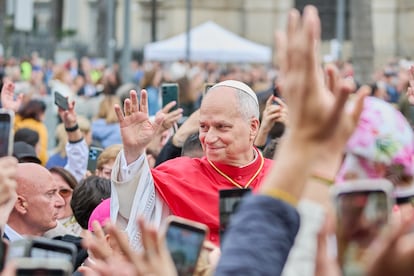
“The pope would rather talk about the fact that it’s OK for Iran to have a nuclear weapon,” Trump said in an interview on May 4. “I don’t think that’s very good. I think he’s endangering a lot of Catholics and a lot of people.”
Only Pope Leo had made no such declaration, but rather, put out a call in favor of peace. Trump continued by saying the pope is “terrible for foreign policy,” to which Leo XIV responded that he had “no fear of the Trump administration.” “I will continue to speak out loudly against war,” the pope said, adding that he had no intention “to get into a debate” with Trump, but that “the Church has a moral duty to speak out very clearly against war.”
Trump’s attacks on Leo XIV represent a break in a tradition of cordial relations between the United States and the Vatican. Presidents typically visit the pontiff, but last Thursday, it was U.S. Secretary of State Marco Rubio who paid an official visit instead of Trump. “Trump’s clear animosity represents a real change. It’s like he’s not at all trying to keep up a good relationship, and is sending other members of the administration in his place,” says Emba.
Before the start of the war, Trump’s anti-immigration policy, a top priority of his second term, had already unsettled the Catholic Church, which has defended refugees and asylum seekers. One of the first measures Trump took upon returning to the White House was to allow ICE agents to enter places of worship to detain migrant. Up until then, they were considered “sensitive locations” and off‑limits for arrests, like schools and hospitals. Many parishes in areas with large migrant populations saw attendance drop sharply as worshippers stayed away for fear of being detained.
The migrant community constitutes a large part of Catholics in the United States. According to numbers from the Pew Research Center published in March 2025, more than four of every 10 U.S. Catholics are migrants. The country’s Catholic population is 54% white, 36% Hispanic, 4% Asian, and 2% Black. (An additional 2% identify as another race.) Since 2007, the percentage of white Catholics has fallen by 10%, while the figure of Hispanic Catholics has risen by six points.
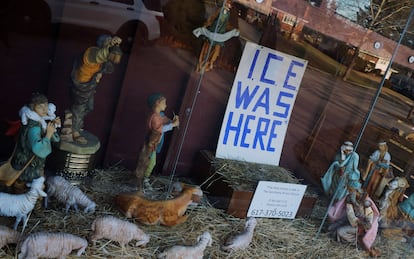
The group in which the Catholic Church has the greatest potential for growth is precisely the one most affected by the Trump administration’s deportation campaign. It has become routine for parishioners to turn to their churches for help out of fear of being detained. They need financial support because they have lost their jobs; they look for solutions for where to leave their children if they are taken into custody; and some even ask priests to accompany them to immigration court hearings, which have become traps where people can be arrested by ICE agents.
The U.S. Catholic Church has defended migrants’ rights, and many of its priests were born abroad given the declining interest in the priesthood among those born in the United States. The Pope’s support for immigrants has been evident since his appointment. Just two weeks after assuming leadership of the Church, the first bishop he named was Michael Pham, a former refugee born in Vietnam, who took charge of the Diocese of San Diego in California.
In November, the pontiff openly criticized the Trump administration’s anti-immigration operations. “When people have lived good lives — many of them for 10, 15, 20 years — treating them in a way that is, to say the least, extremely disrespectful, and with instances of violence, is troubling,” he said. Trump lashed out in response, saying that the Pope was being too permissive of crime and terrorism.
A few days prior, the U.S. Conference of Catholic Bishops published a statement lamenting the Trump administration’s immigration policies. “We oppose the indiscriminate mass deportation of people,” it said. “We pray for an end to dehumanizing rhetoric and violence, whether directed at immigrants or at law enforcement.”
One of the government’s reprisals against the Church was the cancellation of an $11‑million contract with Catholic Charities, part of the Archdiocese of Miami, Florida, which provided shelter for unaccompanied migrant minors. Catholic Charities USA is the official disaster response agency of the Catholic Church in the country, and the third-largest in the United States, behind only the Red Cross and the Salvation Army. The network has seen an increase in private donations in response to the administration’s policies, as it did during the interruption of the Supplemental Nutrition Assistance Program (SNAP), which allowed it to distribute 2.4 million pounds of food, according to the organization.
On May 4, the Pope met with Kerry Alys Robinson, president and CEO of Catholic Charities USA, and recognized the new challenges she’s dealing with on the job. “I am fully aware that the Catholic Charities agencies in the United States of America are by no means immune from these challenges,” Pope Leo said. “I have never seen such unity in the Catholic Church. And I’ve worked for the Catholic Church since I was 14,” Robinson said, according to The National Catholic Reporter.
Last year, in another rebuke to the church’s humanitarian work, the Trump administration put an end to a decades-long refugee resettlement partnership with the Conference of Catholic Bishops.
Latino bishops
The latest unmistakable sign of the Holy See’s opposition to Trump’s immigration policy was the appointment of a priest of Salvadoran origin as the new bishop of the Diocese of Wheeling–Charleston in West Virginia. Evelio Menjívar Ayala, 55, has been very critical of the offensive against migrants — a community he finds easy to identify with. He himself crossed the U.S. border hidden in a car before turning 20. It was 1990, and he was fleeing the civil war that was ravaging El Salvador. He obtained U.S. citizenship two decades ago and, in 2023, became the first auxiliary bishop of the Archdiocese of Washington, from where he advocated for migrants’ rights, including those of undocumented people.
“The mere fact of crossing the border undocumented should not define your entire history as an immigrant,” Menjívar said. “An immigrant cannot be defined by just one part of that journey and experience,” he said in a recent interview with CNN. It’s a message that directly clashes with the narrative of the current administration, which treats being undocumented as synonymous with criminality and grounds for deportation. “I will continue to raise my voice for humanity toward immigrants, for that is part of my own story,” Menjívar said.
In May, Pope Leo appointed another priest born in Latin America as a bishop in the United States. The Reverend John Gómez, originally from Colombia, will lead the Diocese of Laredo, Texas. Gómez arrived in the United States on a student visa in 2002 and became a U.S. citizen in 2021.
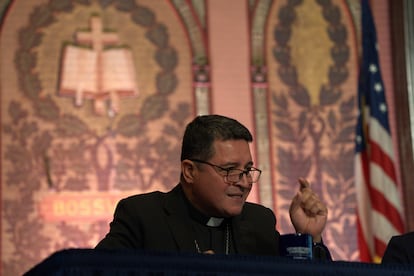
Menjívar Ayala has been appointed to an area that is majority white and Republican. Trump won the white Catholic vote in 2024 by a margin of more than 20 points, but even within this segment, discontent with the president is evident. His approval rating among this group has fallen in The Washington Post poll from 63% to 49% in just over a year.
The last straw was the image Trump posted of himself as Jesus on social media — an image he later had to remove after the backlash it triggered. Eighty percent of his voters reacted negatively to what many considered blasphemy. The president tried to walk it back by saying he had meant to portray himself as a doctor, but no one bought the explanation; he had crossed a red line. Republican Catholics were also unsettled when Defense Secretary Pete Hegseth invoked God while speaking about the war and claimed that God was on the side of the U.S. military.
With the midterm elections on the horizon — in which Trump is fighting to keep control of Congress — losing the Catholic vote, a group that makes up about 20% of the U.S. population, could contribute to his defeat. And as Trump loses Catholic support, the Church is gaining followers: “People are attracted to Pope Leo XIV at this time because he is open to speaking about good versus evil, to adopting a moral posture that is uncomplicated by politics and seems uninfluenced by money,” says Emba.
Sign up for our weekly newsletter to get more English-language news coverage from EL PAÍS USA Edition









































