
The year in which Leo XIV became the moral antagonist of the far right
After a swift election in which the role of US funding for the Vatican is now emerging, and months of caution, Prevost has revealed himself as a global leader who can stand up to Trump
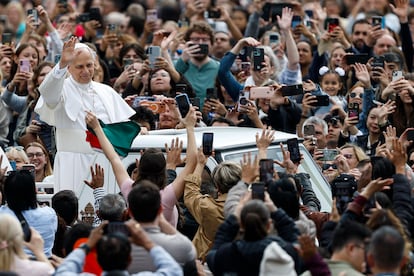

A week before the conclave to elect a new pope that began on May 7, 2025, 120 major Catholic donors from the United States met at the luxurious St. Regis Hotel in the center of Rome, on the invitation of the Papal Foundation. This organization was created in 1988 by John Paul II, in line with Ronald Reagan during the Cold War and following the establishment of relations between the two countries in 1984. It was created to overcome the Vatican’s financial scandals and channel money to the Holy See from the U.S., the country that is the largest benefactor of the Catholic Church: it is estimated that this foundation has donated $250 million up to 2024. But that was until Francis’ pontificate: at that point, the flow dropped drastically, as Jorge Mario Bergoglio was seen by conservatives as a communist pope who hated the United States.
The Vatican coffers were facing an emergency (a $90 million operational deficit in 2023), and this matter was discussed at the meeting organized by the Papal Foundation’s president, Cardinal Timothy Dolan of New York, a friend of Trump’s and leader of the conservative faction in the conclave. Those present at the meeting were willing to reopen the flow of funds, “so long as we have the right pope,” one of the participants told The Times UK.
This decidedly unspiritual factor—money—played a significant role in the conclave’s election of the first American pope, according to several analysts. Among them is Massimo Franco of Corriere della Sera, who has dedicated a book to the subject, “Papi, dollari e guerre” (Popes, Dollars, and Wars). He believes it was one of the three major issues that determined the conclave’s outcome. Furthermore, he reveals that during the preliminary meetings, amidst a lengthy financial discussion to find the right candidate, the conservative German Cardinal Gerhard Müller grew weary and exclaimed: “We have to elect the successor of Peter, not of Judas!”
The other two priorities were to quell the divisions within a highly polarized Church, and to restore shared governance of the institution, without the excessive authority for which Francis was criticized. Franco also notes that the 10 U.S. cardinals, ideologically divided in two, met in the preceding days at the Pontifical North American College and agreed to support Prevost.
What remains unclear, a year after his election, is whether Leo XIV was ultimately the pope some had hoped for. Starting with Donald Trump, who on April 13th finally lashed out at him: “Leo should be thankful because, as everyone knows, he was a shocking surprise. He wasn’t on any list to be Pope, and was only put there by the Church because he was an American, and they thought that would be the best way to deal with President Donald J. Trump. If I wasn’t in the White House, Leo wouldn’t be in the Vatican.”
One of the first people to realize they’d been had was Steve Bannon, the ideologue of the MAGA movement, who had conspired to bring down Francis, as the Epstein papers revealed. Just days after his election, he labeled Prevost a pope of the “deep Church,” a euphemism for the “deep state,” which this movement considers the root of all evil. Prevost’s candidacy had been well-concealed, and the ultraconservative American world detected the danger too late. This led to accusations in the final days before the conclave that Prevost had covered up child abuse during his time as bishop in Chiclayo, Peru.
The speech to the diplomatic corps
Leo XIV’s first priority was to heal wounds. He signaled a return to tradition in his vestments, protocol, and above all, by making it clear that he would return to the papal apartments. He also revived Vatican diplomacy, which under Francis had become more personal. Throughout 2025, he remained an enigma, learning the ropes and studying the situation. He also chose trusted aides to feel protected. But after moving cautiously for a few months, beginning with his address to the diplomatic corps accredited to the Holy See on January 9, 2026, he began to reveal himself as a strong global leader against far-right populism, starting with its main exponent, his fellow American Donald Trump. “It is clear that Trump then recognizes the danger posed by the Pope’s underlying ethical and political stance, which places him in an antagonistic position,” notes Vatican expert Marco Politi.
This is what the Pope said in that speech: “In our time, the weakness of multilateralism is a particular cause for concern at the international level. A diplomacy that promotes dialogue and seeks consensus among all parties is being replaced by a diplomacy based on force, by either individuals or groups of allies. War is back in vogue and a zeal for war is spreading. (...) Peace is sought through weapons as a condition for asserting one’s own dominion. This gravely threatens the rule of law, which is the foundation of all peaceful civil coexistence.” He continued along these lines until his clash with Trump.
The truth is that Prévost is the first pope with a truly international vision, having traveled the world and learned several languages before his papacy. He is the first modern pope who has been a missionary. And he is certainly the first American pontiff, an antidote in these Trumpian times, just as John Paul II was an antidote against communism. Leo XIV is ”animated by a strong political passion (…), by the condemnation of the idolatry of force, and by an aversion to autocrats,” wrote Lucio Caracciolo, a geopolitical analyst, in La Repubblica. When, on April 7, Prévost condemned Trump’s threat to obliterate Iran overnight, he even called on Americans to take action by contacting their political leaders.
A year after his election, it’s clear that the decision to nominate Prevost was meticulously planned in the preceding months, skillfully and discreetly managed as a consensus option between progressives and conservatives, since no single group could muster enough votes to push a candidate through. “It’s obvious, because otherwise, such a swift election in such a polarized situation is inexplicable,” says Giovanni Maria Vian, a historian and former editor of L’Osservatore Romano. He also believes that the financial factor played a significant role, and that Prevost, as a mathematician and longtime head of the Augustinians, could be a capable manager. “The last pope who balanced the books was Pius XI; after him, they’ve all been a disaster,” he notes. “We are at the beginning of a pontificate that promises to be long, interesting, and decidedly reformist. More through actions than words, although the words are clear.”
The secrets of the conclave vote
In recent months, the secrets of the conclave have been gradually revealed. According to Vatican sources consulted by EL PAÍS, the candidacy of Pietro Parolin, Secretary of State under Francis, initially garnered less support than anticipated; the Hungarian Peter Erdo, candidate of the more traditional wing, reached 21 votes, but with no possibility of gaining further support; by contrast, Prevost burst onto the scene with a surprising number of votes, almost 50, which then attracted further support. He was backed by cardinals from the U.S., Latin America, Spain, and many Asian countries.
In reality, continuity won. Those who voted for Prevost—and Francis was the first to do so—were looking for someone who would follow in the last pope’s footsteps, but without his excesses. “From what I’ve gathered from many who voted for him, they’re happy,” says Elisabetta Piqué. “They’re seeing, for example, that he’s implementing synodality; he’ll convene them once a year. Francis started many processes, and now Leo XIV is continuing them and bringing them down to earth. Those who are unhappy are the group that wanted to reverse course.”
Now Prevost has reached cruising speed. David Gibson, dean of the Center on Religion and Culture at Fordham Catholic University in New York, floated an interesting idea in an article published in The New York Times in January: “Leo is not looking for a fight with Mr. Trump; he is looking past him.” In other words, he is defending basic pillars of coexistence so that they remain standing after the populist cyclone has passed: against nationalism and individualism, he proclaims universal values, the Christian message, human rights, and international norms.
Sign up for our weekly newsletter to get more English-language news coverage from EL PAÍS USA Edition









































