
Frei Gilson, the Brazilian priest who attracts online crowds to pray the rosary at dawn
The Carmelite friar has 28 million followers on his social media accounts. He embodies a movement to bring Catholics back to the fold of the Church
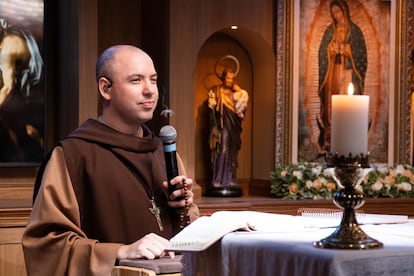

Hundreds of thousands of Brazilians prepared for Easter this year with the help of Friar Gilson, a 39-year-old Roman Catholic friar who has become a phenomenon, attracting massive digital and offline followings. During the 40 days of Lent, faithful across Brazil have been getting up in the middle of the night to log onto social media via their phones or television sets and pray the rosary starting at 4:00 a.m. On the first day of this digital Lent, he drew 1.5 million participants.
The friar has been a part of the daily life of Roseli Gomes, a 40-year-old shopkeeper, for years. Speaking by phone from her home in Pernambuco, she admits that to overcome sleepiness and exhaustion when it’s still dark, she tunes in to the broadcast on her television. “It’s a sacrifice, but when you hear Friar Gilson, you feel an inner peace, you feel welcomed,” she says.
Frei Gilson embodies a nascent movement within Catholicism, people who are returning to their faith with renewed fervor. He is a breath of fresh air for a Church besieged in recent decades by the rise of the evangelicals, who in Latin America are gaining both converts and political power. For this reason, this affable, charismatic priest who plays soccer—an important thing in Brazil—has the blessing of the Catholic hierarchy, although they reined him him after a controversial sexist sermon and flirtations with former president Jair Bolsonaro’s far-right political movement.
A friar of the Carmelite Messengers of the Holy Spirit—a relatively new order—he wears a brown habit with a large cross on his chest, sandals, and a shaved head. Years ago, he left the parish he led in São Paulo to dedicate himself to the internet, where he has built a massive audience. He has never had a strategy for gaining followers or made large investments, he explains; success, according to him, is a matter of divine power.
The fact is, he has amassed some 28 million followers across social media platforms, including Instagram, YouTube, Facebook, TikTok, WhatsApp, and others. This constitutes a digital following considerably larger than that of the most powerful and influential Catholic on the planet, Leo XIV. The Brazilian was able to greet the Pope during a recent visit to the Vatican.
“Praying the rosary at four in the morning isn’t exactly groundbreaking; religious orders always get up early,” notes Tabata Tesser, a sociologist and researcher on Catholicism at the Institute for Religious Studies (ISER). “What’s different about Frei Gilson is that he’s taken the idea of sacrifice to social media and become a phenomenon. He combines a strong Marian devotion with spiritual discipline and a clear, didactic, and direct style.” Last year, he was the most-watched and most-listened-to content creator in Brazil (followed by a war video game commentator and an evangelical pastor).
Gilson da Silva Pupo Azevedo was born in São Paulo in 1986. He himself has confessed that he was a rebellious teenager who was traumatized by his parents’ separation. Raised in a family with little religious practice, his mother’s conversion, discovering the guitar, and living in the Paraisópolis favela in São Paulo changed the course of his life. When his priestly vocation arose, he went to find the girl he had liked since he was 11: “I didn’t want to be a priest without experiencing love,” he said in a podcast.
After taking his vows as a friar, he studied to become a priest. He built a career in the footsteps of the first Brazilian singing priests who, starting in the 1990s, began filling stadiums.
The Carmelite friar is conservative; for example, he opposes couples living together without being married. A 2025 sermon in which he advocated for the submission of women sparked a formidable controversy. “Man was given leadership, but woman desires power. (…) The war of the sexes is pure ideology, it is diabolical. To cure man’s loneliness, God created you [woman]. You were born to help man,” he proclaimed. That sermon also catapulted him to fame beyond the Catholic world. Jair Bolsonaro and his most media-savvy protégé, Congressman Nikolas Ferreira, an evangelical Christian, rushed to express their solidarity with him.
Six months later, the National Conference of Bishops of Brazil (CNBB) convened what it called the Meeting of Priests in Digital Mission. Its objective? “To inspire a more authentic, creative, and evangelizing digital presence, in tune with the challenges of the contemporary world.” The Catholic hierarchy wanted to bring order to the vast array of influential Brazilian priests and avoid being dragged into the mire of political polarization.
In the case of Frei Gilson, it involved deleting some 30 or 40 videos with statements considered too risqué, explains the specialist from the Institute for Religious Studies. “The episcopal conference accepts that a priest can be very conservative; what it doesn’t want is to be associated with any one candidate, it seeks a certain neutrality,” she adds. That’s where the friar’s public controversies ended.
But Frei Gilson also speaks through his silences, the sociologist notes. “He avoids commenting on social issues relevant to the Church in Brazil, such as the environment, housing, or the recent rape and femicide of an 82-year-old nun in a convent.” The friar, who doesn’t use money or have a bank account due to his vow of poverty, has just bought land in São Paulo with $4 million received in donations to build a megachurch, as revealed by Folha de S.Paulo.
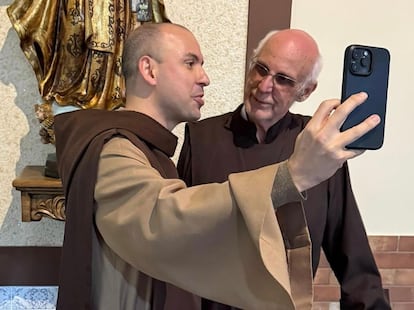
One of the priests most beloved by the Brazilian left, Father Julio Lancelotti, 77, a staunch advocate for the homeless (some 100,000 wander the streets of São Paulo) and transgender people, visited the friar—“my dear brother”—a few months ago in a gesture of reconciliation. They took a selfie. The veteran Lancelotti is no stranger to controversy himself. The latest has resulted in a vow of silence imposed by the archdiocese, which has left him without social media access or the ability to broadcast his Masses live.
Undoubtedly, Brazil being one of the countries with the largest Catholic population in the world (and its internet users spending many hours online each day) contributes to the Carmelite friar’s success. Although the Catholic population is declining, it still numbers around 100 million, compared to approximately 47 million Evangelicals, whose numbers are increasing, but at a slower pace than expected. From this group have emerged bold proposals that the Vatican has either embraced—such as allowing gay and transgender people to be baptized—or rejected, such as permitting married priests in places like the Amazon.
Tesser, who investigates changes in Brazilian Catholicism, suspects that the Carmelite’s secret lies in the simplicity of his message: “Our hypothesis is that Frei Gilson became a mass phenomenon because he sticks to basic catechesis, preaching about Jesus, about original sin… he doesn’t delve into complex theological debates.” In this, he is in tune with the new pontiff, who is promoting adult catechesis.
Brazil, a conservative country that fervently follows all kinds of beliefs, is fertile ground: “That primary catechesis allows Frei Gilson to engage in dialogue with non-practicing Catholics, with Spiritists [who communicate with spirits through mediums], who in Brazil number 1.5 million, with Evangelicals raised in Catholicism…”.
Gomes, the shopkeeper from Pernambuco, is married and has two children aged 13 and 11. She says that the boys “only fall asleep when Frei Gilson says his prayers.” The priest’s teachings have brought profound changes to her life: “Thanks to him, I’ve grown closer to God, and I’ve started going to church more often. I’ve given up habits that weren’t good for me.”
She is a devout follower, both online and offline. A couple of weeks ago, this woman from Pernambuco attended the vigil where Frei Gilson filled a Recife stadium with 45,000 people for an all-night Christian prayer and music session. She already has tickets for the charity soccer match the Carmelite friar has organized for July. And in August, she will participate in another Lenten vigil, this time for Saint Michael, also at four in the morning.

Sign up for our weekly newsletter to get more English-language news coverage from EL PAÍS USA Edition









































