
Takeshi Yoro, anatomist: ‘In Japan, we don’t see a robot as a threat: it’s simply another form of presence in the world’
The 88-year-old Japanese physician swapped autopsies for popular science writing. In his best-seller, he argues that we have vast amounts of information but fail to understand one another because of an ‘invisible wall’ made up of prejudice, bias, self-assurance, and the failure to listen
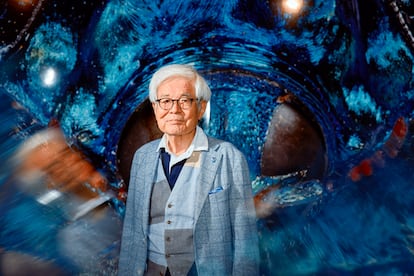

Anatomist Takeshi Yoro is 88 years old and spent 30 of those years performing autopsies at the University of Tokyo. When he retired from teaching in 1995, he turned to studying the human brain and its relationship with the body — and to collecting insects.
In 2003, he published Baka no Kabe (The Wall of Ignorance), in which he argued that human intransigence is not a moral flaw but a neurological condition: when faced with information that contradicts its certainties, the brain simply does not process it — it behaves as if it does not exist. We have vast amounts of information, he writes, yet fail to understand one another because of an “invisible wall” made up of prejudice, bias, self-assurance, and the failure to listen.
The book sold four million copies in its first two years, turning him into a celebrity who explained mathematical concepts on variety shows and in packed auditoriums of families. His critics note that Yoro does not always escape his own diagnosis: a self-confessed smoker of more than 20 cigarettes a day, he denied for decades any scientific link between tobacco and lung cancer; in 2024, he published an essay revealing that he himself had developed the disease. At the Osaka World Expo, an AI version of “Professor Yoro” — a digital double trained on his more than 200 books — was unveiled.
Yoro receives EL PAÍS at the Tokyo Museum of Photography, where giant photographs of his insect collection are on display. He has thick, white hair. He walks leaning on a black cane. He wears a patchwork vest and a light blue cotton blazer, accentuated by a tiny turquoise beetle pin that his wife pinned to his lapel before they left. He punctuates his responses with long silences and, from time to time, hints at a smile.
Question. In Baka no Kabe, you define the human brain as a computer, a system of inputs and outputs. Is this approach closer to being applied to AI?
Answer. It used to be said that computers were becoming more and more like humans. I always maintained the opposite: that humans had become more like computers. Both processes exist and will converge. There’s no need to judge whether it’s good or bad. If they fulfill their function, it’s fine. What worries me is that there are already 8 billion intelligent people. Why are we so determined to manufacture something of which 8 billion units already exist?
Q. But there is a Professor Yoro AI. Does your digital alter ego respond the same way you do?
A. For me, participating in that project is like having written a book. What was recorded differs from what I think today. It depends on those who built the AI. They tell me it was easy: I’ve written a lot.
Q. Do you see the failure of the U.S.-Iran negotiations as a confirmation of your intransigence thesis?
A. Yes. Even if the input arrives, there is no output; their behavior doesn’t change. Politicians don’t listen. Information comes in but isn’t processed: the coefficient multiplies everything by zero. They know it, but they forget it immediately.
Q. Do you think Japan has stopped believing in pacifism?
A. To believe that Japanese pacifism is due to defeat in World War II and an imposed constitution is a mistake. Japan has been the site of earthquakes, typhoons, and volcanic eruptions; war never improved the situation. It is a small country with a dense population; naturally, it wants to live in peace. Until the emergence of the samurai in the 12th century, Japan’s history was fundamentally peaceful. The Japanese army did not arise to confront external enemies, but because of natural disasters. When bandits cut off the food supply to Kyoto, military power became necessary to prevent famine.
Q. Does the smartphone enslave society?
A. The problem isn’t the smartphone: it’s systematization. And systems have a way of absorbing you, even if you don’t want to be part of it. I’m undergoing cancer treatment, and as soon as I went to the hospital, the system took me in — 10 million yen a year [$63,000] covered by insurance, without asking anyone’s permission. We’ve lost small but real freedoms. But this didn’t start with the mobile phone. It’s modernity as a whole. What used to resist systems was nature. Today, only its most extreme forms remain: earthquakes and eruptions. The same thing is happening in education: everything has become a controlled system. When the university became systematized, I retired. My teacher’s mentor organized an expedition to the Himalayas to look for the yeti. Today, no professor could do that. They’d be criticized for wasting time. The university used to be a place with room to dream. It isn’t anymore.
Q. In Baka no Kabe, you use Spanish examples like “la manzana” and “una manzana” to explain what Japanese cannot express grammatically. How did you become familiar with Spanish?
A. I like Argentine tango. The lyrics intrigued me, and I started to investigate. I haven’t studied it formally. I’ve been to Costa Rica for entomological research. And to the Canary Islands on a cruise. They took us to a village and told us that no young people lived there.
Q. Why do the Japanese get along better with robots, than Westerners?
A. We have coexisted with representations of non-human figures for centuries — Shinto gods do not have a fixed human form. The same barrier between animate and inanimate does not exist. A robot does not seem like a threat to us: it is simply another form of presence in the world.
Q. You say that truth is just information that the brain transforms. Is that the origin of all disagreement?
A. The problem with information is that time disappears within it. A photograph captures what something was like at that instant — a horse suspended in mid-air. That is information. At the beginning of the information age, people believed that information was constantly changing, that it was in motion. But it is only replaced: static objects are substituted for others. What the ancients called truth was that which never changes. And the only thing that doesn’t change is information. Heraclitus said panta rhei — everything flows —, but that phrase has remained unchanged for over 2,000 years. If truth is what doesn’t mutate, then all information is truth. What has changed today is the way we think about this. Now, what matters is change itself. To be alive means to transform oneself every day.
Q. Is there a message you would like to convey?
A. I have no messages. I’m Japanese: I don’t want to take on the task of moving people with words. I only aspire for each person to think for themselves. Alongside photos of any war, we should put photos of an earthquake. Natural disasters already do enough damage. It makes no sense for human beings to add to the destruction.
Sign up for our weekly newsletter to get more English-language news coverage from EL PAÍS USA Edition









































