
Deported and returned to the US: Trump administration forced to backtrack after expelling ‘Dreamers’
The move underscores the unlawfulness of Trump’s persecution of DACA recipients as part of his immigration offensive
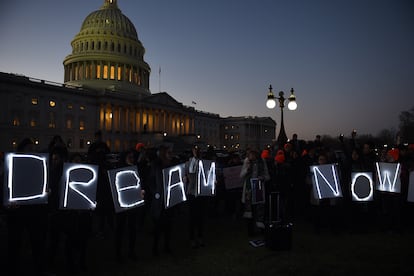

Mistakes made by the U.S. administration in its deportation campaign have forced the government to backtrack and return two migrants to the United States in less than 10 days. In both cases, the two deported individuals were beneficiaries of DACA (Deferred Action for Childhood Arrivals), the program that former president Barack Obama created in 2012 through an executive order to protect from deportation those who came to the United States illegally as children.
The program kept its beneficiaries protected until Donald Trump began his second term and included them in his administration’s deportation campaign. It is estimated that immigration agents have detained nearly 300 people with DACA, and about 90 have already been deported. In recent days, a court ruling and the prospect of facing a lawsuit have forced the Trump administration to return two “Dreamers,” as those protected by DACA are known. More than half a million people depend on the program to maintain their legal residency.
This Wednesday, Luis Roldán-Cerda crossed the Reynosa-Hidalgo International Bridge to return to his hometown of McAllen, Texas, and be reunited with his wife and two children after five weeks apart. “It affected me a lot,” he admitted to the reporters present at the family reunion. “But, more than anything, I’m grateful to be back with my family. I missed them terribly, especially these little ones,” he declared. This family’s ordeal began on February 17, when Roldán-Cerda went to an immigration appointment to have his fingerprints taken as part of his visa application process.
What was supposed to be a routine step in his immigration process turned into weeks of anguish on the other side of the border. At his appointment, he was detained by Immigration and Customs Enforcement (ICE) agents and then deported to Reynosa, in the northeastern Mexican state of Tamaulipas, within hours.
The country where he was born is unfamiliar to him, as he hadn’t visited it in three decades. At just three years old, he was taken to the United States, where he built a life. He works as an electrician, is married and has two children, ages two and four. “Reality hits you hard when you’re there and you can’t be with them,” said Roldán-Cerda. “Especially during holidays like Easter. You’re so close, but you can’t run to them and hug them,” he told the media.
His return to the United States and back to his life came after his lawyer, Wendy Rodríguez, initiated legal proceedings that ultimately did not take place because the Administration backed down. “The government realized we had filed a federal lawsuit. They got nervous because they know what they did wasn’t legal, and before we could go to trial, they ordered him to be sent back,” Rodríguez explained by phone.
“It broke my heart”
The Trump Administration made the same mistake when it deported María Jesús Estrada Juárez, also a DACA recipient. A judge ruled her expulsion illegal and ordered the government to reverse course and return her as an emergency measure. On March 30, she was brought back and was able to reunited with her 22-year-old daughter, who actively participated in a campaign demanding her mother’s return, a campaign that involved civil organizations and politicians.
“This has been one of the most painful experiences of my life. As a mother, being separated from my daughter in that way—feeling helpless, not knowing if she was okay—broke my heart in a way I can’t describe,” Estrada Juárez stated during the press conference. On February 18, she had gone to an appointment with U.S. Citizenship and Immigration Services (USCIS) in connection with the process for obtaining a green card, which grants permanent residency. ICE agents detained her, and in less than 24 hours, she was deported to Mexico without being given the opportunity to consult with a lawyer.
She had arrived in the United States at age 15 and raised her daughter alone there. The two of them resided in Sacramento, California. District Judge Dena Coggins called Maria’s deportation a “flagrant violation” of DACA protections. For months, advocates and members of Congress have warned about the Department of Homeland Security’s violation of these protections.
“Maria’s story is one of hundreds of stories of DACA recipients who have been targeted, detained, and even deported by immigration agents. It is worth emphasizing that, despite today’s monumental victory, we continue to face the most dangerous moment in DACA’s 14-year history,” the Home is Here advocacy coalition said in a statement.
Trump had already tried to end the program during his first term, but a court ruling prevented him from doing so. Upon his return to the White House, with a more aggressive anti-immigrant agenda, he included its beneficiaries on the deportation list.
DACA was created as a temporary solution to protect from deportation people who were brought to the United States as children and have built a life in that country, which they consider their own. Congress has been unable to pass comprehensive legislation, such as the DREAM Act, which has lacked the necessary support for years. Under DACA, its beneficiaries must renew their work permits every two years.
Currently, no new applications are being processed, but renewals are accepted and can be submitted up to 150 days in advance. The problem arises from the processing delays. While USCIS previously took about four weeks, it now takes up to five months. During this time, beneficiaries are left in limbo, without work authorization and facing the possibility of deportation.
Last month, several members of Congress, led by Nevada Senator Catherine Cortez-Masto and Illinois Senator Dick Durbin, sent a letter to former DHS Secretary Kristi Noem and her successor, Markwayne Mullin, urging them to reduce processing times. “DACA recipients contribute billions of dollars annually to the national economy and perform vital roles in our communities. Administrative delays in DACA renewals undermine not only individual stability but also overall economic resilience,” they stated.
Rodríguez emphasizes the importance of the fact that in both cases the detainees had legal representation, something not all those arrested have access to. Another DACA recipient who was deported recently contacted her to try to return to the United States. His case is more difficult because, pressured by federal agents “basically with lies,” the lawyer says, he got scared and signed his voluntary departure. Rodríguez maintains that the resolution of Roldán-Cerda’s case is relevant “because it sends the message that the government itself acknowledges it did something illegal by ordering his return, and it warns DACA recipients that if they are illegally detained, they should not sign anything.”
Sign up for our weekly newsletter to get more English-language news coverage from EL PAÍS USA Edition









































