
Arrests of migrants in public spaces increase by over 1,100% during Trump’s second term
The latest report from the Deportation Data Project breaks down, through ICE figures, the workings of the anti-immigrant machinery of the US government


No one doubts that the anti-immigrant machinery deployed by the Trump administration is more extensive and aggressive than ever before, but the data to confirm this has always been elusive. This week, however, the Deportation Data Project (DDP) at the University of California, Berkeley, published its most comprehensive analysis to date, with previously unknown figures covering data up to March 10. Its findings confirm what could be inferred from the images of the terror unleashed on American streets: arrests of migrants in public spaces have increased by more than 1,100%, detentions of people without criminal records have risen by 770%, and releases on bail have practically ground to a halt. These are just a few of several trends that, taken together, paint a picture of how the United States is progressing toward its goal of carrying out the largest deportation in history.
The Trump administration does not regularly release figures on the implementation of its immigration agenda, and when it does, they are often incomplete. But the DDP obtained data from Immigration and Customs Enforcement (ICE) through a Freedom of Information Act lawsuit. As soon as it had the data, it made it publicly available, and this week it released its own analysis.
The Department of Homeland Security (DHS) has questioned the DDP’s findings, maintaining that 70% of the agency’s arrests have been of migrants with criminal records. Numerous other reports over the past few months have refuted this, demonstrating that the majority of those detained do not have criminal histories. The DDP has responded that the data analyzed are the raw figures from ICE and that its process has been completely transparent.
Beyond the political dispute, the data reveals a structural transformation of the U.S. immigration system, based on two simultaneous changes: detaining more people — and in more places — and making it as difficult as possible for them to leave the system once inside, unless it is as deportees.
In the past year, total arrests have quadrupled. The critical driver has been an explosive increase in arrests outside of correctional facilities. These arrests in public spaces — on the streets, in courthouses, or at immigration appointments — have increased more than elevenfold. Transfers from jails and prisons — that is, of migrants already detained for other offenses, the traditional focus of ICE — have doubled.

This shift also explains another: the 770% increase in arrests of people with no criminal record. At the same time, arrests of people for non-violent offenses have only doubled, and those for serious crimes have grown much more moderately. In other words, the data confirm that the system no longer meaningfully distinguishes between profiles, thus expanding the reach of the immigration network.
It’s not just that there are more arrests. The detention system has grown substantially, with a fourfold increase in the number of beds used for people arrested within the country. This growth has been made possible both by increased investment in new facilities — which are only a fraction of the projected expansion — and by the drop in border apprehensions, which has freed up space in facilities for those arrested inland.
But the most revealing statistic is not the increase in capacity, but the collapse in bail releases. Overall, the likelihood of being released within the first 60 days of detention has fallen from 16% to 5%. For migrants without criminal records — precisely the group whose detentions have increased eightfold — the probability of being released while their cases are being heard has plummeted, while the likelihood of being deported within weeks has doubled.

Furthermore, as detainees spend more time in immigration detention centers, notorious for their appalling conditions, many are choosing to accept deportation or request voluntary release rather than remain and fight their cases in court. These voluntary releases have increased 28-fold, demonstrating the effectiveness of detention as a pressure tactic.
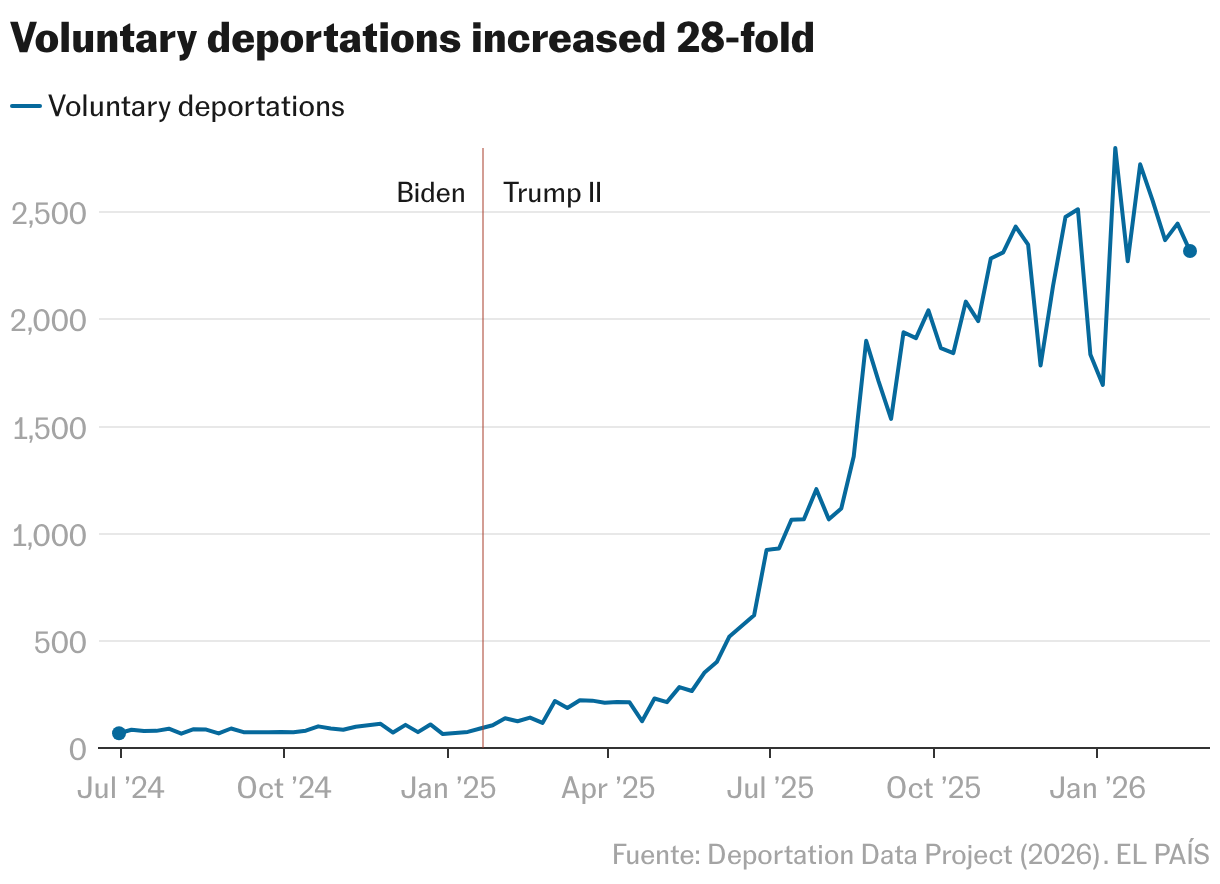
Taken together, the DDP data reveals a strategy that expands the reach of the immigration system, tightens its conditions, and accelerates its results. More than a collection of policies, what emerges is a coherent machine: detaining more people, in more places, with fewer selection criteria, and ensuring that, once inside the system, they have increasingly fewer chances of escaping it.
Sign up for our weekly newsletter to get more English-language news coverage from EL PAÍS USA Edition









































