
In the final stretch of Colombia’s presidential campaign, undecided voters are in high demand
The leading candidates are looking to attract citizens who are still considering their vote, while being careful not to lose their base of loyal supporters
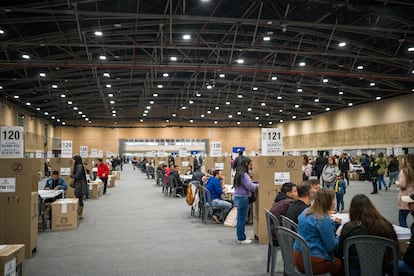

Just days remain until the first round of Colombia’s presidential election on May 31, and millions of citizens still haven’t decided which of the 12 candidates to vote for.
This heterogeneous group of undecided voters includes people with no clear political affiliation, those disillusioned with democracy, people who prefer to cast a blank ballot, young people with no interest in politics, as well as potential abstainers. Various campaigns estimate that, in this final stretch, these undecideds could represent a third of the total electorate. An analysis by independent digital news outlet La Silla Vacía (“The Empty Chair”) using microdata from polls suggests that the undecided account for around 28% of Colombian voters. Therefore, the five leading candidates in the polls have developed strategies to attract them… while being careful not to lose their base of loyal supporters.
Several political analysts consulted by EL PAÍS agree that undecided voters will play a decisive role in determining who will join leftist Senator Iván Cepeda in the second round. The battle for this spot is being waged by the right and the far-right, with Senator Paloma Valencia and criminal lawyer Abelardo de la Espriella in the mix.
Political strategist Diego Correales asserts that the latest polls, released Saturday and showing a surge in support for De la Espriella, “will be key in shaping the undecided voters, especially those torn between two similar options.” Correales explains how, four years ago, the results of those polls tipped the scales against the mayor of Medellín, Federico Gutiérrez, and in favor of the former mayor of Bucaramanga, Rodolfo Hernández, who ultimately lost to incumbent President Gustavo Petro in the second round. This time around, a key question in the electoral contest will be who is most likely to defeat Cepeda… a question that all the polling firms are asking when modeling runoff scenarios.
Augusto Reyes, director of the consulting firm Poder y Poder (“Power and Power”), maintains that the principal characteristic of undecided voters is that their vote is volatile; it can change at any moment, even in the hours leading up to the election. “They’re people without party affiliation, without ideological convictions, who are usually far from the extremes.” Reyes agrees that the main competition for their support is on the right, but insists that centrists like Claudia López and Sergio Fajardo — and even Cepeda — are seeking to secure that support with specific messages. “All the campaigns are targeting this large group [of undecideds],” he explains.
For Corrales, it’s no coincidence that, in the final days before the elections, President Petro — who has repeatedly expressed his desire to maintain the left-wing political project — has embarked on a series of interviews with major media outlets, delivering a moderate message and defending his administration’s record. “The president’s [TV appearances] and announcements are aimed at consolidating these undecided voters for Cepeda’s campaign. The goal is to gain two or three percentage points that could be decisive for the final result,” Corrales insists.
Nadia Pérez Guevara, who holds a doctorate in political science from the University of Salamanca, explains that the fact that there’s a two-round system in Colombia produces a greater number of undecided voters, because it gives citizens more time to make their final decision.
This expert mentions another factor: that a shift in political preferences has also increased the number of undecideds. “Electorally, Colombia is changing, as demonstrated by Petro’s election four years ago and the recent legislative elections (which were won by the leftist coalition). [Today], there’s a significant left-wing bloc and a very distinct right-wing bloc.”
In this realignment of forces, Pérez notes, many voters who previously voted for traditional parties or for the political center have been left adrift. “They don’t know what decision to make within the framework of the left-wing and right-wing alternatives, which — [despite being] the majority — don’t represent them.”
It’s within this context that Fajardo and López — trailing in the polls — are insisting on winning back these undecided voters. Fajardo, the former mayor of Medellín, is confident that, in the last 72 hours of the campaign, many doubtful citizens will agree that his proposals are the best option. In fact, he has publicly stated that there are recent precedents for this: “28% of voters are undecided! With just over two weeks to go, one in three Colombians is undecided. They’re unsure about what’s best for them, their families and their country. And that’s good. It’s healthy. Doubting, thinking, reflecting and getting informed, [these are] the best ways to decide how to vote. Everything is still up in the air. Anyone who tells you that the elections are [already] decided, in either the first or second round, is lying. There’s plenty of time and anything is possible!” he wrote a few days ago, on his X account.
However, Yann Basset, a political analyst and university professor, says that a significant percentage of these undecided voters are expected not to vote at all. He also explains that even many of those who already claim to have settled on a candidate won’t actually go to the polls. “Studies show that there’s a segment of the electorate that always decides at the last minute. And that’s why it makes sense for campaigns to target undecided voters… but the key lies with those who abstain.”
Basset insists that, in Colombia, where voting isn’t mandatory and almost half the population doesn’t exercise their right to vote, convincing abstainers can change the election result more than convincing undecided voters. And time is running out.
Sign up for our weekly newsletter to get more English-language news coverage from EL PAÍS USA Edition









































