
AI-generated videos flood Colombia’s presidential campaign with electoral fantasies
The surge of clips created by artificial intelligence is being driven largely by the two campaigns battling for right‑wing voters, with the left hesitating to use this strategy
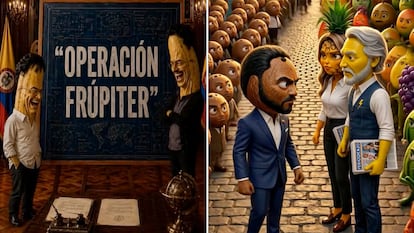

Colombia is experiencing its first presidential campaign in which every candidate has artificial intelligence at their fingertips — though each uses it in markedly different ways. While almost all of them have turned to AI‑generated videos, social media has been flooded above all by the output of two campaigns.
First, that of the far‑right candidate, the criminal lawyer Abelardo de la Espriella, known as “El Tigre” (The Tiger): he appears dancing on stages in front of videos of big cats, or transformed into a giant tiger destroying a train meant to represent traditional politics.
Not far behind is the candidate of the traditional right, the senator Paloma Valencia, who has brought several “fruit novels” — a TikTok viral phenomenon featuring characters like apples, bananas, and chili peppers — into the campaign. In Frutimbia, the senator is a cheerful pineapple facing off against the bananas of the left and the coconuts of De la Espriella.
AI‑generated videos are cheaper to produce than traditional campaign ads, which means they’re within reach of any candidate, not just the frontrunners. Those further behind in the polls have used them as well: Sergio Fajardo, the centrist candidate, made one imitating characters from Harry Potter. Mauricio Lizcano, a former minister under Colombian President Gustavo Petro, created a version of the film Encanto titled Desencanto. “They live in an unreal Colombia,” the video says about his rivals.
Even Iván Cepeda, the left‑wing senator leading the polls with a more traditional campaign, released an AI video last week in which a refrigerator says it’s happy because it’s fully stocked — a nod to the government the candidate supports.
Most of the AI videos share an overtly artificial aesthetic — tigers, fruit, or Disney‑style characters dancing. They don’t try to pass as real or mislead; they are explicitly caricatures.
“These videos aren’t trying to show reality, but a feeling,” says Juan Diego Castañeda, co‑director of the Karisma Foundation, an NGO that monitors the use of technology in power. “Politics has long been more about emotions than proposals, and these videos follow the same visual logic we’ve seen for decades, from cinema to advertising. The difference is that now candidates are saving a lot of money thanks to AI.”
Dozens of De la Espriella’s videos, for instance, are clearly fake — such as when a tiger walks among crowds. But that doesn’t stop them from appealing to voters’ emotions, especially with the narrative that the lawyer is the only candidate outside the political establishment.
They’ve been so effective that members of the traditional right have complained about the depiction of former president Álvaro Uribe in these videos. In them, he is shown in alliance with political rivals such as Claudia López — the former Bogotá mayor and presidential candidate — former president Juan Manuel Santos, and Interior Minister Armando Benedetti. It’s a fantastical image — a conspiracy theory that would be inconceivable outside AI. Yet it still feeds a narrative that divides the world into “them” and “us.”
In the campaign universe Valencia has created, she casts herself as the one who can bring different groups together — like a fruit salad. Supporters of Petro are rotten bananas, and Abelardo de la Espriella is a plantain too, just disguised as a coconut. That idea — that Petro and De la Espriella supporters are on the same team — also has no real footing outside AI.
In another video, her rivals appear as ears of corn that, when struck by the “lightning bolt” of Juan Daniel Oviedo, her vice‑presidential running mate, burst into popcorn — the center‑right voters the senator is courting to make it into the second round.
AI videos reinforce electoral stereotypes, such as portraying Sergio Fajardo as indecisive or Abelardo de la Espriella as a robot who can only repeat “loyal to the homeland.” But they also reproduce tropes that are far more problematic in Colombia’s history — depictions that would be unacceptable outside caricature.
In some videos by Valencia and De la Espriella, for instance, Cepeda is shown as a guerrilla fighter or an ally of the guerrillas. “I find this troubling, because it reinforces the prejudice and persecution of leftist parties, which are accused of being affiliated with guerrillas,” says Castañeda of Karisma.
The exception to the trend toward AI seems to be Cepeda, the candidate leading in the polls. Beyond the recent talking refrigerator, he hasn’t posted videos of fruits or animals on social media, focusing instead on giving speeches in public squares. “It doesn’t surprise me at all. His campaign probably believes his electorate isn’t online, isn’t on social media,” says Carolina Botero, an independent consultant on artificial intelligence and a member of Karisma’s board of directors.
“That contrast strongly reminds me of the 2010 Green Wave,” she adds. This is a reference to the presidential campaign of former Bogotá mayor Antanas Mockus, which focused heavily on social media messaging. Mockus reached the second round but was defeated by Juan Manuel Santos, who spent more time traveling the country, boosted by Álvaro Uribe’s popularity (back when they were still allies).
“I don’t know if that strategy will work for Cepeda, but I do know that De la Espriella’s electorate, on the other hand, is very active on social media, and that he and Paloma are engaged in a heated debate there, which is generating a lot of buzz: they need to show who’s generating more movement,” she says.
The analysts interviewed agree on one piece of good news: although these videos stir emotions, they haven’t become the massive disinformation machine many feared — at least not yet. “That constant fear we have of ultra‑realistic videos that deceive us hasn’t materialized, at least for now, into any major scandal,” says Botero.

There are exceptions. After March 8, the Colombiacheck website identified an AI-generated video showing Petro voting in an inter-party primary, despite having called for abstention. But overall, AI videos in the Colombian campaign still struggle to convincingly imitate the candidates.
“AI-generated video is improving a lot, but it still has a way to go to be realistic,” says journalist Juanita Vélez, who co-directs MioPÍA, a platform that monitors the use of this technology in Colombia. “It’s much easier to deceive people with audio,” adds her colleague, Daniela Amaya.
One example, they note, is an audio clip shared by the labor minister that purported to capture Senate president and opposition politician Efraín Cepeda plotting with the national registrar to commit fraud ahead of the legislative elections. A similar audio clip, released just days before Slovakia’s presidential vote, cost a liberal candidate the race. In Colombia, no AI‑generated audio or video has (so far) had such a decisive impact — just as in past campaigns, there have been memes and billboards spreading falsehoods.
So far, AI has shaped the campaign mainly through videos that sell fantasies and emotions. The battle is to go viral, though virality doesn’t guarantee victory. Mauricio Lizcano, the former Petro minister trailing in the polls, appears in one such video as an adorable cat. “A kitten has up to 300% more reach than hate,” the animal says while promoting his proposals. The clip has 2.7 million views on YouTube.
Sign up for our weekly newsletter to get more English-language news coverage from EL PAÍS USA Edition









































