
‘I hope our comrade Cepeda wins’: Armed groups are poisoning Colombia’s elections
Illegal pressure to influence the vote of hundreds of thousands of people resurfaces and once again is shaping the presidential race
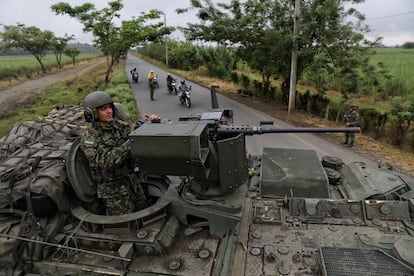

A high-pitched voice, recorded somewhere in Guaviare, at the gateway to the Amazon in southern Colombia, echoed across the country on Thursday.
“I hope our comrade [Iván] Cepeda wins, because then we’ll really put the pressure on them for another four years,” says the man, a purported leader of one of the many dissident groups of the now-defunct Revolutionary Armed Forces of Colombia (FARC).
Cepeda — the leftist presidential candidate, leading in the polls — has rejected any support from the armed groups that terrorize hundreds of thousands of Colombians every day, but the audio is a reminder of the power these underground forces can wield in an election.
Seventeen days before the first round of the presidential elections, the armed groups — which some still call guerrillas, drug traffickers, or paramilitaries — are once again entering the public discourse. They are an invisible force that can decide not only who to vote for, but also who can and cannot campaign in the territories they control.
“This goes beyond how many votes they influence; it indicates how many votes they can suppress, how much advertising they allow a candidate to run, and which candidates they prohibit,” explains Luis Trejos, a professor at the Universidad del Norte in Barranquilla.
In Colombia’s conflict-ridden regions, these criminal groups have killed mayors, council members, and community leaders over the years. And they control the ballot boxes. In smaller communities, the vote is not truly secret: with the data from each polling station, it isn’t hard to figure out whether someone disobeyed an order.
The preferences of criminal groups are not uniform; they vary by region, by election, by candidate, and by the political moment. But in this race, there is an uncomfortable reality for the left‑wing contender: many of these groups prefer him. Although Cepeda has spent his entire career denouncing the influence of illegal armed actors in the country’s political life — especially paramilitaries — he is, for them, a more convenient candidate.
While the right wing promises a hardline approach to end the violence, Cepeda represents the continuation of Gustavo Petro’s total peace policy, which has attempted to negotiate with all groups simultaneously. The results are highly questionable, and criminal organizations have continued the territorial expansion they began after the 2016 peace accord with the FARC.
“There is an interest among the groups in maintaining the negotiation tables or opening new ones,” explains a source familiar with the terrain in which they operate.
In the final stretch of the campaign, former president Álvaro Uribe and his candidate Paloma Valencia have accused the ELN and FARC dissidents of pressuring voters to support Cepeda. The allegation is not new: for years, the right claimed that the FARC helped the political left — an accusation intertwined with the genocide of thousands of members of the left‑wing Patriotic Union, including the father of Senator Cepeda.
The accusation carries its own irony: Uribe governed Colombia from 2002 to 2010 under the shadow of parapolítica, the biggest paramilitary‑infiltration scandal in the country’s history, which ended with dozens of lawmakers in his political orbit convicted for their ties to the United Self‑Defense Forces of Colombia (AUC).
Cepeda responded to the audio on Thursday — the second time in just two weeks. “It is absurd to claim that whoever wins the elections in Colombia will do so because of pressure from armed groups on voters,” he said, distancing himself from illegal actors. The candidate, Petro’s choice to carry forward his political project, added that he also has information about pressure exerted by armed groups in certain parts of the country and will share it with the authorities.
“I categorically and forcefully condemn any kind of pressure on voters,” he said in a press release following the latest revelations. “Those responsible must be investigated and punished to the full extent of the law.”
REITERO LA POSICIÓN QUE HICE PÚBLICA EN DÍAS PASADOS
— Iván Cepeda Castro (@IvanCepedaCast) May 14, 2026
IVÁN CEPEDA CASTRO DENUNCIA PRESIONES DE GRUPOS ARMADOS PARA INFLUIR EN EL ELECTORADO Y EXIGE SANCIONES
En los últimos días he recibido información proveniente de organizaciones sociales, autoridades locales y la Defensoría…
“Cepeda has had to come out and condemn these practices because the situation was already very evident in various regions,” says Trejos, the academic. “But even though he condemns them, it’s difficult for him not to benefit from these practices; he can’t just say, ‘Take those votes away from me.’”
Trejos believes the candidate has been “a bit ambiguous” about how he would handle the existing peace negotiation tables — keeping those that work and ending those that don’t. “In that ambiguity, the groups have interpreted it as meaning there will be continuity in the peace policy. And if there is continuity in that, there will surely be continuity in the security policy, one that has allowed them to grow,” he argues.
The involvement of armed groups in Colombian elections is not new, nor did it begin under the Petro government. It has been a constant in every electoral cycle, with examples going back decades. Pablo Escobar used violent lobbying in Congress to block the extradition of drug traffickers like himself to the United States, and the AUC paramilitaries captured political power in the 1990s and 2000s — to the point that their commander Salvatore Mancuso boasted of having ties to 35% of lawmakers. FARC and the ELN guerrilla have also influenced local administrations.
“This goes back a long time, and we haven’t been able to solve it,” Trejos laments. “Either because of the country’s institutional design or because state control over large parts of the territory is very weak.”
When candidates denounce the influence of armed groups, the image that comes to mind is always that of a man with a rifle forcing his neighbor to vote for someone. But the reality is far more subtle. Criminal groups are deeply embedded in the social structures of these communities, and in most cases, no one needs to point a gun at anyone to achieve the desired outcome. That less obvious form of control makes it harder to pursue and harder to report.
“You have to know the territories very well to be able to do that,” explains Kyle Johnson, a researcher at the Fundación Conflict Responses. “That doesn’t mean they have less power, because even behind the indirect methods, the weapons are still there.”
Without honest public debates that acknowledge this reality, he warns, nothing will change. Meanwhile, somewhere in Guaviare, someone has already decided who to vote for.
Sign up for our weekly newsletter to get more English-language news coverage from EL PAÍS USA Edition









































