
‘Sodomized’ gargoyles beside Spain’s world-famous Santiago Cathedral: The ‘aberration’ only the public noticed
The controversial restoration of the Hostal dos Reis Católicos, considered the oldest hotel in Spain, slipped through every administrative filter
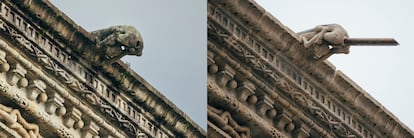

In the heart of Santiago de Compostela, steps from the city’s world‑famous cathedral, a restoration project has ignited a fierce debate over how Spain protects its heritage. Workers renovating the Hostal dos Reis Católicos — a 15th‑century pilgrim hospital turned parador — installed copper pipes straight through its Renaissance gargoyles, leaving the sculptures visibly impaled. The images have shocked locals and specialists alike, forcing authorities into damage‑control mode.
The public fury was instant. On Gargopedia — the online platform created by art historian Dolores Herrero, Spain’s leading specialist in gargoyles and chimeras — one follower summed up the mood bluntly: “When a brain can’t take any more, aberrations like this happen.” Others demanded resignations or insisted on seeing “the face” of whoever approved the intervention.
Much of the anger focused on one image that quickly dominated local media: a waterspout in the shape of a naked man who, until a few months ago (and since the 16th century), crouched with his genitals exposed while rainwater flowed out through his anus. It was a symbolic, playful gesture by a Renaissance stonemason — but now, as people describe it, he has been “impaled,” “colonoscopied,” “sodomized” by a long copper pipe installed during the multimillion‑euro restoration of the parador led by Spain’s Institute of Tourism.
This figure displays its open buttocks to passersby from the cornice of the Hostal dos Reis Católicos, the “oldest hotel in Spain,” one of the four heritage landmarks surrounding one of the most famous squares on the planet: the Plaza del Obradoiro.
To the left of Santiago de Compostela Cathedral, the gargoyles — which once spewed freely and are now encased in tubing supposedly meant to protect the Baroque balconies below, despite having poured over them for centuries — were fully revealed only after Easter Week.
Sixteen gargoyles are affected — eight on each balcony. These are whimsically carved stone spouts: monsters, animals, and human figures with teeth, tongues and, in one famous case, an exposed anus. All of them are now pierced by the copper “lances” described in the technical reports, their forms distorted yet photographed more than ever.
Word has spread so quickly among pilgrims and tourists — who at this time of year stream into the square that marks the end of the Way of Saint James (or Camino del Santiago as it’s known in Spain) — that the once‑ignored gargoyles have become selfie backdrops and targets for zoom‑happy phones.
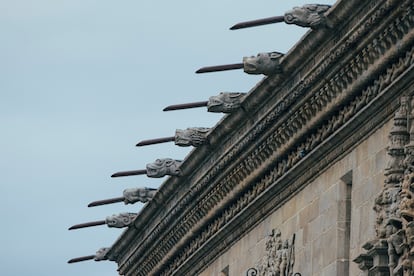
In mid‑April, Benxamín Vázquez — a retired journalist, scholar of Santiago de Compostela’s three hundred gargoyles, and author of Gárgolas de Compostela (Gargoyles of Compostela) — was the one who blew the whistle… or opened the floodgates of outrage. The tarp covering the façade began to come down “in February,” just as the second edition of his gargoyle guide was being released, and after Easter the restoration was fully exposed, he recalls.
Public anger spread quickly, and the veteran reporter alerted several media outlets to the architectural blunder. The backlash swelled like a torrent, from neighborhood groups to international architects and art historians. Among the strongest criticisms was an open letter by architect Carlos Henrique Fernández Coto, president of the Association for the Defense of Galician Cultural Heritage (Apatrigal). In a lengthy statement, he argues that the solution to the humidity problems carried out for Turespaña “introduces a visually aggressive element into one of the most sensitive ensembles in the country.”
For if Santiago de Compostela is the capital of the Spanish region of Galicia, the Praza do Obradoiro is its heart — a space “of maximum historical and symbolic significance, where every element forms part of an extremely delicate balance.” In such a place, “which does not tolerate trivialization,” Apatrigal argues, “the architect should aspire to go unnoticed.”
“Galicians are unsettled by an intervention that does not understand the place,” Fernández Coto says, arguing that “in the 21st century, there are technical solutions that do not require such rudimentary expressions,” such as “hidden conduits and integrated systems.” This is, he stresses, “a matter of social, cultural, and even civic importance.” And “it is not possible to take refuge in the technical or administrative approval of the intervention, nor in the authorization of the heritage authorities.”
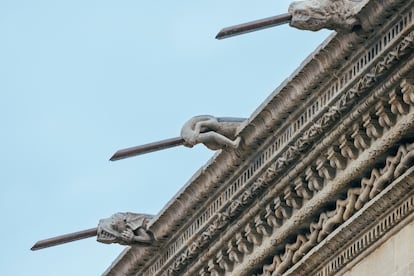
Coto tells EL PAÍS that his organization is now “calmer, but keeping a close watch on what happens next.” “Are gargoyles even necessary nowadays to drain water?” he asks via WhatsApp from Italy. “Let them be left alone as a historical artifact, and let the water be collected and drained through hidden pipes, so that the work at the zero kilometer mark of Europe goes unnoticed.”
The same word — “vigilant” — is used by an official spokesperson for Galicia’s Ministry of Culture, headquartered on the very same Praza do Obradoiro, when asked about the controversy. Apatrigal, the Ateneo de Santiago, the Fonseca Historic‑City Neighborhood Association, and the Casino Cultural Association have also just sent a letter to the International Council on Monuments and Sites (Icomos) in Spain to ensure it is aware that the figures have been altered.
As for next steps — and the three or four alternatives to the “lances” that the project leaders and administrative authorities have agreed to study — the regional government offers a terse response: “The technical teams of the Directorate‑General for Cultural Heritage and Turespaña are in permanent contact. For now, we have nothing to report.”
The meeting between Galicia’s director‑general for heritage, Ángel Miramontes, and the lead architect Fernando Cobos, along with several technicians, capped days of statements, reactions and justifications from every level of government — ministry, regional department and city hall — surrounding a project that, for four years, managed to pass through all filters and that residents have described, with a mix of mockery, anger and dismay, as “sodomitic.”
Although the renovation falls under Turespaña, the Galician regional government supervised it and issued a report authorizing the works, albeit with several observations. Before meeting with Cobos, the regional culture minister, José López Campos, explained that his technical team had warned that the façade’s humidity issues needed to be “analyzed in detail with a specific document to find the best solution — not only from an architectural and functional standpoint, but also an aesthetic one.” He then added that this documentation, which should have been provided by the ministry‑dependent agency, “was never submitted.”
Turespaña, for its part, responded in a statement that the work was included in the Conservation Master Plan, which the regional government approved in 2022 and which “sets the guidelines for all interventions on the building.” “As with all cultural‑heritage conservation projects, the different options and solutions are the result of rigorous study by those responsible, taking into account long‑term preservation, material compatibility and minimal intervention, in line with national and international conservation standards, reinforcing the project’s quality and soundness,” the state agency argued.
According to the regional culture minister, the installation of the pipes is “reversible” and causes “no irreparable structural damage.”
Dolores Herrero — author of La gárgola y su iconografía (The Gargoyle and Its Iconography) and one of Spain’s leading experts on these sculptures — traveled from Madrid to Santiago the weekend after the emergency meeting between the Galician regional government and Turespaña to see the damage for herself. She says she found “horrified people,” art lovers who “literally cried,” devastated by what they saw. The use of pipes, she explains, is not new in Spain, though typically the nozzles are far smaller; in France, she adds, “you would never see anything like this.” For her, the intervention shows no respect for the artwork and amounts to an attack on “an exceptional iconographic ensemble.”
In heritage conservation, Herrero insists, solving a technical problem is not enough — how it is solved matters. A gargoyle, she says in her latest Gargopedia video, “is not just a drainpipe,” but an image that provokes emotion like any other work of art and deserves protection. “Every shape, every gesture, every detail carries a story,” she says. “When you touch a gargoyle, you are not just touching a drain — you are touching a piece of heritage that belongs to all of us.”
Sign up for our weekly newsletter to get more English-language news coverage from EL PAÍS USA Edition









































