
Juan Manuel Santos, former president of Colombia: ‘The world is on the wrong track’
Between international forums, visits to coffee plantations and meetings with ex-combatants, the statesman reflects on peace, Venezuela, Trump, Petro and global chaos
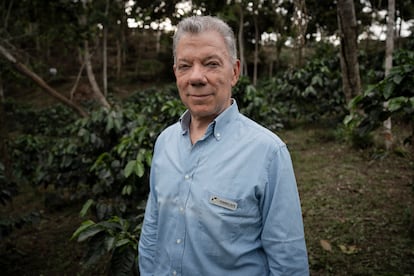
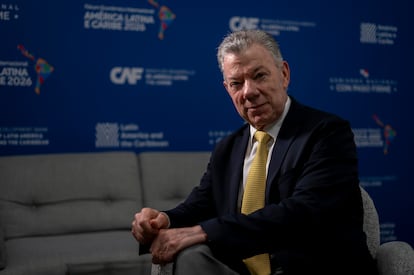
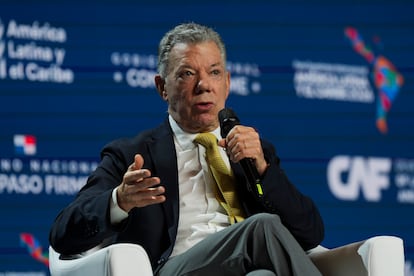
Former Colombian president Juan Manuel Santos, 74, is received like a rock star wherever he goes. A couple of weeks ago, in Panama City, three bodyguards cleared a path among the dozens of people who wanted to take a selfie with him. The Bogotá-born Santos – who governed his country from 2010 to 2018 – doesn’t shy away from anyone: he stops, smiles, listens, poses. And he asks questions, a lot of questions. In January, he was invited to the International Economic Forum for Latin America and the Caribbean. The event was organized by the Development Bank of Latin America and the Caribbean (CAF), with the support of Grupo Prisa (the publisher of EL PAÍS) through the World in Progress (WIP) forum. Santos was one of the most sought-after figures at the event. Amid greetings and expressions of admiration, it became clear that, far from retiring from the international stage, Santos is still playing the game.
His interview with EL PAÍS continued days later, in Colombia’s northern Valle del Cauca. He traveled there to meet with former FARC guerrillas, who have transformed their lives after the signing of the peace agreement, which celebrates its 10th anniversary this year. Today, they cultivate, produce, and sell coffee. Santos remained tireless during the event: he spent more than seven hours straight mentally taking notes on the successes and failures of his main legacy. “Peace and coffee are my two passions,” he smiles.
Question. You seem more active than ever. After a few years of keeping a low profile, are you still eager to be part of the conversation?
Answer. I believe that former presidents shouldn’t interfere in the electoral process. They shouldn’t cling to power, although they should be willing to collaborate on matters of national interest when required. On the international stage – which has always been very important to me – I’m very concerned about what’s happening in the world. The world is on the wrong track. The risk of nuclear war is increasing, but nobody is talking about it. Furthermore, climate change, pandemics and artificial intelligence are existential risks that are being relegated to the back burner.
Q. What did you think of the U.S. military intervention in Venezuela on January 3rd? And what do you think of Trump’s plan?
A. From a military standpoint, it was an impeccable operation. I tip my hat to them. But it was an illegal operation that violated the UN Charter, international law, and set a terrible precedent. Once again, we see one of the great powers – which created this world order to prevent wars and respect the sovereignty of nations – violating its own rules. At the same time, many people are glad that Mr. [Nicolás] Maduro – [who is] responsible for war crimes, human rights violations and corruption – is no longer in power.
Q. But the regime continues.
A. People are very surprised that [Maduro] has been replaced by people who are part of the regime that committed those crimes. There’s a dichotomy. As a Colombian, as a democrat and as someone who’s interested in Venezuela recovering its democracy and freedom, what matters to me is for a clear roadmap for the transition to be defined as soon as possible. It’s surprising that, at this point, the opposition hasn’t had a chance to participate in that process, when [they were the ones] that won the 2024 elections and were recognized by the world.
Q. Many were surprised that Vice President Delcy Rodríguez got to take power. What’s your feeling about that decision?
A. It all depends on whether this accelerates the transition. But up to what point? The colectivos (armed civilian groups) keep repressing people, and not all political prisoners have been released. To what extent has [the old system] in Venezuela actually continued? Everything will depend on the speed and the way in which the transition occurs.
Q. Do you think Delcy Rodríguez is capable of leading a democratic transition?
A. What we’re seeing is that Delcy and her brother (Jorge Rodríguez, president of the National Assembly) are taking orders from Trump. He told them, “If you don’t behave, you’ll end up worse off than Maduro.” And they’re obeying. Therefore, [things don’t] depend so much on whether she’s capable or not, but rather on what Trump tells her to do.
Q. The opposition agrees on the need for a roadmap, but not on accelerating the electoral timeline.
A. Precisely for that reason, it’s crucial to define that roadmap as soon as possible. Even if the United States says it’s controlling Chavismo [the movement that has governed Venezuela since Hugo Chávez took office in 1999] Trump should bring Chavistas and the opposition to the table and agree on a peaceful transition as soon as possible.
Q. What future awaits the Chavista regime?
A. The failure of Chavismo has been resounding. The Bolivarian Revolution was a disappointment to many people. Politically, it will be greatly diminished. I don’t see Chavismo having much relevance through democratic means in the near future.
Q. What did you think of María Corina Machado giving her Nobel Peace Prize to Trump?
A. I supported the Nobel Committee when they awarded the prize to María Corina. She was brave and stood up to a dictatorship with courage. I also support the committee when it says that the Nobel Peace Prize is non-transferable.
Q. You have championed dialogue like few other leaders in the region. How do you have a dialogue on a continent where Javier Milei, Nayib Bukele and Gustavo Petro coexist?
A. Political leaders must be able to sit down with those who think differently – whether they’re left-wing or right-wing – and find common ground that benefits the region. If the president-elect of Chile sits down with the president of Colombia, ideally, they should work together instead of insulting each other. There are many things that Latin America can resolve if it acts as a region.
Q. Are you optimistic?
A. We have to put ideologies aside. In Colombia, everyone believed the peace process with the FARC was impossible… even my own family told me not to get involved. Perseverance, when you have a goal, allows you to achieve things. But it requires leadership. I hope leaders with different positions can reach an agreement and move from words to action.
Q. What kind of action?
A. A concrete opportunity would be, for example, if Latin American countries agreed to jointly produce the military equipment that they currently purchase individually. There would be enormous economies of scale and cooperation that could also translate into a more effective fight against organized crime. Why not a drone or anti-drone factory? These kinds of concrete actions are what can bring countries closer together, regardless of their ideology.
Q. How do you see the dichotomy between a hardline approach and a long-term strategy? Are you concerned about a shift toward Nayib Bukele’s approach when it comes to security?
A. It’s an approach that can be politically effective, but in the long run, it can backfire. With the FARC, it was once said that they all had to be wiped out... and that proved to be impossible. Something similar is happening with organized crime. A firm hand is needed, yes… but with rigor and [strategy]. You can’t sit down to talk without clear objectives, or simply grant political status to criminal gangs; that’s counterproductive and, moreover, prohibited by international humanitarian law. Furthermore, a comprehensive approach is required: regaining control of the territory, investing in social programs and winning over local communities. That worked with the signing of the peace agreement. We only have to remember how [the current Colombian] hotspots were in 2017; they were havens of peace. Unfortunately, subsequent governments didn’t continue it. And the situation has worsened.
Q. Has Gustavo Petro worsened what his right-wing predecessor, Iván Duque, left behind?
A. The problem isn’t the peace agreement itself, as some say, but rather the failure to implement it. Duque campaigned against the agreement and only implemented the bare minimum. Petro promised to implement it, but instead focused on his “total peace” [strategy] at the expense of the agreement with the FARC. This has aggravated the situation.
Q. It’s been 10 years since the signing of the agreement. How do you feel about it?
A. I feel great frustration because my successors didn’t understand the need to implement it, but also great pride that it’s still alive: 86% of the signatories remain committed to it, even though almost 500 have been murdered. There’s still time. The agreement continues to be [a model] recognized by the international community, as well as a solution to many of our current problems.
Q. Senator Iván Cepeda, from Petro’s left-wing coalition, is leading in the polls in Colombia. If he were president, do you think he could get the peace agreement back on track?
A. I don’t want to get involved in the [ongoing presidential campaign]. I think the quieter and less clingy the former presidents are, the better. But since you mention it, there is one issue that interests me: I hope whoever becomes president understands that, to solve many of the problems they’ll have to face, they don’t need a constitutional reform or a constituent assembly. The solutions are already contained in the peace agreement signed with the FARC, and the agreement is already in the Constitution. It’s enough to implement it.
Q. The meeting between Trump and Petro ended up going well. Were you one of the many Colombians who held their breath before the meeting?
A. Yes. After the call between Petro and Trump, the groundwork was laid in a constructive spirit to resolve a situation that benefited no one, and that led me to think [that the in-person meeting] would turn out well, as fortunately it did. Now, agreements are expected to be finalized, especially regarding collaboration in the fight against drug trafficking and criminal groups on the border, and Venezuela’s cooperation in this fight is crucial for Colombia.
Q. Can we then speak of a peace agreement or just a truce between Colombia and the United States?
A. I hope a peace agreement, because, among other things, there’s no time for it to fall apart. Petro only has a few months left in office. And I hope what has happened serves as a lesson on the importance of putting diplomacy above ideologies and personal biases. I’m keeping my fingers crossed that this will be the case, because these are two unpredictable people… like two sparks that ignite at the slightest provocation. [Petro and Trump are] political animals who don’t mind having enemies. From a political standpoint, Petro is a good enemy for Trump to have… and Trump is a good enemy for Petro to have. What I hope is that the national interests of both countries will prevail and that this truce will return us to a stable policy of cooperation and coexistence in the long term, like the one we had before.
Sign up for our weekly newsletter to get more English-language news coverage from EL PAÍS USA Edition









































