
Javier Corrales: ‘Chavismo believes it’s possible to coexist with the United States without ceasing to be authoritarian’
The author and expert on the Bolivarian Revolution warns that the Venezuelan opposition must strongly denounce its exclusion or the country will risk remaining ‘a dictatorship’
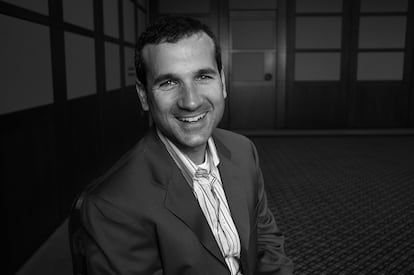
The removal of Nicolás Maduro from the presidency by U.S. Delta Force soldiers compelled the small global community of Venezuela experts to almost immediately reassess the new power map. Few are better equipped to do so than Javier Corrales (born in Puerto Rico 59 years ago to Cuban parents in exile), who has been studying the DNA of the Bolivarian Revolution for more than two decades. In 2006, he published the now-canonical article “Hugo Boss” in Foreign Policy, in which he identified the key characteristics of Hugo Chávez as a singular and effective autocrat. There, he also anticipated the logic of gradual autocratization, one of the main contemporary enemies of democracy in the world, including in the United States. Since then, Corrales has offered some of the most insightful analyses explaining the mutations of Chavismo under Chávez and Maduro.
In his book Dragon in the Tropics, co-authored with Michael Penfold, he laid out how oil was both Chavismo’s greatest strength and its main vulnerability. Today, once again, oil appears as the decisive factor in the country’s direction, to the point of aligning — at least tactically — interim president Delcy Rodríguez, Maduro’s successor, with Donald Trump, the regime’s historical enemy. Meanwhile, María Corina Machado, the opposition leader, is looking for ways to influence a game from which she has been publicly sidelined. Trump says he admires Machado, but he is satisfied with Rodríguez’s work and obedience.
The irony is brutal: in the name of a political solution, Venezuela has surrendered its sovereignty and placed the fate of its democratic struggle, at least for now, in Trump’s hands. From that moment on, the country’s democratic aspirations became tied — for better or for worse — to the calculations, whims, and limitations of the Republican president, as well as to the growing turbulence of U.S. domestic politics.
Question. Maduro’s departure was abrupt and caused by external factors. From the perspective of the gradual autocratization that you have worked on so extensively, what is the most important thing that did not fall along with Maduro?
Answer. The big surprise was discovering that they took away the dictator, but the government remained: the cabinet, the state apparatus, and the party. There are very few cases of interventions of this kind where something like this happens, and then the United States makes peace with that structure. There’s talk of a new “normalization” and concessions to the United States, but the concessions being made aren’t democratizing: they’re investments. Period. That’s why it’s difficult to use historical evidence to predict what might happen. There are very few comparable precedents.
Q. Chavismo was a laboratory for autocratization. Is it plausible to think of a gradual exit from authoritarianism under the current conditions, a phased transition, led or at least tolerated by its own Chavista elites, as Marco Rubio’s plan seems to suggest?
A. Completely plausible. Many democratic transitions happen from within. The founders of the regime are removed, and people from within the system itself come in and conclude that the only way to save themselves, their party, and their project is through gradual liberalization. That happened in Spain after Franco. Also in the Soviet Union with Gorbachev. And, in a way, in Venezuela after [Marcos] Pérez Jiménez: the military took power and quickly organized a transition. This phased transition is possible.
Q. If that scenario gains traction, what real incentives would the Chavista elites have today to cede power without exposing themselves to political or judicial retribution?
A. The first incentive would have to come from outside. These transitions usually occur when international actors demand political liberalization. That’s why it’s key to see if Washington will impose those demands. If it doesn’t, the incentives fail. The second is internal: that the government concludes it’s sinking and that it’s better to negotiate a way out before it’s too late. We don’t know how deep the wound left by Maduro’s removal was. If it generated a sense of crisis, a group within Chavismo might emerge that says: we’re in the final stage and we have to negotiate our salvation. There’s also a factor in its favor: the country hasn’t erupted into instability. When there’s chaos, the hardliners usually prevail and any liberalization is canceled. Since that hasn’t happened, perhaps Chavismo feels more secure in considering a political opening. Having said all that, today I don’t see any clear incentives: neither external nor internal.
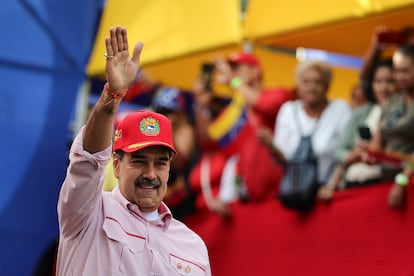
Q. The liberalization that is being hinted at seems very much controlled by the Chavista hierarchy. And there are figures like Diosdado Cabello, who negotiate and at the same time exert control. The release of political prisoners has been minimal, despite the amnesty announcement. How do you interpret that?
A. It’s important to make distinctions. What has happened with the prisoners is a humanitarian achievement, and it must be recognized as such. But it’s not an achievement of democratization. Even if the prisons were emptied, that wouldn’t mean the repressive system is being dismantled. To speak of liberalization, there would have to be a process of dismantling the coercive apparatus, and that’s not happening. The second point is the political veto. In dictatorships, certain actors are banned. In Venezuela, María Corina Machado and her party remain completely banned. At some point, that has to change: they have to sit down and talk with them. That happened in Spain, when Franco’s regime had to talk with the PCE (Communist Party of Spain). It happened in Chile, when Pinochet’s regime had to negotiate with socialists and Christian Democrats. We don’t see any of that here. That’s why there are very few signs of a democratic transition underway.
Q. As an observer of these processes, beyond cold analysis, what feeling does all this leave you with?
A. The feeling is that Chavismo believes it’s possible to coexist with the United States without ceasing to be authoritarian. Something similar to a “Vietnamization.” Vietnam went from a full-blown war with the United States to normalization: economic liberalization, but the Communist Party remained in power and maintained good relations with Washington. I think that’s one of the moves Delcy Rodríguez is considering: doing the bare minimum politically and a lot economically and commercially. In Vietnam, there were more concessions, including the release of American prisoners, but the general model is the same: the same party continues to govern and normalizes relations.
Q. It’s even beneficial for Chavismo.
A. To a certain extent, yes. Venezuela hasn’t been liberated. Who they’ve really liberated is Delcy Rodríguez from Maduro’s brutality. If the United States were demanding profound political reforms, it would be different.
Q. In retrospect, was Maduro expendable within the system or did he fulfill a glue-like function that no one can replace?
A. Everything indicates that Delcy and Jorge Rodríguez had been preparing for this. Maduro didn’t govern as a one-man dictator. He created a kind of confederation of relatively autonomous power zones. This meant the system wasn’t exclusively dependent on him. Removing that central hub creates instability, but as long as the confederations remain intact and someone quickly takes control, the system can continue to function. If this had happened under Chávez, whose government was much more personalistic, the collapse would have been greater. The other unknown was whether the rest of Chavismo would accept Delcy and Jorge Rodríguez as heirs. That wasn’t automatic, but it seems to be happening. And with that, the system is being rebuilt. Maduro prevented them from moving forward in certain directions.
Q. [Delcy] Rodríguez has been the key figure in shaping the economic framework in recent years. Many complaints concerned the sanctions and the limitations placed on progress. Lifting the sanctions will allow the oil sector to open up.
A. Delcy understands that economic reforms are necessary, along with closer ties to the United States and a reduction in inefficient dependence on Russia. Furthermore, this White House doesn’t seem to have particularly stringent human rights requirements. That makes things easier.
Q. In this post-Maduro Chavismo, do you see real cracks or rather resilience?
A. I’ll say it again: the cracks will depend on the demands of the United States. If Washington simply opens up the oil sector and moves forward, there won’t be any cracks. I don’t think anyone within Chavismo would oppose major oil deals with the United States. That was already happening under Chávez. But if the United States starts demanding elections, dismantling the SEBIN (Bolivarian National Intelligence Service), combating drug trafficking, or other reforms of that kind, cracks could appear that compromise the power of many actors within Chavismo. And we also have to see what happens if María Corina Machado or her party regain some influence, or if social protests resurface. We’re already seeing some, although they’re still very contained. If there were a new explosion, that could also open up cracks.
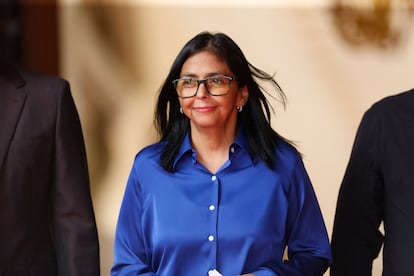
Q. What is Delcy Rodríguez’s role today? Is she managing a retreat, like Gorbachev or [former Spanish prime minister Adolfo] Suárez, or is she the architect of a new form of post-personalist control, a third wave of Chavismo?
A. I think Delcy Rodríguez has a dual personality. In public, she represents ideological dogmatism and revolutionary radicalism. But behind closed doors, she seems capable of negotiating with anyone. She achieved something extraordinary: talking with the United States before and after Maduro’s departure. We don’t know what was said, but she must have done something to convince Washington that she was the right person to stay and govern. That style has brought her enormous benefits. We have to acknowledge that.
Q. It is known that she has the backing of oilmen close to Trump and of [presidential envoy] Richard Grenell. That has carried a lot of weight. And there are stories — not yet corroborated — about why María Corina Machado did not have Trump’s support after Maduro’s removal.
A. Continuing with this delicate matter, one might even wonder if Delcy is not becoming a kind of double agent, supplying information to the United States, even about Cuba.
Q. How do you interpret the central paradox; Maduro’s military removal without a commitment from Washington to nation-building or democratization?
A. That fits perfectly with Trump. He has always detested the concept of nation-building. National reconstruction is expensive: in troops, technicians, investments, and long-term commitments. Trump wanted to do it in the cheapest way possible, almost like a DOGE model: eliminate the dictator and not rebuild the state.
Q. In an article you explained that Maduro had built rings of interests that protected him from falling: a shield. He fell, but the shield is still there and now protects Rodríguez.
A. Delcy even has an additional shield: the backing of the United States. That’s a very strong form of international legitimacy. Is it conditional? Yes, but for now that’s enormous political capital.
Q. In this context, what type of opposition leadership is more effective: one that seeks rapid ruptures or one that dismantles the system step by step?
A. There isn’t a single answer. There are times when prudence is advisable and others when it’s necessary to make noise and generate pressure. More than choosing a type of strategy, what’s important is having actors with political savvy to know when to hold back and when to act.
Q. What are the risks of having an opposition outside the core decision-making body, as is happening now?
A. The risk is that Venezuela will remain a dictatorship. There is evidence that the opposition represents at least 70% of popular sentiment. If the opposition continues to be excluded, the only way to govern is through repression. There is no possibility of openness without addressing the desires of the majority of Venezuelans.
Q. You said something key: we don’t know who is working for whom. Whether it’s the United States for Delcy or Delcy for the United States. And one of the conditions could very well have been to completely exclude María Corina Machado.
A. Many analyses focus on whether or not María Corina deserved to be included. But another explanation is simpler: that was Chavismo’s condition. Something like: you want investments and Maduro’s departure, perfect, but don’t talk to María Corina Machado. It’s comparable to [South Africa’s] apartheid [regime] saying: we’ll negotiate, but never with Mandela. That was Chavismo’s hard line, and it’s the one the White House ended up accepting.
Q. Ironic.
A. Yes. It has been speculated that Trump read her resume and rejected her. Perhaps. But the other explanation is that there was an explicit political agreement: economic openness yes, María Corina, no.
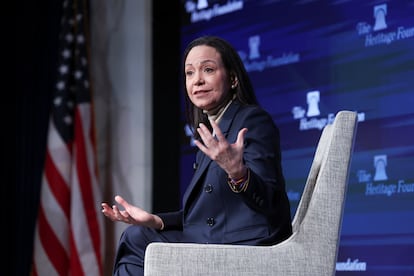
Q. How do you view María Corina Machado today after Maduro’s departure?
A. I have enormous admiration for her performance between 2023 and 2025. What she did to confront such a biased election is epic. The problem is what happens afterward, when she is left politically orphaned and a new administration in the United States actually does something for the first time. I think her mistake was not distinguishing between gratitude and subservience. She could have expressed gratitude without being overly familiar. I also understand that: she was desperate and had been abandoned by the international community.
Q. She created enormous political capital by mobilizing the vote. Can that capital be translated into a transition like the current one, or are there structural limitations?
A. She needs to do something she has always struggled with: think about a broad opposition coalition. Depersonalize the movement. For Chavismo, she is an extremely problematic figure. If she manages to dilute her centrality without losing influence, she can protect her political capital. In Chile, the socialists understood they were unacceptable to Pinochetism and relied on the Christian Democrats during the transition. It’s not a bad model to consider now.
Q. Given Trump’s stark realism and transactional nature, what should the opposition do to avoid becoming trapped in a dependency on Washington?
A. It must strongly denounce its exclusion and the lack of transparency in the agreements with the Rodríguez siblings. But it must also demonstrate pragmatism and a capacity for deradicalization. The opposition has to accept that there will be concessions. There are people prepared for that, but it needs to be shown. Transitional justice is key: it’s not about revenge, but about creating incentives for Chavismo to become a competitive political party. This idea is not foreign to a large part of the opposition.
Q. Recently, Venezuelan economist Ricardo Hausmann raised in an interview the possibility of confronting Trump if he obstructs the democratic transition. Is this a realistic strategy, or a risk that could further isolate the opposition?
A. It’s always risky to confront Trump. But something very sad has happened here for the Venezuelan democratic cause: it has lost international admiration because it is perceived as too willing to accept U.S. imperialism. Democratic forces need to shed that image, because when a democratic cause is associated with capitalist imperialism, it loses its soft power. That’s what happened to the Cuban opposition with Fidel Castro, and it still hasn’t recovered. One of the great virtues of the Venezuelan democratic movement was its moral legitimacy, its ability to garner international support. Today, with Trump practically holding the Venezuelan problem hostage, it would be healthy for democratic forces to give clear signals that they do not endorse this hijacking.
It is essential that Venezuelan democratic forces speak clearly about sovereignty. International cooperation does not mean tutelage or reconquest. Venezuela has a very strong historical tradition of defending its autonomy against empires. This was the case for decades, until Chávez came along and subordinated the country to other empires. Recovering that tradition is of utmost importance.
Q. Given that context, what advice would you give the opposition today to regain agency in such an adverse situation?
A. The only thing they can do now is publicly condemn the path being taken: a Latin American dictatorship doing business behind closed doors with U.S. economic interests. That hasn’t been seen since the era of the banana republics.
Q. Let’s play with the idea that Venezuela is improving economically and socially. Beyond elections, what three institutional indicators would you observe in five years to gauge if the country has truly emerged from authoritarianism or merely mutated?
A. First, an electoral system reform accompanied by a call for elections. That is vital. Second, the opening of formal talks with the opposition on specific institutional reforms, as happened in Mexico when the PRI began reforming state institutions alongside the opposition. And third, a reform of the coercive system. That was key in Panama after Noriega and in Colombia with Plan Colombia. It also has to happen in Venezuela.
Q. What is the greatest risk facing the opposition today? And what would you say to María Corina Machado and Edmundo González Urrutia?
A. The usual story: rapidly deflating after reaching a peak of influence without actually gaining power. It’s happened to all opposition leaders. They must occupy any available space of power, however small it may seem. It’s better to have crumbs than an empty plate.
Q. This seems unlikely, but if you were to speak with Delcy Rodríguez today, what would you say to her, thinking about the well-being of the country?
A. They are not in a “govern or disappear” situation. Chavismo can transform itself into a competitive political party. There are many precedents, from Paraguay to Panama. As long as they remain in power as they are, they will depend on repression and now also on Washington. Perhaps it would be better to rely on their electoral capacity, something that can be negotiated with the opposition.
Q. Do you see the risk of a partially integrated opposition, but without real power, that ends up serving as a symbolic alibi for a post-Maduro regime?
A. That argument is used to dismiss any pragmatism. But there are times when being inside the system gives you more influence than being outside. If getting in means sacrificing essential principles, that’s bad. But if not, you can achieve more from within than from without.
Q. Where do you draw the red line between political realism and ethical capitulation?
A. Two things are unacceptable: a regime that invests in repressing its citizens and the blocking of electoral processes.
Q. If in 10 years Venezuela is more stable and less violent, but is still built on opaque pacts, will that be a victory or an outstanding issue?
A. Transparency is better than opacity, but privacy, understood as discretion and even secret negotiation, is also necessary. In highly polarized societies, this allows political actors to compromise without public humiliation. If these agreements aim for coexistence and result in greater freedom for Venezuelans, privacy can serve a greater good. Secret agreements to divide benefits are a very different matter. Privacy must be used in a very limited and strict way. In the long term, transparency must always be the objective.









































