
Félix Plascencia, Delcy Rodríguez’s envoy to Washington: a skilled Chavista for a highly complex mission
The first Venezuelan diplomatic representative in the US in six years is tasked with rebuilding a damaged relationship. He is appreciated as a moderate diplomat, although his moderation has more to do with style than substance
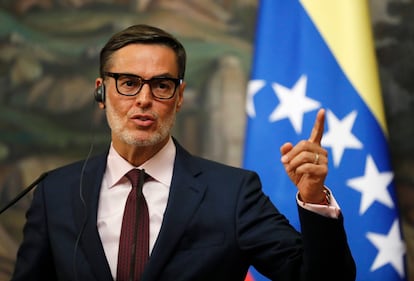
As the newly appointed Venezuelan envoy to Washington, Félix Plascencia is arriving on the most delicate diplomatic stage for Chavismo in recent years. A former foreign minister, former deputy minister, and one of the few remaining technocrats in Nicolás Maduro’s regime, the career diplomat assumes the task of rebuilding—or at least managing—a bilateral relationship that has been broken since 2019 and is now conditioned by unprecedented foreign oversight of Venezuelan authorities.
The outgoing ambassador to the United Kingdom, Plascencia is a leader who rose to the highest echelons of Venezuelan political power more through his skills and knowledge than through ideological fervor. He is a career diplomat who obtained his credentials in 1991, relying on institutional mechanisms that Chavismo dismantled after coming to power: a competitive public examination that emphasized professional qualifications.
Plascencia, who graduated with a degree in International Affairs from the Central University of Venezuela that same year, is personally and politically close to the current acting president, Delcy Rodríguez, around whom the few remaining figures of the pro-government technocracy gravitate. The two were colleagues when they worked at the Venezuelan embassy in the United Kingdom in the second half of the 1990s, during the government of Rafael Caldera, the last president of the democratic era. Plasencia also holds a master’s degree in European Studies from the University of Leuven in Belgium, and a postgraduate degree in Diplomatic Studies from New College, Oxford University.

Present in Washington, from now on, in the capacity of “diplomatic representative,” Félix Plascencia has to fulfill a complex mission: to reestablish a dialogue between the Bolivarian revolution and the North American nation, suspended since 2019, and to channel the interests —but also the differences and demands— that both nations maintain today, particularly after the military intervention to capture Nicolás Maduro and his wife, Cilia Flores, in Caracas, just a month ago.
Following that episode, the Chavista government faces a list of imposed obligations that are being overseen, against its will, by a foreign government. Plascencia’s role will consist of “working through diplomatic channels”—as Delcy Rodríguez has stated—on matters that will never be resolved by force of arms.
The son of immigrants from Spain’s Canary Islands, Félix Plascencia was born in Maracay, Venezuela’s fifth largest city, in 1972. He rose to high-ranking government positions through the influence of the siblings Jorge and Delcy Rodríguez. One of his first roles within the Bolivarian Revolution was as Secretary of International Relations for the Mayor’s Office of Caracas in 2012. At that time, Jorge Rodríguez was the mayor of the city, and his sister Delcy was the director of his office.
In 2014, with Nicolás Maduro already in power and the Rodríguez siblings’ presence in Miraflores Palace consolidated, Plascencia was appointed Director of Protocol at the Ministry of Foreign Affairs. From there, his career ascended through various levels of the revolutionary government’s power structure. In 2016, he served as Vice Minister for Asia, the Middle East, and Oceania. In 2018, he was appointed Vice Minister for Multilateral Affairs.
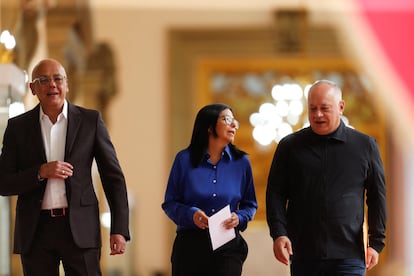
Plascencia was one of the diplomats who received and assisted the United Nations High Commissioner for Human Rights, Michelle Bachelet, during her first visit to the country in 2019. That same year, the office she headed published a report that harshly criticized the Maduro government on human rights and its handling of the Venezuelan social crisis.
On January 20, 2020, Plascencia witnessed a meeting between the then Spanish Minister of Transportation, José Luis Ábalos, and then Vice President of Venezuela Delcy Rodríguez—sanctioned by the European Union for allegedly undermining democracy in her country—aboard an airplane at Barajas Airport in Madrid. This meeting, which was held discreetly, was leaked to the press and sparked a lengthy controversy in Spain.
Appointed Venezuela’s ambassador to the People’s Republic of China in 2019, Plascencia served as foreign minister in the Maduro government in 2022; ambassador to Colombia between 2022 and 2023; and ambassador to the United Kingdom in 2024. He also briefly held the portfolio of Tourism and Foreign Trade. He was secretary general of the Alliance for the Peoples of Our America (ALBA), the subregional bloc created by Chavismo and comprised of Cuba, Nicaragua, Bolivia, and several Caribbean islands, such as Haiti and Saint Vincent and the Grenadines. Plascencia was part of the Chavista political team that facilitated dialogue sessions with the Venezuelan opposition, mediated by the Norwegian government, in 2019 and again in 2024.
In local politics, he is appreciated as a moderate diplomat, an ideal profile for handling specific political disputes or highly complex diplomatic crises. His moderation, however, does not mean he is not a revolutionary. He has supported all of Maduro’s decisions during this period, purged the offices under his responsibility by demanding ideological commitment, defended the Chavista regime against international accusations, and assumed responsibilities that entail a high level of political loyalty.
His moderation has more to do with style than substance. He possesses the diplomatic skill and sufficient international experience to handle with tact what other officials of the Venezuelan regime would carry out ruthlessly and forcefully.
Sign up for our weekly newsletter to get more English-language news coverage from EL PAÍS USA Edition









































