
Trump and Petro conclude White House meeting aimed at repairing bilateral ties
The meeting between the presidents of the United States and Colombia lasted more than two hours and was held behind closed doors
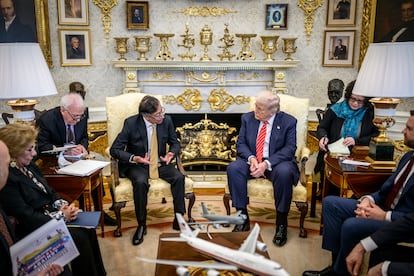
After a meeting that lasted more than two hours — which included a walk by U.S. President Donald Trump and Colombia’s President Gustavo Petro through the controversial presidential gallery of the White House — the encounter between the two leaders ended in Washington on Tuesday, shortly after 1 p.m. local time.
The meeting between the two presidents, who have clashed repeatedly over the past year, unfolded quietly, behind closed doors and without the customary reception reserved for heads of state on official visits. In those cases, an honor guard welcomes visiting leaders with both nations’ flags. This time, with the meeting classified as a simple visit, the welcome was far more subdued.
Because it was not an official visit, the Colombian president did not enter with his delegation through the North Portico, the entrance reserved for foreign leaders. Nor was he received by the honor guard that accompanies leaders during official or state visits. Petro entered through the West Wing door, which connects the presidential residence to the Eisenhower Executive Office Building, where most executive‑branch offices are located. In general, that access is used for diplomatic visits, not for heads of state, though there are exceptions. Last year, Syrian President Ahmed al-Sharaa also entered through that door.
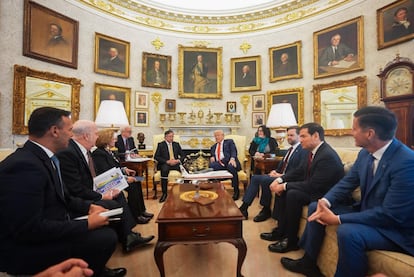
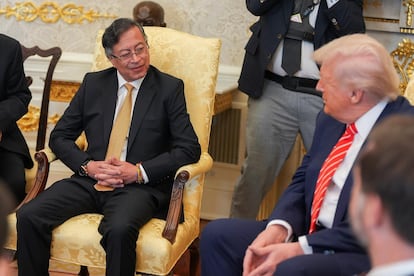
The two delegations settled into the meeting room. On the U.S. side, Trump was accompanied by Vice President J.D. Vance, Secretary of State Marco Rubio, and Republican senator of Colombian origin Bernie Moreno. On the Colombian side, Petro was flanked by his foreign minister, Rosa Villavicencio, his defense minister, Pedro Sánchez, and his ambassador in Washington, Daniel García‑Peña. Judging by the photos released to the media, the atmosphere of the conversation was relaxed.
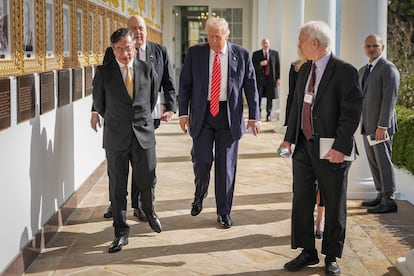
The meeting marks a turning point after months of escalating tension between the two. Several analysts noted in recent days that, given the history of disagreements and confrontations, the encounter could open an opportunity to reshape the bilateral relationship if handled with prudence, clear priorities, and a willingness to engage in dialogue.
Unlike in earlier periods, when Petro and Trump traded insults on social media, both leaders have now shown a willingness to understand one another. On the eve of the meeting, the U.S. president emphasized that after the U.S. intervention in Venezuela on January 3, Petro’s attitude had been “very nice,” and that he was looking forward to a “good meeting.”
“Petro has perhaps been the fiercest critic in Latin America of Trump’s policies on immigration, climate change, Gaza, drugs, and Venezuela,” says Lee Schlenker, an analyst on the Global South at the Quincy Institute for Responsible Statecraft. “The fact that Trump agreed to receive him at the White House as an attempt to relaunch bilateral relations is a monumental opportunity, and both leaders would be negligent if they failed to capitalize on it.”
The meeting aimed at repairing the relationship between the two leaders was expected to focus above all on the fight against drug trafficking — which the Trump administration considers one of its top national‑security priorities, along with measures against irregular migration. The Colombian head of state, whose country will hold presidential elections in May, favors confiscation, reducing demand, and alternative economic projects for small‑scale coca growers. The United States insists on crop eradication and controlling the supply.
Colombia has already conceded ground in this area as part of its negotiations with Trump and has agreed to resume bombings, extraditions, and glyphosate fumigation — actions that are highly sensitive for this left‑leaning government. Given that willingness, an agreement in this area appears the most likely outcome.
The situation in Venezuela is also a key issue — a scenario Petro knows well and for which he has already offered himself as a mediator. Colombia is essential for ensuring security along the border, and its role could be significant in opening pathways toward democracy. Beyond Trump’s interest in consolidating a democratic system in Venezuela, the Republican leader needs stability in order to carry out his economic plans in the country. Energy matters and the possibility of opening markets in Caracas are also on the agenda.
Amid the preparatory meetings, García‑Peña explained that the encounter had been in the works since the January 7 phone call — the conversation in which the two leaders reconciled after months of outbursts. That contact, he said, marked a turning point in the bilateral relationship and allowed the visit to be prepared with the goal of “ensuring it goes well for both countries.” García‑Peña acknowledged that these are two heads of state who “have had differences and will continue to have them,” but he stressed that, alongside disagreements, there are always “areas of joint work.”
The relationship between Trump and Petro had been marked by constant clashes over the past year, beginning with a public exchange of insults after Petro declared on social media that he would not accept flights of deported citizens sent from the United States. This culminated in another round of barbs following the U.S. military campaign in the Caribbean against alleged drug‑running boats during the months of pressure on Venezuela prior to the military operation.
Petro called Trump a “complicit actor in genocide” in the Gaza Strip, while the U.S. president has accused him of being a drug‑trafficking kingpin. In addition to this accusation, Trump has threatened reciprocal tariffs, the withdrawal of financial assistance to Colombia, and, more recently, military strikes against the South American country.
The tensions — which at one point led Petro to fear an imminent attack on his country — suddenly dissipated after the January 7 phone call between the two, initiated by the Colombian leader. After 55 minutes of conversation, during which Petro dominated the discussion, Trump radically shifted his tone. The Republican went on to describe it as “a great honor to speak with the president of Colombia,” who had called him to “explain the situation of drugs and other disagreements that we have had”
Sign up for our weekly newsletter to get more English-language news coverage from EL PAÍS USA Edition









































