
Petro revives his anti-Trump rhetoric: ‘Maduro must be brought back and tried in a Venezuelan court’
The Colombian president has received a temporary permit for his meeting with the Republican, scheduled for next Tuesday
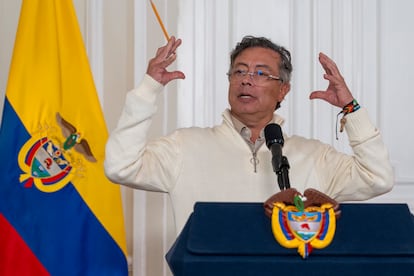

Hours after the U.S. government issued a temporary permit allowing Colombian President Gustavo Petro to visit U.S. President Donald Trump in Washington, the leftist politician revived a critical discourse against the Republican, which he had kept dormant in recent weeks. “They must bring Maduro back, and let him be tried in a Venezuelan court,” he said at a public event in downtown Bogotá. While the meeting was intended to announce a project to revitalize an old hospital, Petro ended up resuming his criticism of Trump’s intervention in Venezuela, accusing Washington of “undermining international law at missile range.”
Petro, with six months left of his term, is enjoying a period of high approval. According to the most recent polls, his approval rating has improved among citizens, from 30% or 35% last year to 45% at the beginning of 2026. “Polls say that if there were reelection, which [Juan Manuel] Santos prohibited, I would easily be president of Colombia. By a long shot... I think I’d win in the first round,” he said at the start of his speech at the San Juan de Dios Hospital in Bogotá.
The smile that accompanied that introduction underscored an emotion that framed the nearly three-hour discourse, which touched on a dog he brought back from Cuba, criticism of those who name their children with Anglophone names like Kevin or Bryan, and the COVID-19 pandemic. It also showcased his renewed critical tone toward Trump and echoed the anti-Americanism that was a fundamental part of the vision of the guerrilla group he belonged to, the M-19, which laid down its arms in 1990. “We have to tell Trump — they can’t forget this in the movies — it wasn’t the United States that defeated Hitler. It helped, yes, heroically,” he said at one point. “We have to remember that the Americans didn’t reach Berlin, and that the Americans didn’t capture Mussolini.”
“Colombians who go to the United States go as slaves,” he said later, in a speech announcing the stipends for medical interns in Colombia. “It will always be better to live in Colombia than in the United States,” he stated, before speaking about the upcoming binational meeting: “It is a key, fundamental, and decisive meeting, not only for my personal life, but for the life of humanity,” he stated.
Petro’s renewed tone also revisited his belief that Trump was planning to attack Colombia. On January 9, when a call between the two presidents defused the crisis, he had prepared a speech based on that assumption: it was a “call to action, urging us to move like jaguars the day Petro fell in the Palace guarding Bolívar’s sword. I was going to invite all the soldiers of Colombia, with or without leave, to come with their rifles and ammunition to become liberating guards.” This is an allusion to an event Petro frequently recalls: the death of Chilean president Salvador Allende, gun in hand, in the La Moneda Palace in Santiago, an episode that marked his generation.
Preparations for the meeting in Washington also hinge on Petro’s immigration status, after his visa was revoked by the Trump administration last September when he participated in a pro-Palestinian protest in the streets of New York. In a lighthearted and jocular manner, he wondered why they would revoke his visa if they were going to grant him entry again. “They took away my visa, now they say they’ve given it back: why take it away if they’re just going to give it back?” he said, even though it’s a one-off, five-day permit. What was once an affront is now a source of laughter, another sign of the change in tone.
“With Trump, you have to talk to him as an equal, not as though you were a servant,” he stated, revealing one of the motivations behind his new tone: the meeting in Washington elevates him to the status of a valid interlocutor with the leader of the superpower.
And although he maintains significant ideological differences with Trump, he also finds similarities: “He does what he thinks, just like me. He’s also pragmatic, though more so than I am. I like to talk. His views on many issues are very different from mine. But for example, on drug trafficking, we have no differences,” he said in a recent interview with EL PAÍS. And that is precisely the biggest change compared to the anti-Trump Petro of 2025: now he questions a president with whom he has spoken and who has invited him to visit in six days’ time — if the renewed criticism doesn’t derail that meeting.
Sign up for our weekly newsletter to get more English-language news coverage from EL PAÍS USA Edition









































