
The wounds and questions that remain open 40 years after the siege on Colombia’s Palace of Justice
The operation by the now-defunct M-19 guerrilla group in the heart of Bogotá, and the military response to it, left a hundred dead, a dozen missing, and a decimated judicial leadership
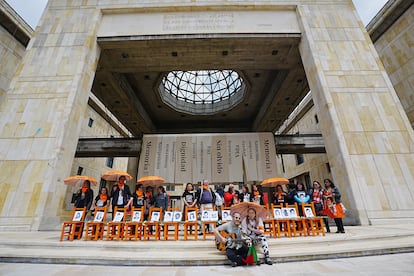

“Please help us, stop the firing. The situation is dire. (...) Publicize this so the president will give the order,” pleaded Alfonso Reyes Echandía, president of the Supreme Court of Justice of Colombia, on Radio Todelar. It was the afternoon of November 6, 1985, and the seat of the country’s judicial branch, the Palace of Justice in Bogotá, was a battlefield. Thirty-five guerrillas from the M-19, an urban group known for its media stunts, had stormed in, demanding that the magistrates hold a “trial” for President Belisario Betancur, whom they accused of betraying them in a peace negotiation that was already doomed. The reaction, which the president left in the hands of the military, was even bloodier. The building was burned to the ground, 11 of the 25 Supreme Court justices were killed, and thousands of files of all kinds were lost.
In a long history of political violence like Colombia’s, the events at the Palace of Justice remain particularly relevant, even more so than other, more recent and more deadly episodes. In 1989, for example, the drug lord Pablo Escobar blew up a plane taking off from Bogotá to Cali, killing 110 people. In 2000, paramilitaries ravaged the village of El Salado in the Caribbean region, leaving more than 100 dead, according to the Attorney General’s Office. And in 2002, the FARC guerrillas attacked the church in the town of Bojayá, in the Chocó department, murdering at least 74 civilians. The circumstances—the location of the attack, the political importance of the victims, or the visibility of what happened—make all the difference. And that is why an episode that in Colombia has been called a “holocaust” has attracted particular attention in journalism and the arts, comparable only to the assassination of Liberal leader and presidential candidate Jorge Eliécer Gaitán on April 9, 1948, and the subsequent street rioting known as El Bogotazo.
Furthermore, the judiciary has felt the attack as a lasting loss. The murdered judges were colleagues, professors, superiors, and even relatives of many lawyers of subsequent generations, and their deaths left a mark that the justice system still mourns today.
Beyond that open wound, the debate surrounding the takeover and recapture of the Palace of Justice remains so current and contentious that even President Gustavo Petro, himself a former member of the M-19 guerrilla group, is affected. While he did not participate in the takeover, Petro has defended a narrative that minimizes the responsibility of his former comrades. The issue is so sensitive that a judge recently ordered the removal of dialogue from a film about the Palace; it is so relevant that just this Wednesday, former President Álvaro Uribe Vélez, recently acquitted in a witness tampering case, proposed a new law “granting all benefits equivalent to an acquittal to the military personnel who participated in the rescue of the Palace of Justice, whether convicted or still under investigation or on trial.”
The enduring relevance of what happened four decades ago is reflected in the unanswered questions. One of them concerns the protection of the judges. Despite the revelation of a guerrilla plan to attack the Palace of Justice—a story that had dominated newspaper headlines—and the fact that several judges had received death threats, security at the Palace had been reduced on November 5. “I would like to know who gave that order,” says Ángela María Buitrago, former Minister of Justice and, as Attorney General, the lead prosecutor in the criminal investigation into the forced disappearances of a dozen people at the hands of the military.
Another unanswered question concerns the motives for the attack. The M-19 issued a proclamation from the Palace regarding what it called Operation Antonio Nariño for Human Rights. “We call for the public trial of stateless minorities who have betrayed the aspirations for peace and thwarted the demands for progress and social justice of the entire nation,” it stated in one of its central phrases, before demanding that the main media outlets broadcast the trial they envisioned. “Honorable magistrates: you have a great opportunity, before the nation, and in your capacity as the great moral compass of the Republic, to preside over a memorable trial,” it said later.
But the shadow of drug trafficking has loomed over the events since 1985, as the guerrillas shared a demand from the drug traffickers. “Through an unpopular and scandalous Extradition Treaty, our legal system is being surrendered—the most unprecedented and rapidly growing surrender of all—which is a mortal blow against national sovereignty,” reads the same proclamation. Individuals close to Pablo Escobar have said that the drug lord paid the guerrillas for the attack, trying to prevent the Supreme Court from upholding the extradition treaty, which they vehemently opposed. His former lieutenant, Jhon Jairo Velásquez, “Popeye,” is one of these sources; others have included Virginia Vallejo, Escobar’s lover, and the paramilitary leader Carlos Castaño. The question remains unanswered, as there is no proof, nor is it clear that such an atrocity would have had the desired effect. The closest thing to an answer, according to a Truth Commission formed by the high courts in 2005 to clarify the events at the Palace of Justice, is to point to this as a probable hypothesis. “Everything indicates, then, that there was a connection between the M-19 and the Medellín Cartel for the assault on the Palace of Justice,” reads its final report.
A third question is the extent to which the military wielded real power during those hours. The then Minister of Justice, the liberal politician Enrique Parejo, argued that a power vacuum existed, in which the generals decided what to do. But his then-colleague in the government, Jaime Castro, published a book arguing that no such vacuum existed, and that the decision to respond with force came from Betancur and his government, who feared that giving the guerrillas leeway would have led to a popular uprising and a seizure of power.
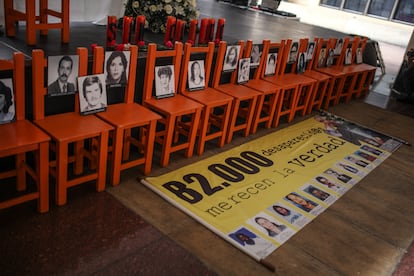
The fourth question revolves around the responsibility for each murder, each disappearance, each decision made during the more than 27 hours of fighting and fires. Investigators, journalists, and other interested parties have encountered all sorts of problems in finding sufficient evidence of what happened. In some cases, witnesses gave conflicting accounts; in others, witnesses have died—either during those days or in the four decades that have passed; in still others, the lack of ballistic evidence or the manipulation of the Palace by police and military personnel before judicial officials arrived prevented the collection of sufficient technical evidence.
Perhaps the most significant of the unanswered questions, ranging from the legal to the political, is whether the military was aware that the M-19 group was going to carry out the attack and allowed it, so they could strike a heavy blow against the guerrillas in what some have called a “trap operation.” Although the generals have repeatedly denied it, the three magistrates who led a commission investigating the events between 2005 and 2010 give credence to the idea. “The Truth Commission considers this hypothesis to be one of the most probable ones,” reads its final report. Jorge Aníbal Gómez, José Roberto Herrera and Nilson Pinilla point out that the Army was “insulted in its dignity” and “wounded in its pride” by past actions of a particularly media-savvy guerrilla group. Others have added that the military was angry with the president, who had expedited peace talks without consulting them and against their wishes.
The most complex issue, according to former minister Buitrago, is that the answers to these questions have varied, leaving a legacy of distrust and low credibility, as when the military denied knowing about the M-19 plan. And that keeps the wounds alive and open.
Sign up for our weekly newsletter to get more English-language news coverage from EL PAÍS USA Edition









































