
Four heart transplants in three days: A race against time at Madrid’s 12 de Octubre Hospital
EL PAÍS reconstructs a record‑breaking weekend of simultaneous surgeries and helicopter organ transfers to save four lives within a critical window
1
Transplant 1
Male, 62 years old, resident of Extremadura
After an arrhythmic storm, he was transferred to the 12 de Octubre Hospital and placed on the urgent heart‑transplant waiting list, category 0B — the second‑highest urgency level in Spain.
2
Transplant 2
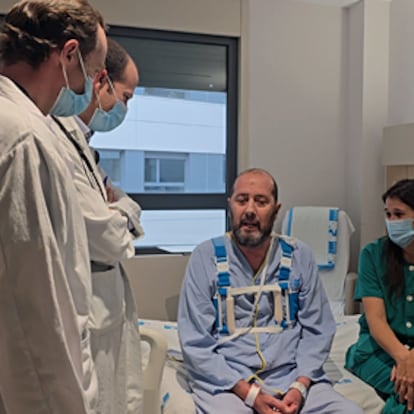
Male, 55 years old, resident of Extremadura
With very advanced severe heart disease, he was placed on the elective heart‑transplant waiting list in April 2025. After an arrhythmic storm, he required hemodynamic support with extracorporeal membrane oxygenation (ECMO) and was moved to the urgent transplant waiting list, category 0A — the highest urgency level.

3
Transplant 3
Male, 56 years old, resident of Castilla–La Mancha
He had already undergone a heart transplant at the 12 de Octubre Hospital in August 2017. After an initially good evolution during the first years, his new heart began to deteriorate progressively and did not respond to any of the therapeutic measures used. He was placed on the waiting list for a retransplant in August 2024.
4
Transplant 4
Male, 48 years old, resident of the Madrid region
He was admitted to the hospital after the onset of severe heart failure. Within the first hours of admission, he suffered a cardiac arrest that required advanced cardiopulmonary resuscitation and circulatory support with the implantation of an ECMO device. He was placed on the urgent transplant waiting list, category 0A.
Wednesday
10:00 p.m.
yellow*3
One Wednesday in autumn, at 10 p.m., the phone rang at the 12 de Octubre Hospital in Madrid: Spain’s National Transplant Organization (ONT) was calling to announce that a heart was available. A complex but finely tuned machine immediately kicked into gear — locating a recipient (the person who needs it most and is compatible), bringing them to the hospital if they are not already admitted, mobilizing teams to retrieve the organ from its place of origin, preparing the operating room, and finally transplanting the heart into the patient.
Calls like that, at any time of day or night, are fairly common at a hospital like the 12 de Octubre, one of the leading centers in Spain for heart transplants. This operation is performed between 20 and 30 times a year at the hospital. What was not normal is that barely 24 hours later, there was another call. And then another. And another. Four heart transplants in just over three days — 75.5 hours — something unprecedented.
“Those were very tense days, because heart transplants are even more time-dependent than other transplants [the longer it takes, the more complications can arise], so it creates a lot of stress,” explains María Orejana, a nurse in the transplant coordination unit at the hospital. Her department is responsible for setting up all the teams, those who go out to collect the organ, and those who will perform the transplant. They also manage the patient, with whom they are in direct contact.
Thursday
8:00 a.m.
yellow*1
The first transplant presented an additional challenge: the donor was in asystole. This means the heart was not extracted from a brain-dead person while the organ was still beating, which was the only procedure performed until 2020, when the Puerta de Hierro Hospital in Madrid carried out the first transplant in controlled asystole. This requires even more precise protocols to guarantee the organ’s viability, which were safeguarded by a team that set out for the donor’s city early Thursday morning.
4:00 p.m.
yellow*3
The organ, which was located more than 120 miles away, arrived at the hospital the following afternoon by air. All the teams involved were waiting, ready to act: anesthesiologists, the blood bank, hematology, intensive care, cardiology, cardiac surgery…
The recipient, a 62-year-old man from the Spanish region of Extremadura, was also ready and waiting in the hospital’s ICU. Selection criteria include blood type, height, and weight, which must be similar to those of the donor. Upon admission, a baseline blood test and a Covid-19 PCR test are performed, along with cross-matching by the blood bank in case a transfusion is needed.
Before any of this, patients receive information from the nursing staff about how the entire transplant process will unfold. “We reinforce everything they’ve heard in their consultations, we put faces to names, they know which healthcare professional will be in contact with them. We check their medication, their emergency contact, how transfers will work,” says Orejana. The goal is to ensure that, when the moment comes, everything happens as quickly as possible, with no last‑minute questions.
11:45 p.m.
blue*1
At 11:45 p.m., while the first operation was still underway, the second call came in. As in the previous case, the donor was more than 120 miles away, so the transport also had to be done by air — no specific dates or locations to prevent the donor from being identified.
Friday
9.00 a.m.
blue*3
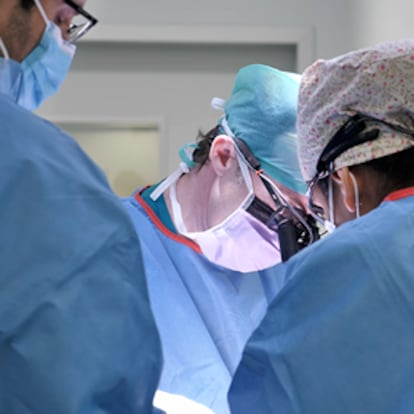
A team set out for the donor’s city, traveling to the airport in three ambulances: a cardiologist, an intensivist, a cardiac surgeon, a surgical resident, a perfusionist, and a scrub nurse. They brought everything necessary for the operation: a defibrillator, surgical instruments, a cardiopulmonary bypass pump, cannulas, preservation fluids…
Waiting for the heart in Madrid was Alfonso Pinilla, a 55‑year‑old from Extremadura who had been diagnosed with heart disease in 2017. He suffered from arrhythmias, but from 2024 onward they worsened. “It was crazy, my heart would race, it was like there was a sprite running around inside,” he says.
After several episodes of arrhythmia and four bouts of pneumonia, he was placed on the waiting list for a heart transplant last April. Permanently unable to work due to his illness, he and his wife settled in a campsite in Villaviciosa with their motorhome to be close to the 12 de Octubre Hospital in case of a crisis and a heart transplant.
12:00 p.m.
blue*1
At midday, Alfonso’s operation begins. The weeks surrounding the surgery are a blur in his mind. He remembers some things that happened, “like in a dream,” but each day brings new memories.
3:30 p.m.
network*1
What he had no idea about was that, while he was undergoing surgery, which lasted just under six hours, the hospital received another call from the ONT.
11:45 p.m.
green*1
And as the operation was winding down, another call came. “I can’t believe it, another heart,” nurse María Orejana told her colleagues. At 11:45 p.m., the entire team was mobilized again.
Saturday
7:00 a.m.
green*1
At 7 a.m. on Saturday, the medical team left for the donor’s hospital to extract the organ, while the patient, a 56-year-old man, was transferred from Castilla-La Mancha, where he lives, to the 12 de Octubre Hospital.
12:45 p.m.
network*1
The third and fourth transplants were almost simultaneous. The recipient of the fourth transplant went into surgery a few hours earlier. This time the organ was very close by, so the operation did not require the kind of large‑scale deployment used in the previous cases. The patient who was to receive it — a 48‑year‑old man living in Madrid — was on the very urgent waiting list. His heart was severely damaged. He had undergone a coronary revascularization procedure with stents — which involves opening blocked coronary arteries using small metal devices that keep the vessel open and restore blood flow — but it had not been enough. After seven and a half hours, the heart transplant operation was a success.
4:00 p.m.
green*2
And before that operation had even finished, the surgery triggered by the third alert began. The recipient had already undergone a transplant in 2017, but it was rejected and he now needed another. He had been on the waiting list for more than a year. This situation makes the surgery far more complex, explains Christian Muñoz, head of the hospital’s Heart Transplant Program.
“We perform a chest CT scan and take into account the complications that can arise during the operation due to adhesions that form within the chest and the possibility of changes in the anatomy of the cardiac structures [due to the first transplant],” Muñoz explains. The operation lasted nine and a half hours.
Sunday
1:30 a.m.
The transplant marathon ended in the early hours of Sunday morning. All of the surgeries were successful. The recipients spent a few days in the ICU and then several more weeks on the cardiac surgery ward. Three of them have already been discharged. The patient undergoing his second transplant remains hospitalized, but his prognosis is favorable.
Achieving this required enormous coordination — the kind that has made Spain the world leader in transplants for over 35 years. This coordination extends from the National Transplant Organization to each reference hospital. Mario Chico, transplant coordinator at 12 de Octubre, highlights the role of donor families, who respond “at the most devastating moment of their lives.”
Credits
Sign up for our weekly newsletter to get more English-language news coverage from EL PAÍS USA Edition