
Europe is making progress in designing its own new security architecture
The Munich Conference highlights Europe’s willingness to deepen coordination in both nuclear and conventional defense
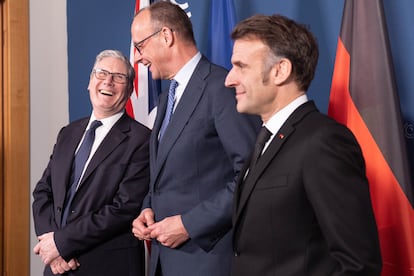
The Munich Security Conference produced multiple signs that major European countries are willing to build new frameworks for cooperation in the defense sector, both in the conventional and nuclear sphere. Among the most notable developments are the start of talks between Germany and France on extending the French nuclear umbrella — announced on Friday by German Chancellor Friedrich Merz — as well as the unequivocal expressions of intent to deepen cooperation between the EU and the United Kingdom, voiced on Saturday by European Commission President Ursula von der Leyen and British Prime Minister Keir Starmer.
The nuclear issue is undeniably significant, even if it remains in an early stage and, for now, is without even a preliminary outline of what achievable goals might look like. But the formal opening of dialogue — made with the clear premise that this is a project meant to complement the U.S. nuclear umbrella within NATO — marks a profound shift.
France’s proposal to extend its nuclear shield to a European scale dates back decades, with references to it in the time of General Charles de Gaulle. Only now has Germany decided to take up the proposal and begin discussing it, a clear sign of a changing era. European leaders have not openly questioned France’s plan for a nuclear deterrent, but while they hope for the best, they are preparing for the worst.
Another sign of a changing era — a kind of leitmotif of the Munich Security Conference — is the renewed closeness the United Kingdom and the EU seem to be seeking. “We are not the Britain of the Brexit years any more,” Starmer said, earning applause. “Because we know that in a dangerous world, we would not take control by turning inward, we would surrender it, and I won’t let that happen.”
Earlier, Von der Leyen had also expressed the EU’s willingness to deepen cooperation with other partners, especially the United Kingdom. The Commission president cited several examples of existing cooperation mechanisms with third countries.
But Von der Leyen also delivered messages directed at EU member states themselves: “Europe needs to step up and has to take on its responsibility. […] We must grow a European backbone of strategic enablers: in space, intelligence, and deep strike capabilities. No taboo can go unchallenged.”
The cost of not having a seat at the table
On Friday, Emmanuel Macron had already urged Europeans to secure a seat at the table in negotiations on Ukraine and Europe’s security architecture, firmly rejecting the idea that such a framework could be designed by others without European involvement. “Europe is practically not present at the table. It’s a big mistake to my mind,” Ukrainian President Volodymyr Zelenskiy agreed on Saturday in his address in Munich.
Another area in which Europeans are shaping a new security framework for the continent is, of course, the debate over security guarantees for a potential ceasefire in Ukraine. Skepticism in Munich about Russia’s willingness to seal any agreement was extremely high. Even so, diplomatic and planning efforts are progressing. While European leaders insist that the United States must be involved in providing legally binding guarantees, they know that achieving a practical, tangible deployment will be difficult. And that such a deployment will ultimately fall to the Europeans, with varying degrees of complexity depending on how the territorial aspects of any eventual agreement are defined.
Starmer succinctly summarized what appears to be the prevailing spirit of the times in Europe. “We do not seek conflict. Our objective is lasting peace,” he said. “And in the face of these threats, there is only one viable option. Now, to break the convention of a thousand speeches, we are not at a crossroads. The road ahead is straight and it is clear. We must build our hard power, because that is the currency of the age. We must be able to deter aggression. And yes, if necessary, we must be ready to fight. To do whatever it takes to protect our people, our values, and our way of life.”
“As Europe,” Starmer continued, “we must stand on our own two feet. And that means being bold. It means putting away petty politics and short-term concerns. It means acting together to build a stronger Europe and a more European NATO, underpinned by deeper links between the UK and the EU, across defence, industry, tech, politics, and the wider economy.”
Starmer also announced that the United Kingdom will deploy its aircraft carrier Prince of Wales to northern waters, in an operation coordinated with other partners — a move clearly in response to U.S. President Donald Trump’s interest in annexing Greenland, an autonomous island that belongs to Denmark.
While Trump has recently softened his statements on the issue, Danish Prime Minister Mette Frederiksen told the Munich Security Conference: “I think the desire from the U.S. president is exactly the same.”
Steven Everts, director of the EU Institute for Security Studies, said from one of the corridors of the venue: “The results of the past year point to the need for Europe to invest in its own strength, both materially and psychologically. There has been a psychology of weakness. Last year we made a very unbalanced trade agreement. We accepted a number of compromises, even in the negotiations on Ukraine, and one might ask whether that was the most effective approach. Then we had the issue of Greenland. It was interesting because the Europeans responded firmly. I think that demonstrates — and I have always believed this — that if Europeans are united and back their diplomatic objectives with resources, they can achieve what they set out to do.”
The Munich Security Conference heard many declarations of European resolve. Translating those words into concrete action will likely be a difficult path, as the many challenges of recent years have shown. But there is no doubt that Europeans are moving through the stages of grief, and they have now reached acceptance and reaction. Time will tell how effective that response proves to be.
Sign up for our weekly newsletter to get more English-language news coverage from EL PAÍS USA Edition









































