
Trump and Petro bury the hatchet with an hour-long call
The US president has invited his Colombian counterpart to the White House and said it was a ‘great honor’ to speak to him after months of verbal attacks

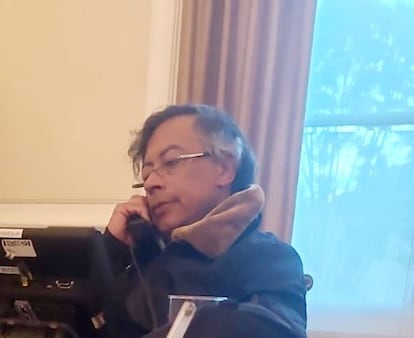
Gustavo Petro and Donald Trump ended their mutual attacks on Wednesday after a phone call lasting more than an hour. Upon hanging up, the U.S. president said it had been “a great honor” to speak with his Colombian counterpart and that he looked forward to welcoming him at the White House, a meeting his advisors are already arranging. Petro responded that Colombia can now “sleep peacefully.” The standoff between the two leaders, which had taken on a pre-war tone, has been resolved, at least for now.
Neither admitted to having been the first to call the other, but what is certain is that the phone conversation took place in a cordial atmosphere. Trump revealed on social media that Petro explained “the situation of drugs” to him and thanked him for “his tone.” The Colombian president also extended an olive branch to the Republican. When he was about to address a crowd in a packed plaza in Bogotá, he joked that he had prepared a speech but that after the call he had to write another one. Petro was much more cordial than usual and assured his audience that Trump is not “stupid” and that it was other people who had led him to believe that he was a drug trafficker or a front man for Nicolás Maduro, the Chavista leader captured on Saturday in Caracas and forcibly transferred to New York.
The reconciliation between Petro and Trump was not spontaneous. For months, according to three sources consulted by EL PAÍS, a group of business leaders, politicians, the attorney general, the foreign minister, and other individuals in the Colombian president’s inner circle have been building bridges with the Trump administration. It has been a secret effort, accessible to very few people. Any leak could have jeopardized a highly delicate diplomatic undertaking, given that two volatile figures like Petro and Trump were involved.
The confrontation between presidents, reminiscent of those between Hugo Chávez and George W. Bush, or Chávez and Álvaro Uribe — who also went so far as to speak of armed conflict—has cooled. Petro and Trump have been embroiled in months of disagreements, insults, and high-stakes insinuations. The most serious have come from the U.S. president, who has called Petro a drug trafficker, threatened to overthrow him, and added him to the Clinton List along with the first lady, Verónica Alcocer.
“Colombia is very sick, too, run by a sick man, who likes making cocaine and selling it to the United States, and he’s not going to be doing it very long,” Trump said of Petro in a conversation with reporters aboard Air Force One. In one of those verbal skirmishes, he revoked Petro’s visa to enter the United States.
Petro has repeatedly engaged in confrontation with Washington. He was the first Latin American president to call for humane treatment for deported immigrants arriving in his country in handcuffs. This prompted Trump and Secretary of State Marco Rubio to announce a trade war against Colombia. The Colombian president said he felt prepared to face such a confrontation, but his foreign minister at the time, Luis Gilberto Murillo, reached an agreement with the Republicans. In light of subsequent events, what seemed at the time to be a crisis of enormous proportions has been minimized.
Trump’s advisors and Republican congressmen subjected Petro to psychological warfare tactics. The threats were similar to those issued against Maduro, who was ultimately captured during a raid early Saturday morning in which dozens of soldiers escorting him were killed. Hours later, the feeling was growing that Petro, if he continued with his anti-imperialist rhetoric, could face a similar fate. This unexpected phone call alters the course of the crisis.
The Colombian right wing has aligned itself with Trump just months before the presidential elections. Petro accuses them of defaming him during trips to Washington, where they allegedly led the Trump administration to believe he is a dangerous leader who threatens U.S. national security — an accusation similar to the one leveled against Maduro. Petro has accused them of being “irresponsible” and of bringing the country to the brink of conflict.
The Colombian leader has not forgotten the Venezuelan situation, which he has tried to resolve countless times without success. He was the first to propose to Chavismo a kind of transition that would lead to Maduro’s peaceful departure after receiving amnesty. Maduro ignored this offer, as he has many others.
“We cannot let our guard down; we still need to talk at the White House. I also spoke two days ago with the current president of Venezuela, Delcy Rodríguez, and invited her to Colombia. We want to establish a tripartite dialogue, and hopefully a global one, to restore order in Venezuela,” Petro added.
The conversation did not prevent Petro — who had called on his supporters to demonstrate across the country Wednesday night in protest against the U.S. military intervention in Venezuela — from delivering a speech with heroic overtones. “If anyone dares to harm me,” he said, “what will happen is that the people of Colombia will enter the conflict.” In a subsequent message, Petro explained that he spoke with Trump about their disagreements regarding “the U.S. relationship with Latin America” and that he proposed a clean energy alliance. He did not provide many further details.
For days, Petro has been sharing images on his social media accounts of a jaguar, representing the defense it would offer against an attack by a condor, an animal that symbolizes the United States. References to Simón Bolívar and his sword, which is displayed in the halls of the Casa de Nariño, the presidential residence, have also become increasingly frequent. Occasionally, in his free time, he approaches the sword and observes it silently.
Comparisons to Maduro seem forced. Colombia has a consolidated democracy with a separation of powers. Presidential terms are four years and cannot be extended. In fact, Petro only has seven months left in office. An attack against him by the United States in another context would be unimaginable, but Trump’s volatility has everyone on edge. The threat seems to have dissipated. Sometimes, problems can be solved with a phone call.
Sign up for our weekly newsletter to get more English-language news coverage from EL PAÍS USA Edition









































