
The war on drugs, Trump’s double standard in Latin America
The arrest of Maduro for alleged drug trafficking contrasts with the pardon of former Honduran president Juan Orlando Hernández, convicted of the same crime
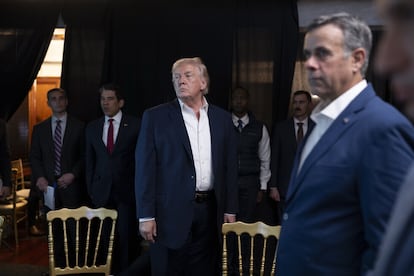

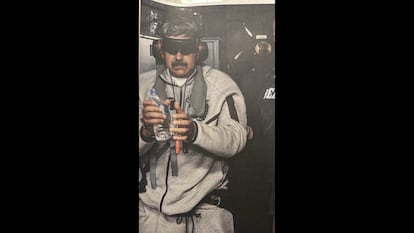
The war on drugs has returned to the forefront in Latin America, led by the United States and its president, Donald Trump, as it was decades ago. The capture of Nicolás Maduro in Caracas on Saturday, in an operation rarely seen in the region, marks this new paradigm. Drugs have once again become the number-one public enemy for the U.S., just as Islamist terrorism had been until recently. However, Trump’s recent moves reveal certain contradictions, which are exemplified by the now‑pardoned Juan Orlando Hernández, former president of Honduras.
Hernández, who was convicted a year and a half ago in New York — the same city that will host Maduro’s trial — received a pardon from Trump just a month ago. The decision was controversial, given the conviction of the former Central American leader, who governed Honduras from 2014 to 2022. The jury found him guilty of drug trafficking and possession of automatic weapons — the same crimes the U.S. justice system has charged Maduro with — and a judge sentenced him to 45 years in prison, a term that would have kept him behind bars for life. But then Trump intervened, announcing the pardon on his social media platform, Truth Social, at the end of November.
The Republican later justified his decision by claiming that the administration of his predecessor, Joe Biden, had framed Hernández. “The people of Honduras really thought he was set up and it was a terrible thing [...] I looked at the facts and I agreed with them,” the U.S. president said. Trump provided no evidence of how Biden allegedly “set up” the former Honduran leader — nor did he say which “people of Honduras” had told him this. Days later, Hernández, who belongs to the same party as the presidential candidate Trump supported in the Central American country, Tito Asfura, was released from prison.
The parallels between the case against Hernández and the one now opening against Maduro go beyond the charges themselves. In both cases, the U.S. justice system implicates one of the most notorious Mexican drug traffickers of the last 30 years, Joaquín “El Chapo” Guzmán, head of the Sinaloa Cartel. In Hernández’s case, the U.S. prosecutors proved that El Chapo’s organization, which is serving a sentence in Colorado for drug trafficking and other crimes, bribed the then-Honduran president with millions of dollars in exchange for allowing his government to use the country’s roads, coasts, and airspace to traffic cocaine.
The indictment against Maduro, originally filed in 2020 during Trump’s first term and updated and released on Saturday, alleges that the Venezuelan president, his son, his wife, and others — including Interior and Justice Minister Diosdado Cabello — “partnered” with the Sinaloa Cartel to traffic cocaine into the United States via Venezuela. The document provides examples, noting that in 2011 El Chapo financed the construction of cocaine labs in Colombia. The Revolutionary Armed Forces of Colombia (FARC) moved the cocaine produced in Colombia to Venezuela, where it was transported to airstrips — all with Maduro’s approval, who was under Hugo Chávez’s wing at the time.
The contradictions go beyond the differences in how the two leaders are treated. Neither Venezuela nor Maduro appears to play a significant role in the trafficking of fentanyl to the United States, one of Trump’s top talking points and the grounds for which he justifies his threats to regional partners, particularly Mexico. It is no secret that Venezuela serves as an exit point for cocaine produced in Colombia, and to a lesser extent in Peru and Bolivia — countries that grow coca, the raw material for the drug. But Venezuela’s role in the production and regional trafficking of fentanyl is nonexistent.
According to the United Nations Office on Drugs and Crime, only minimal quantities of the opioid were detected in Venezuela between 2022 and 2024 — nothing comparable to Mexico or Canada. The epidemic of opioid and opiate overdose deaths in the United States, which numbers in the tens of thousands, underpins Trump’s claims, but Venezuela and Maduro have little to do with it. Nor does it appear to be part of the business of the Tren de Aragua, another target of the U.S. president, which designated it a terrorist organization a few months ago. Fentanyl trafficking does not even appear in the indictment against Maduro.
What happened in Venezuela — where Maduro and his wife, Cilia Flores, were detained in an operation reportedly leaving several dozen dead — sends a warning to the region, particularly Colombia. Trump told reporters on Saturday that Colombian President Gustavo Petro should “watch his ass,” arguing that “cocaine mills” were operating in Colombia. Unlike Maduro, Petro won the Colombian elections without controversy. Furthermore, this is his final year in office, and there are no charges against him. But given the events of recent months, everything can change quickly. It all depends on Trump.
Sign up for our weekly newsletter to get more English-language news coverage from EL PAÍS USA Edition









































