
With Maduro in US custody, who governs in Venezuela?
Delcy Rodríguez, as vice president, is second in the line of succession, and her brother Jorge, president of the National Assembly, is third
With disbelief, shock, and confusion, after more than 20 weeks of political tension, Venezuela awoke to the news of the arrest of President Nicolás Maduro and his wife, Cilia Flores, following a combined military operation by U.S. forces in Caracas. The question now is what will happen to Chavismo and who will assume power.
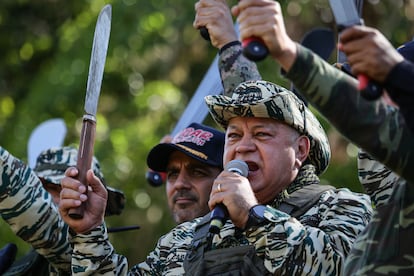
With Maduro and Flores detained, the 1999 Constitution stipulates that the vice president, in this case Delcy Rodríguez, a close confidante of the president, assumes the reins of the executive branch. Her brother Jorge Rodríguez, president of the National Assembly, is third in the line of succession. Diosdado Cabello, the country’s second most powerful figure, would retain his position as Minister of the Interior and guardian of the pro-government civilian-military establishment.
The whereabouts of Delcy Rodríguez are unclear after Reuters reported that she was in Russia. The New York Times, however, reported hours later that she was in Caracas.
The silence of the early morning was shattered suddenly and unexpectedly around 2:00 a.m. in Caracas — and also in the states of Aragua, Miranda, and La Guaira. This is the first foreign military aggression in the history of the country. Details regarding the number of casualties are not yet available. The operation targeted key locations of the Chavista regime’s civilian-military power base. According to initial reports, the attacks included the famous Mountain Barracks, formerly the Military History Museum, in the west of the city, where Hugo Chávez’s remains are interred.
Despite Maduro’s capture, the Chavista regime has yet to show any signs of cracking. The Bolivarian Revolution is deeply entrenched in the Venezuelan state, a situation that transcends Maduro’s presence in Miraflores Palace.
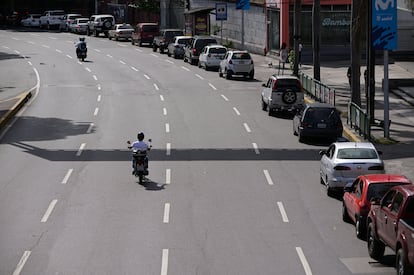
On the streets of Caracas, disbelief, caution, and fear prevail: the memory of the military repression of recent years is still very much alive. In the cities of the interior, there is calm. Security forces are gradually taking to the streets. The most outspoken members of the ruling party appeared in the early hours to condemn the announcement by U.S. President Donald Trump, demand news about Maduro’s whereabouts, and denounce violations of international law and national sovereignty.
The issue currently obsessing Chavista militants is the whereabouts of Maduro and Flores. Vice President Rodríguez demanded information about the fate of the president and his wife, and asked Trump for “immediate proof of life.” The Republican later published a photograph of Maduro aboard the USS Iwo Jima on his social media platform, Truth. Rodríguez, like other Chavista leaders, has implied that the Chavista regime is fully aware of what it must do to guarantee territorial integrity and the presence of the revolutionary leadership in power. A State of Internal Disturbance has already been declared, a measure that will militarize daily life and have clear consequences for the nation. Rodríguez emphasized that Maduro “has given very clear instructions to the Bolivarian National Armed Forces, so that, in perfect civic-military, popular, and police unity, all plans for the defense of the nation are activated.”
At the crack of dawn, Diosdado Cabello, the regime’s second-in-command, appeared on state-run Venezolana de Televisión, clad in tactical vest and helmet and surrounded by members of the political police. Cabello called the U.S. attack “treacherous and vile” and urged his supporters “not to lose their composure, to avoid despair.” “Avoid situations that favor the invading enemy,” he said. Cabello questioned the role of “international organizations” in this crisis, accusing them of being “complicit in a massacre of civilians.” The leader addressed his men on camera with the two central slogans of the regime’s security forces: “Always loyal, never traitors” and “To doubt is treason.”
Vladimir Padrino, Minister of Defense and a key figure in the Bolivarian Revolution, denounced Washington’s explicit intention to “provoke regime change” and described the events as “the most serious outrage in our entire history.” Padrino called for calm among the citizens and asked them to trust the Armed Forces. “Faced with this vile and cowardly attack, which threatens the peace and stability of the region, we issue the strongest possible condemnation to the international community so that the U.S. government is held accountable,” he said. Padrino confirmed the deployment of all the country’s military forces within the territory.
Both Venezuelan Foreign Minister Iván Gil and Attorney General Tarek William Saab called on the international community to expressly condemn the military attack perpetrated against the country. Gil demanded “an immediate statement from the UN Security Council.” Saab denounced that “many innocent civilians have been killed in this hour. This threat of bloodshed has materialized. I call on the people to be vigilant, and I call on the country’s prosecutors to be attentive to the consequences of these cowardly attacks.”
The segments of the Venezuelan political opposition that are still tolerated within the country have, so far, maintained a prudent silence. In exile, however, the situation has been different. María Corina Machado, the recent Nobel Peace Prize laureate, stated in a lengthy communiqué that they are ready to seize power. “We are going to restore order, free political prisoners, build an exceptional country, and bring our children home,” the opposition leader promised, adding that she will announce the next steps of her movement through her official social media accounts.
Sign up for our weekly newsletter to get more English-language news coverage from EL PAÍS USA Edition









































