
Venezuelans in exile: ‘This could be the end of a very dark chapter for Venezuela, but also the beginning of a time of uncertainty’
More than 400,000 people from Venezuela reside in Spain. Half of them live in Madrid
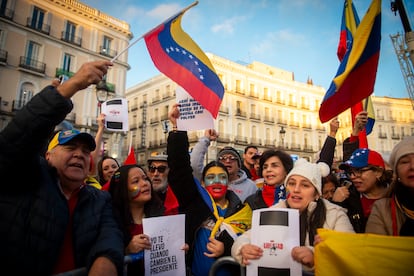

The U.S. bombing of Venezuela and the arrest of its president, Nicolás Maduro, by the U.S. military shocked the Latin American country and the world this Saturday, and its impact has been strongly felt in Spain, particularly in Madrid. According to data from the National Institute of Statistics (INE), more than 400,000 Venezuelans were living in Spain at the beginning of 2025, the latest available figure. Half of this exile is concentrated in the Spanish capital, with 200,000 Venezuelans registered in Madrid. At this moment, they are glued to their phones and computers as they try to contact their families in Venezuela and follow the situation in real time.
José González Vargas, a 34-year-old communicator, was still asleep when the news broke early Saturday morning: “My mom called me to tell me that La Carlota, an air base in the heart of Caracas, had been attacked. I checked the WhatsApp groups I share with other Venezuelans, both inside and outside the country, and they were already sharing videos and speculating about what was happening,” he recounts.
The confusion gradually gave way to the first certainties, and with them came the hope of political change in her home country: “I was a journalist for five years in Venezuela, and I’ve learned not to get carried away in situations like this. I’ve had moments of hope and disappointment in the past regarding positive change in Venezuela. It feels like anything can happen, but I’m watching with caution.”
Vargas also called for peace: “This is a critical moment, and calm and level-headedness are needed. It could be the end of a very dark chapter for Venezuela, but also the beginning of a time of uncertainty and instability.”
“Historic day! It’s over!”
Daniela Goicochea, 41, co-founder of the Goico burger chain, summed up her feelings to this newspaper in two words: “Historic day!” The businesswoman drew a parallel with some of the most important moments experienced by Venezuela in recent decades, such as the death of former president Hugo Chávez: “I have that feeling again that it’s over. From the outside, we’re calm for now because we know our families are safe. We’re all waiting for Trump’s announcements. But we’re already celebrating.”
Zuleika Meneses Gómez, a 34-year-old environmental engineer and political activist in Spain, learned of Nicolás Maduro’s capture while coordinating, along with other Venezuelans in Missouri, the dissemination of information that many within the country were afraid to publish. “We were monitoring to make sure the teams in every corner of Venezuela were safe and that nothing had been done to our political prisoners in the torture centers,” she explains. She says she feels a mix of hope and concern: excitement at the possibility of returning home someday, but also unease about the continued hold on power of figures like Interior Minister Diosdado Cabello, who has called on Venezuelans to protest against the U.S. attack.
For Meneses, the impact is especially personal. She says she has been involved in political processes since her youth and recounts that she had to leave Venezuela three days before the 2024 elections after receiving threats. Her entire family now lives in exile, and one relative was imprisoned for a year.
“We feel a certain sense of justice,” she says. Still, she insists that this is only the first step and hopes that more arrests will follow, that opposition figure Edmundo González will assume the presidency, and that all political prisoners will be freed. Only then, she says, will many Venezuelans abroad consider returning home.
“This regime has many heads”
Meanwhile, Alessandro Di Stasio, a Venezuelan investigative journalist at Armando.Info and resident in Madrid, urges caution regarding Nicolás Maduro’s capture. “This regime has many heads. Nicolás may be gone, but until we know where the others are, we cannot declare victory,” he warns.
He believes the U.S. may have acted following a still-unknown political plan and points to two possible scenarios: that the operation is meant to present U.S. President Donald Trump as the winner and reduce military tension, or that it is part of a negotiated transition supported by sectors of the armed forces. Regarding the messages spread by leaders such as Vladimir Padrino López or Delcy Rodríguez, he believes they were aimed at asserting control over the military and their own supporters.
Sign up for our weekly newsletter to get more English-language news coverage from EL PAÍS USA Edition









































