
Has the democratic transition begun in Venezuela?
It remains uncertain whether Maduro’s removal will lead to a regime change, as the ruling elite still controls the territory and the armed forces
Just when there were fears in Venezuela that the U.S. operation against Nicolás Maduro had stalled, U.S. President Donald Trump announced early Saturday morning, January 3, that the dictator had been captured and taken out of the country, along with his wife, Cilia Flores.
Minutes later, Vice President Delcy Rodríguez made a phone call where she appeared to confirm that they had no contact with the dictator and demanded proof of life from him and his wife.
Fragments of information have gradually painted a picture of what may have been the operation that Trump called successful. Around 1:50 a.m. in Venezuela, explosions were heard. Witnesses reported seeing plumes of smoke rising from the country’s main military installations in Caracas, such as Fort Tiuna and the Generalísimo Francisco de Miranda Air Base. Residents of Caracas also reported hearing aircraft flying overhead.
A video showed seven Chinook helicopters, used in extraction operations, flying over the city. Meanwhile, explosions were reported at the port of La Guaira, located about 20 minutes from Caracas.
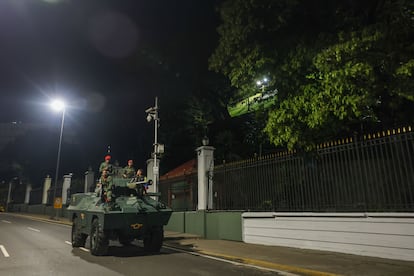
Two hours after the first explosions, the Maduro regime issued a statement acknowledging the attack. Three hours later, a recorded address was broadcast by Defense Minister Vladimir Padrino López, who confirmed the declaration of a state of emergency in the country.
Trump said there would be more information at 11 a.m. Florida time.
In previous weeks, Turkey had been suggested as a possible destination for an exile that Maduro might have been negotiating. However, U.S. authorities have stated that he will be tried in the United States.
The Venezuelan Constitution stipulates that if the head of state is permanently absent, the vice president assumes power, provided this absence occurs before the midpoint of the presidential term. In 2013, following the death of president Hugo Chávez, a snap election was held, which brought Maduro to the presidency.
Following the fraudulent election of July 28, 2024, Maduro assumed a third term. The presidential term in Venezuela is six years. The vice presidency is not an elected position; the vice president is appointed by the sitting president.
While events are still being reconstructed, many questions remain. In previous reports, Maduro allegedly offered Delcy Rodríguez the opportunity to lead a transition. This possibility has been rejected by the leaders of the democratic forces: president-elect Edmundo González Urrutia and his designated vice president, María Corina Machado, who in December was escorted out of the country by a special forces unit to Oslo to receive the Nobel Peace Prize.
More than four hours after the attacks, Interior Minister Diosdado Cabello issued a statement saying that troops were deployed throughout the country. The only member of the Chavista leadership absent was the president of the National Assembly, Jorge Rodríguez, who has always played a negotiating role.
At first glance, it’s unclear whether Maduro’s overthrow will signal a regime change. The ruling elite maintains territorial control and control of the armed forces. As of Saturday morning, there were no reports of demonstrations in Caracas for or against the U.S. military action.
It’s possible that Maduro, following Chávez’s example in April 2002 when he was ousted in a coup, will seek to negotiate until the very last moment. However, on that occasion, the mobilization of Chávez’s supporters and the participation of military personnel loyal to him were crucial. Nevertheless, unlike Maduro, Chávez was the country’s constitutional president.
Sign up for our weekly newsletter to get more English-language news coverage from EL PAÍS USA Edition









































