
Key points of the military attack on Venezuela: Early morning bombings and a ‘captured’ president
Trump ordered a ‘large-scale strike,’ while Caracas has declared a state of emergency
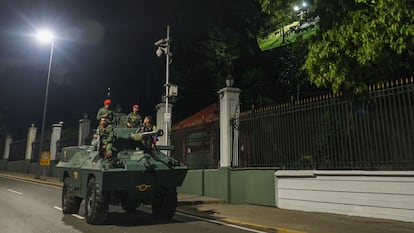

The United States launched a military attack on Venezuela on Saturday and “captured” its president, Nicolás Maduro, according to U.S. President Donald Trump. Here’s what is known so far:
How did the attack happen?
Around 2:00 a.m. local time on Saturday several explosions occurred at various points in Caracas, the capital of Venezuela. A U.S. administration official, speaking on condition of anonymity, told Reuters that the explosions were bombings carried out by order of the White House. Two hours later, U.S. President Donald Trump posted a message on his social media platform Truth Social, confirming it was a “large-scale strike” ordered by him and announcing that he would provide more details at 11:00 a.m.
Colombian President Gustavo Petro posted a list on social media of the locations reportedly bombed. One of them is the Cuartel de la Montaña in Caracas, a military base that houses the mausoleum of Maduro’s predecessor, Hugo Chávez. This site is considered one of the most sacred for Chavismo. The list also includes the Federal Legislative Palace, several airports, various points in the capital, and at least four Venezuelan military bases. Petro added that the urban center of Caracas has been left without electricity.
Where is Maduro?
Venezuelan President Nicolás Maduro and his wife, Cilia Flores, have been “captured” and were flown “out of the country,” according to Trump’s brief statement on Truth Social. Prior to this announcement, it had been reported that the Venezuelan government had declared a state of emergency and called on its citizens to defend the country.
“President Nicolás Maduro has signed and ordered the implementation of the decree declaring a state of emergency throughout the national territory, to protect the rights of the population, the full functioning of republican institutions, and to immediately transition to armed struggle,” Venezuelan authorities stated in an official statement. “The entire country must mobilize to defeat this imperialist aggression.”
The official statement, which did not specify whether there were any fatalities, said that the strikes took place against civilian and military locations in the states of Miranda, Aragua, La Guaira, and the capital, Caracas. It also ordered “the deployment of the command for the comprehensive defense of the nation.” “The objective of this attack is none other than to seize Venezuela’s strategic resources, particularly oil and minerals,” argued the statement.
What is the Venezuelan opposition saying?
Sources close to the Venezuelan opposition in exile told this newspaper early this morning that they did not plan to comment on the military aggression against their country and would wait for more information. “At this time there is no official statement regarding the events reported in Venezuela,” said the official spokesperson for opposition leader María Corina Machado and Edmundo González Urrutia.
What are other countries saying?
Colombian President Gustavo Petro has condemned the U.S. aggression against Venezuela, urging “all parties involved” to contain the escalation and calling for an urgent U.N. meeting. The Iranian regime has also strongly condemned the operation, calling it “illegal,” as has the Cuban government, which demanded an “urgent” response from the international community. “State terrorism against the brave Venezuelan people and against Our America,” Cuban President Miguel Díaz-Canel wrote on social media. Former Bolivian President Evo Morales asserted that “Venezuela is not alone.”
Argentine Javier Milei, on the other hand, celebrated the U.S. attack and the capture of Maduro with this message: “Freedom advances. Long live freedom, damn it.”
The Spanish Ministry of Foreign Affairs, headed by José Manuel Albares, issued a statement calling for “de-escalation and moderation” and urging everyone to “always act in accordance with International Law and the principles of the Charter of the United Nations.”
Sign up for our weekly newsletter to get more English-language news coverage from EL PAÍS USA Edition









































