
Pressure from Trump: María Corina Machado’s strategy to force a transition in Venezuela
In recent months, the opposition leader has joined the Republican’s efforts to pressure Maduro to relinquish power
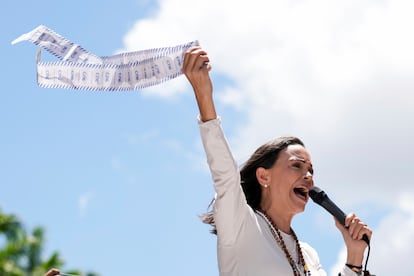

María Corina Machado has made U.S. foreign policy the central platform of her strategy to bring about a transition in Venezuela. Since July 28, 2024, when the opposition presented the official records declaring Edmundo González Urrutia, Machado’s chosen representative, the winner of the presidential election, the most troublesome opposition figure for Chavismo has received a new boost: renewed attention from Washington. But even there, it is unclear what this support will lead to; a military intervention, a surgical coup, or will it be limited to air maneuvers and targeted attacks in the Caribbean? In this gray area between diplomatic support, displays of force, and ambiguous messages, Machado has built her narrative. “Venezuela’s freedom is near,” she said in October, upon learning that she had won the Nobel Peace Prize, an award she is expected to receive in person this Wednesday in Oslo, Norway.
The Venezuelan opposition leader has aligned her rhetoric with every move made by the Donald Trump administration. She has supported Washington’s most frontal offensive against the Nicolás Maduro government and integrated it into her strategy of psychological pressure on Chavismo. The demonstration of electoral fraud — insufficient thus far to break the ruling party — has become a starting point for Machado: with the regional shift to the right and the U.S. military deployment, Machado is once again raising the issue of a “credible threat,” a scenario in which the Chavista elites must choose between negotiating or risking their own survival.
That concept, which the opposition leader has championed for years, has now taken on a military dimension. The presence of 20% of the United States naval force off the Venezuelan coast has been hailed by Machado as a necessary step in cornering Chavismo. Her narrative insists that each additional pressure — from air maneuvers that have emptied Venezuelan airspace to the destruction of vessels linked to drug trafficking — brings the regime’s downfall closer. “We are on the threshold of a new era,” she has repeatedly stated.
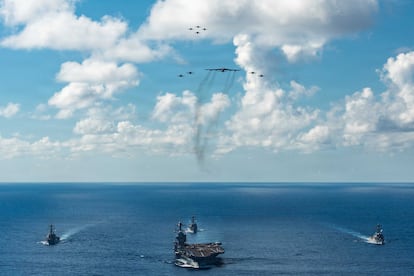
In the opposition’s narrative, Maduro’s loss of legitimacy following the 2024 electoral fraud justifies these forceful measures. Machado maintains that the aim is not to pressure an authoritarian government, but to confront a “criminal structure” — supported by drug trafficking networks, smuggling, and armed groups — that controls Venezuela. For this reason, she has echoed the framework of the fight against drug cartels that the United States has used to justify its military offensive in the Caribbean.
The evidence for the accusations is elusive, but during the Maduro regime, criminal groups involved in gold smuggling in the south of the country, Colombian guerrillas linked to drug trafficking, and extortion networks have gained power and seized territory in Venezuela. Chavismo has also been accused of supporting groups considered terrorist organizations, such as Hezbollah, which explains why Machado backed Israel in the war in Gaza, taking a firm stance in favor of Trump’s policies.
Machado insists that Venezuelans cannot stand alone against a state that, she alleges, operates as a violent and repressive apparatus. This is not a new stance.
In 2019, when more than 60 countries refused to recognize Maduro’s reelection, the opposition leader unsuccessfully promoted the activation of the Inter-American Treaty of Reciprocal Assistance, a coordinated regional response that would act as a superior force to topple the regime. This was interpreted then — as it is now — as a call for military intervention in the country. “It is clear that he will not relinquish power except in the face of a real threat from a force superior to the one they are using to kill and destroy Venezuela,” Machado said in 2019.
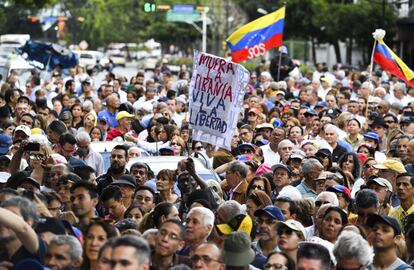
This is what the opposition calls “the credible threat.” Then, the pressure came in the form of economic and individual sanctions. Today, it is military operations, attacks on drug-running boats, financial strangulation, the closure of airspace… How far the pressure can go is anyone’s guess. Trump has hinted at the imminence of ground operations inside Venezuela, a blurry line that has not yet been crossed.
The United States has further escalated the situation by offering bounties on high-ranking Chavista officials and linking them to the Tren de Aragua criminal network and the Cartel of the Suns, an alleged drug trafficking organization with supposed links to the upper echelons of the Chavista regime. Several governments in the region have supported designating these groups as terrorist organizations, while Colombia and Brazil — whose mediation efforts after the last elections failed — are urging people to avoid open warfare. This unprecedented scenario involves the possibility of combating drug trafficking militarily.
Machado, however, insists that the transition can still be “peaceful and orderly” and that it is necessary to cut off the regime’s illicit sources of financing. “When those flows start to dry up, the structures begin to crack,” she said recently. That is, in essence, her interpretation of Washington’s offensive: a siege that, if sustained, could force the change that neither voting nor dialogue has achieved.
Sign up for our weekly newsletter to get more English-language news coverage from EL PAÍS USA Edition









































