
Flights suspended, families stranded: The air travel chaos driving Venezuelans to the border
Trump’s offensive has left the country virtually cut off from the world ahead of the Christmas holidays
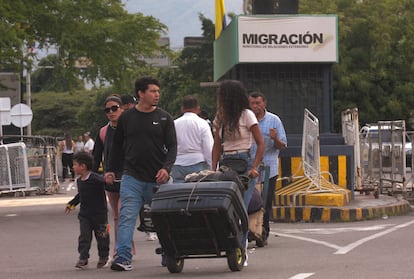

María Cordero should be preparing for her arrival in Caracas for the Christmas holidays, but she’s at home in Spain, checking her airline’s notifications every few hours. Her direct flight to Venezuela was canceled, and the only alternative they’re offering her now is to land in Bogotá and, from there, continue to the border and cross on foot into Cúcuta, the Colombian city that has become the de facto new international gateway for Venezuelans. “They hit us where it hurts,” she says. Her disrupted itinerary is now the reality for thousands of passengers trying to return to — or leave — a country that has been practically cut off from the world.
Over the past two weeks, Venezuelan airspace has emptied, becoming a sky without planes. Restrictions imposed by the United States on commercial operations around Maiquetía — the country’s main airport — have left Venezuela practically isolated. Connections with Europe are effectively closed, and the routes that remain active depend on very few hubs: Bogotá, with dwindling frequencies, and, until last Wednesday, Panama, whose airlines temporarily suspended flights due to intermittent navigation issues.
With Maiquetía Airport reduced to a handful of destinations — Curaçao, Barbados, Manaus, Cancún, St. Petersburg, and Moscow — the country has shifted much of its international traffic to an unexpected location: the small airport of San Antonio del Táchira, on the border with Colombia. There, weekly passenger traffic has increased from 3,500 to more than 5,000. Travel agencies are already selling packages that include assistance crossing the Simón Bolívar International Bridge to the airport in Cúcuta, which has been converted into a makeshift international terminal for Venezuelans. Local airlines will double their flight offerings in December and January to meet the demand at a terminal that was closed for 11 years and reopened just two years ago.
This border diversion doesn’t just affect those trying to return home. It has also trapped those who urgently need to leave. Stefania Chehade was stranded in Panama for three days, waiting to continue her journey to Venice, where she was to participate in a Biennale program. She had a ticket with Venice as her final destination and accepted the change of origin offered by her airline. She bought an additional ticket to fly to Panama from Caracas, but upon arriving at the check-in counter, she was denied boarding due to alleged irregularities in her documents.
Chehade maintains that everything was in order: “My documentation was completely valid, current, and in full compliance with the official entry requirements for Spain for transit passengers, as well as for entry into Italy, my final destination. Even so, staff denied me boarding without explaining the reason, without providing me with a written justification, and without offering me assistance.” After three days of ordeal, Chehade bought a ticket to return to Caracas, just before Copa Airlines also suspended this route until at least December 12.
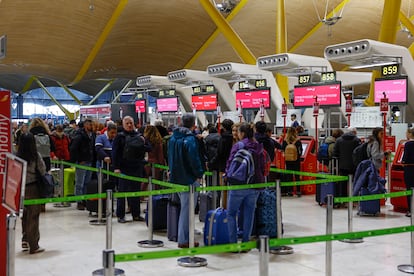
Similar situations are unfolding at airports across the country. In Madrid, dozens of Venezuelans remain stranded at Barajas Airport, waiting for rescheduled flights or consular assistance. The diaspora has organized to bring food and some support to those who cannot afford accommodation. Among those stranded in Madrid is 75-year-old Clementina Urosa, who was visiting family in Spain and now has no return date. “They say flights will resume on December 31, but I can’t imagine myself hopping there that day, and then to get to Venezuela via Bogotá, I don’t have the money to pay for a ticket. It takes a took on your wallet,” says Urosa, who has been staying at her brother’s home. “I’m in limbo.”
The scale of the problem is enormous. Just between Caracas and Spain, 36 weekly round-trip flights were scheduled, each carrying around 300 passengers. The sudden suspension has left thousands stranded or holding tickets that are no longer valid. European airlines that have stopped landing in Caracas, such as Air Europa and Iberia, are offering changes of origin and destination or refunds to passengers, but each adjustment involves new stops, additional costs, and uncertainty about whether these routes will remain open.
The only flights arriving from the United States are those carrying deported Venezuelans, which, according to Venezuela, Washington requested be resumed amidst the political tensions. The crisis is deepening, and stranded travelers are trying to continue their plans through other means, in the midst of total uncertainty.
The collapse of air travel has become one of the most visible elements of the pressure the United States is putting on the Chavista regime of Venezuelan leader Nicolás Maduro. On November 22, airlines temporarily suspended operations following a warning from the U.S. Federal Aviation Administration regarding increased military operations in the region until February 2026. Subsequently, Venezuela revoked the flight licenses for eight airlines — Air Europa, Iberia, Plus Ultra, Turkish Airlines, Avianca, Latam, TAP, and Gol — for having joined, according to the government, Washington’s “acts of state terrorism.” But the cascade of cancellations has continued, now fueled by Donald Trump’s declaration last weekend, in which he declared Venezuelan airspace closed.
While U.S. military planes patrol the Caribbean coast, the tourism industry is trying to salvage the season. On Isla de Margarita, a prime beach destination, local authorities say the suspension of charter flights for Russian tourists will not have a significant impact. “We have the advantage that at this time of year we expect mostly domestic tourists,” says Antonio Abreu, president of the Nueva Esparta Chamber of Tourism. Every 10 days, 400 Russians will arrive at this beach destination. Amid the U.S. military presence in the Caribbean, the island expects 110,000 visitors this season — a 30% increase over 2024 — and between 70 and 100 weekly flights, including some from Trinidad and Tobago. Tickets from December 19 to January 12 are completely sold out, Abreu confirmed.
The few airlines still operating have rescheduled flights to maintain daytime service, avoiding nighttime departures, and insist that the interruptions have not compromised safety. The National Institute of Civil Aeronautics reiterated that it would continue “monitoring the airlines that continue operations in the country, reaffirming the operability and safety of Venezuelan airspace.”
Amid the conflicting statements and military decisions made in distant offices, the effects are felt on the ground: in the cancellation emails María receives, in the tickets Stefania can no longer use, in Clementina’s sleepless nights at Madrid’s Barajas Airport. Venezuela is returning to a familiar state in an exceptional situation: limited connections, uncertain plans, and travelers forced to cross borders just to catch a flight.
Sign up for our weekly newsletter to get more English-language news coverage from EL PAÍS USA Edition









































