
US militarization of Puerto Rico amid Venezuela tensions reopens historical wounds
The deployment of 5,000 soldiers and the reopening of a base revive fears tied to the 60 years Vieques served as a training camp and artillery range
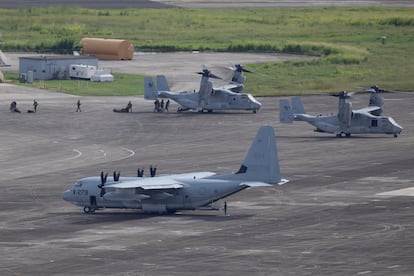

For more than half a century, a 163-square-kilometer U.S. territory in the Caribbean Sea was repeatedly bombarded by the American military. From the 1940s until the 2000s, 2,000 tons of ammunition fell every year on Vieques, a small island in the Puerto Rican archipelago. The U.S. Navy transformed this Caribbean paradise of crystal-clear waters into the most realistic recreation possible of a war zone: after expelling thousands of residents and taking control of two-thirds of the island and its resources, the navy established there a training base and a firing range to conduct artillery tests and other military exercises that terrorized the local population, forcing them to live amid explosions on a narrow strip of land.
After one of those bombs killed a civilian, massive protests forced the navy to withdraw from Vieques in 2003. Although routine military exercises have continued in Puerto Rico since then, the militarization the island experienced during World War II and the Cold War — periods when the territory served as a U.S. military stronghold due to its strategic location in the Caribbean — was not seen again. Until now. Amid escalating tensions with Venezuela, the United States has increased its military presence in Puerto Rico and surrounding areas, while also reopening military bases on the territory.
General Dan Caine, chairman of the Joint Chiefs of Staff, was in Puerto Rico on Monday. The Pentagon stated that the purpose of the visit by the top U.S. military commander was to thank the troops stationed in the territory ahead of Thanksgiving, which is celebrated on Thursday. However, according to The New York Times, Caine is scheduled to meet with soldiers and senior officers from Southern Command to assess the readiness of the deployed forces.
The U.S. Southern Command is in charge of the military deployment that Donald Trump has ordered in the Caribbean, as the United States considers options to force the fall of Venezuelan President Nicolás Maduro, whom it officially considers an illegitimate leader linked to drug trafficking to the U.S. Five thousand of the nearly 15,000 U.S. troops sent to the area are stationed in Puerto Rico for what the Trump administration has characterized as a counter-narcotics operation. This operation has included the sinking of at least 21 alleged drug boats in extrajudicial attacks that have killed more than 80 people.
Caine’s trip to Puerto Rico comes at a time when the Trump administration has alluded to the beginning of a “new phase” in Operation Southern Spear. This could include for the first time actions inside Venezuelan territory. At the same time, the prospect of a telephone conversation between Trump and Maduro to explore the viability of a diplomatic solution has also been opened, according to sources familiar with the situation, cited by Axios.
This week’s visit marks Caine’s second trip to Puerto Rico in recent months. The chairman of the Joint Chiefs of Staff was in the territory on September 9 with Secretary of Defense Pete Hegseth. Both were received by Puerto Rico’s governor, Jenniffer González, a staunch Trump ally. The governor, from the conservative New Progressive Party (PNP), which advocates for Puerto Rico to become the 51st U.S. state, has supported the increasing militarization of the island.
“We thank President Trump and his administration for recognizing the strategic value Puerto Rico has to the national security of the United States and the fight against drug cartels in our hemisphere, perpetuated by the narco-dictator Nicolás Maduro,” González said in September.
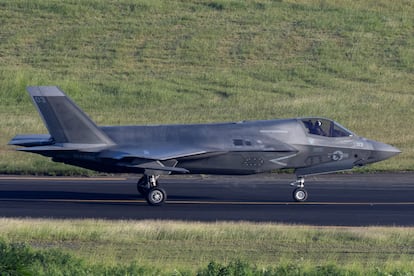
Since late August, F-35 fighter jets, naval destroyers, and combat helicopters have arrived in Puerto Rico, and amphibious training exercises, flight operations, and landing and infiltration maneuvers have been conducted. The largest and most advanced U.S. aircraft carrier, the USS Gerald Ford, and more than a dozen other warships have also been deployed in Caribbean waters.
Open wounds
The military deployment in the Caribbean has involved reopening a naval base in Puerto Rico that was closed more than 20 years ago. Inaugurated in 1943, Roosevelt Roads was one of the largest U.S. Navy bases in the world until its closure in 2004. Roosevelt Roads is located in the municipality of Ceiba, on the eastern tip of the island, just 16 miles (26 kilometers) from Vieques. The naval base opened in Vieques in the 1940s was conceived as an extension of Roosevelt Roads and closed shortly after the navy withdrew from the island following the death of David Sanes, a 35-year-old Vieques resident who worked as a security guard at a military outpost where troops accidentally dropped a bomb in 1999.
Now, Roosevelt Roads is operational again, reviving fears that the armed forces could return to Vieques 20 years after residents successfully drove them out. To this day, Vieques continues to live with the consequences of the military’s 60-year-long period on the island. The U.S. government has not finished cleaning up the unexploded ordnance left behind by the navy when it withdrew. And several studies show that Vieques residents have unusually high concentrations of toxic metals such as mercury, uranium, and arsenic in their hair and urine, and are more likely to die from cancer than other Puerto Ricans, with significantly higher rates of heart disease, liver disease, diabetes, and infant mortality.
Last week, those wounds were reopened after it was revealed that since last January, military personnel conducting maneuvers in Puerto Rico have been able to store ammunition on Vieques. Following the revelation, Juan Dalmau, the former gubernatorial candidate for the Puerto Rican Independence Party (PIP), who came in second place in last year’s elections, demanded that Governor González cease any renewed military use of Vieques.
“It is unacceptable that, in addition to the outrage of the U.S. Navy’s failure to fulfill its obligation to repair the extensive environmental damage caused by 60 years of bombing in Vieques, there is now the intention to use the island as a military dumping ground. Even more outrageous is that, knowing the great collective sacrifice of the struggle for peace in Vieques, this administration passively accepts this offense,” Dalmau wrote in a public letter addressed to the governor, which was signed by other politicians from his party.
González, for her part, responded that Vieques “has not been on the map for discussion” regarding the deployment in Puerto Rico and the Caribbean amid tensions with Venezuela. “Not for [military] exercises, nor for absolutely anything,” she asserted. González specified that, in addition to Roosevelt Roads, there are soldiers in the municipality of Aguadilla (in the northeast of the island) and at Camp Santiago, in Salinas, in the south.
The U.S. Federal Aviation Administration (FAA) recently issued a preemptive advisory for all airspace over Puerto Rico, warning of a “potentially hazardous situation” related to increased military operations in the area. The alert is in effect from November 18, 2025, to February 16, 2026.
As happened in Vieques, the presence of the U.S. military has once again been met with both political and citizen protests. In an interview with EL PAÍS this month, New York Democratic Congresswoman Nydia Velázquez, the highest-ranking Puerto Rican in Congress, spoke out against the militarization of her native island and the United States’ use of it “as a platform to attack Venezuela.” And in the streets of Puerto Rico, demonstrations have taken place with signs demanding: “Gringos out of the Caribbean!”
Sign up for our weekly newsletter to get more English-language news coverage from EL PAÍS USA Edition









































