
Trump planning a call with Maduro, according to Axios
The talk, for which no date has yet been set, aims to pave the way for a diplomatic solution to the bilateral tensions
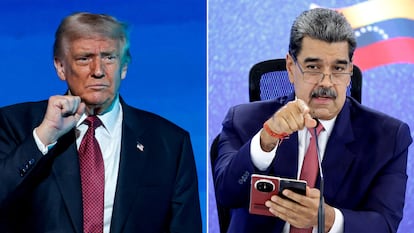

A call between Donald Trump and Nicolás Maduro? The prospect is on the table, despite the heightened tensions between the United States and Venezuela. The Republican has informed his team of his plans to speak directly with the Venezuelan leader, according to the news website Axios. The report came on the same day that Washington officially designated Maduro as the head of a foreign terrorist organization, amid escalating tensions in the Caribbean.
So far, there is no firm date set for the conversation, according to the same sources.
Trump’s idea may suggest that, despite the U.S. deployment of military power in the Caribbean, for now no direct U.S. action on Venezuelan territory is planned or at least it would be delayed. There have been fears of a U.S. military intervention in Venezuela since the first warships began arriving in the area.
“Nobody is planning to go in and shoot [Maduro] or snatch him — at this point. I wouldn’t say never, but that’s not the plan right now," an anonymous senior official told the media outlet. “In the meantime, we’re going to blow up boats shipping drugs. We’re going to stop the drug trafficking.”
The U.S. operation, dubbed Operation Southern Spear, has sunk at least 21 vessels since September 2, killing at least 83 people in strikes that experts, lawmakers, and human rights advocates consider extrajudicial killings and illegal acts.
The news of Trump’s possible phone call with Maduro came after the U.S. president designated the so-called Cartel of the Suns a foreign terrorist organization — a move that came into effect on Monday. The designation encompasses corrupt Venezuelan officials and military personnel who profit from drug trafficking ties and income. In Washington’s view, including a group allegedly led by Maduro on the list of foreign terrorist organizations gives the Trump administration grounds for a new phase of military actions in or near Venezuelan territory.
On Monday, the highest-ranking U.S. military officer, the Chairman of the Joint Chiefs of Staff, General Dan Caine, also traveled to Puerto Rico to meet with soldiers and officers of Southern Command, which is responsible for U.S. military operations in Latin America. It is believed that most of the roughly 15,000 troops mobilized for Operation Southern Spear are stationed on that island. On Tuesday, Caine will also travel to Trinidad and Tobago, according to the government in Port of Spain.
Without ruling out the possible start of a second phase of that operation, Trump has also himself raised the possibility of negotiations with Venezuela that could resolve the issue through diplomatic means.
Eight days ago, coinciding with the arrival in the area of the aircraft carrier USS Gerald Ford, the world’s largest, Trump declared: “We may be having some discussions with Maduro, and we’ll see how that turns out. They would like to talk.” Trump, who made the statement to reporters in West Palm Beach, Florida, before getting on a flight back to Washington, did not provide any further details.
Last week, The New York Times reported that Trump had authorized covert CIA operations inside Venezuela. However, at the same time, a long-closed communication channel between the two countries had been reopened. Through this channel, Maduro had offered to step down within a couple of years. This delay, however, was flatly rejected by the United States, according to the newspaper.
A Trump adviser quoted by Axios stated, “I see a diplomatic solution as being very likely.” “Donald Trump hasn’t said this in as many words, but he wants his legacy to be that he did everything he could to stem the flow of illegal drugs into this country,” the adviser added.
In the first months of Trump’s term, the White House envoy for Venezuela, Richard Grenell, took some steps in that direction. The diplomat established contacts with the Chavista regime and even traveled to Caracas for talks that resulted in the release of six Americans detained in the South American country and in the Maduro government agreeing to accept repatriation flights for nationals deported by the United States.
Sign up for our weekly newsletter to get more English-language news coverage from EL PAÍS USA Edition









































