
Maduro addresses his supporters: ‘Failure is not an option at this crucial juncture’
The message that the Venezuelan leader sought to convey at the close of Tuesday’s march was both an internal response to reinforce the regime’s cohesion, and an external signal of defiance against US pressure
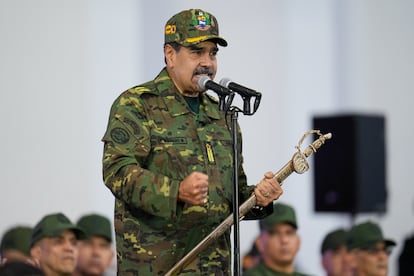
Venezuelan president Nicolás Maduro brought Tuesday’s rally in Caracas to a close, in a show of force with which the Chavista regime sought to demonstrate cohesion amid escalating tensions with the United States. Dressed in military uniform and flanked by the top brass of his government and the Bolivarian National Armed Forces, Maduro raised the sword of Simón Bolívar, a central emblem of Chavista ideology. From below the stage, thousands of supporters chanted in unison: “The man of peace is named Nicolás!”
The mobilization— part of the bicentennial commemoration of the presentation of the sword to the Libertador—brought thousands of Venezuelans into the streets, primarily government employees, military personnel and police officers, who form Maduro’s main support base. The message that Chavismo sought to convey with this march was both an internal response to reinforce the regime’s cohesion, and an external signal of defiance in the face of increasing U.S. pressure. “The homeland demands our greatest effort and sacrifice,” Maduro proclaimed.
The Venezuelan leader—identified by the Trump administration as the head of the alleged Cartel of the Suns—addressed the crowd and delivered a message that made it clear the regime’s intention is to resist. “We are under the obligation to be united! Failure is not an option at this crucial juncture for the existence of the Republic. There are no excuses for anyone, whether civilian, politician, or police officer... If the homeland demands it, the homeland will have our lives if necessary!” he emphasized.
Chavismo’s show of force in the streets contrast sharply with the true popular support it enjoys. Analysts estimate that, currently, around 80% of Venezuelans reject the Maduro regime, compared to 20% who still support Chavismo.
In recent weeks, Trump has taken numerous steps in his pressure campaign against the government of Nicolás Maduro. Following the mobilization of a massive naval and air force to the Caribbean—deploying, among other units, the aircraft carrier USS Gerald R. Ford, the largest in the U.S. fleet—a new operational phase was announced for indirect intervention in the region, which could include covert operations and strikes against targets linked to drug trafficking. Faced with this pressure, Chavismo has responded by activating all its levers of internal power. Venezuelan authorities have declared a state of “maximum readiness,” mobilized armed forces and Bolivarian militias, and reinforced their anti-imperialist rhetoric. Internal repression, according to human rights organizations, has also increased.
In this context, the country has faced international isolation due to the suspension of flights triggered by an alert issued by the U.S. Federal Aviation Administration (FAA) to exercise “extreme caution” when flying over Venezuela and the southern Caribbean Sea due to “increased military activity” in the area. The Venezuelan regime views the measure as part of Washington’s “psychological warfare.” “The lies and imbecility of Marco Rubio will crash against the dignity of our people,” said Diosdado Cabello, Minister of the Interior and de facto second-in-command of the Venezuelan government.
Maduro wove a narrative of resistance on Tuesday. From the stage, surrounded by soldiers and flags, he presented the day as an act of collective defense against what he called “the threats of the empire.” He urged people to see the national symbols—the flag, the sword, the memory of Bolívar—as a reminder that the country is experiencing “a historic aggression” and needs to close ranks.
In invoking Bolívar, he drew a direct parallel between the present day and the wars of independence. Just as the Liberator of the Americas faced invasions and conspiracies, Maduro argued, Venezuela today is called upon to resist the U.S. offensive. “The peoples of the Americas will prevail united,” he affirmed.
The Venezuelan president portrayed Chavismo as the last bulwark against Washington’s military deployment in the Caribbean and against sanctions that, according to him, seek to undermine the government from within. The march, he said, should be interpreted as a show of strength, “a united response” to any attempt at external domination, a kind of visual reminder that his political base has no intention of backing down.
Sign up for our weekly newsletter to get more English-language news coverage from EL PAÍS USA Edition









































