
Maduro to be tried in the US for narcoterrorism and corruption
Attorney General Pam Bondi thanked President Donald Trump for his ‘courage’ in hunting down ‘these two alleged international narco traffickers’
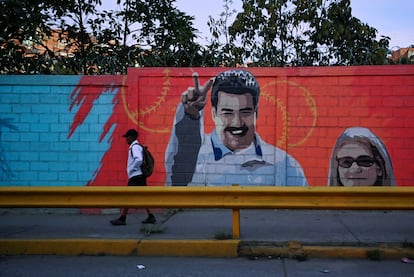

Venezuelan President Nicolás Maduro will stand trial in the United States, Attorney General Pam Bondi confirmed Saturday in a social media post. The head of the Justice Department specified that the Chavista leader and his wife, Cilia Flores, face drug trafficking and corruption charges in the Southern District Court of New York. “They will soon face the full wrath of American justice on American soil in American courts,” Bondi wrote shortly after the U.S. announced their capture.
The Attorney General stated that Maduro and Flores have been charged with “Narco-Terrorism Conspiracy, Cocaine Importation Conspiracy, Possession of Machineguns and Destructive Devices, and Conspiracy to Possess Machineguns and Destructive Devices against the United States”. In the post, Bondi referred to the Chavista leader and his wife as “two alleged international narco traffickers.” The Venezuelan Foreign Ministry dismissed the White House accusations last November as a “fabrication.”
Washington had offered a $50 million reward (approximately €42.6 million) for Maduro, whom it identifies as the leader of the so-called Cartel of the Suns and the Tren de Aragua criminal gang. “On behalf of the entire U.S. DOJ, I would like to thank President Trump for having the courage to demand accountability on behalf of the American People, and a huge thank you to our brave military who conducted the incredible and highly successful mission to capture these two alleged international narco traffickers,” Bondi wrote.
Earlier, Trump had announced the capture of the Venezuelan leader and his wife by U.S. forces in an attack carried out early this morning against targets in Venezuela. The Republican leader added that the couple was no longer in the South American country in a message on Truth, his social media platform.
Open cases
U.S. Secretary of State Marco Rubio reiterated in another post that the Venezuelan leader has several open cases in the United States. Rubio echoed a message he posted on Twitter last July in which he asserted that Maduro is not the president and his regime is not the legitimate government of Venezuela. The president, the Secretary of State maintained, is the leader of the Cartel of the Suns.
The United States filed charges against Maduro for corruption, drug trafficking, and other crimes in 2020, during the final months of Trump’s first term (2017-2021). Washington considers that the Chavista leader lost the July 2024 presidential election, in which he declared himself the winner but never released the official election results. The opposition did release some of the tallies, and these, along with international observers including the Carter Center, indicated a two-thirds majority victory for the opposition.
Republican Senator Mike Lee, who had initially expressed skepticism on social media about the legitimacy of Saturday’s attack on Venezuela, later stated that he had spoken with Rubio and that the Secretary of State had indicated that Maduro would be brought to trial in the United States to face the charges he has been accused of for the past five years.
According to this version of events, the United States has simply executed the existing arrest warrant for Maduro. The military attack against targets in Venezuela was carried out to protect the forces that detained the Chavista leader, so “this action likely falls within the president’s inherent authority under Article II of the Constitution to protect U.S. personnel from an actual or imminent attack,” stated Senator Lee in a post on X.
Precedents
The accusations announced by Bondi and the military attack ordered by Trump are reminiscent of the invasion of Panama in December 1989. Panamanian dictator Manuel Noriega surrendered and stepped down from power after a two-week siege by U.S. forces in January 1990. A year before the military incursion, Washington had charged Noriega with drug trafficking in a Florida federal court.
After a trial that lasted seven months and in which 78 witnesses testified, the general was sentenced in 1992 to 40 years in prison after being found guilty of eight counts of drug trafficking and money laundering. “The trial was forced by those who fear me and who thought they could discredit me through accusations or kill me during the invasion,” Noriega said.
In recent years, New York State has established itself as the epicenter of the U.S. judicial offensive as part of the war on drugs. It was in the Southern District court that former Honduran President Juan Orlando Hernández was sentenced to 45 years in prison for drug trafficking in June 2024, as well as to a fine of $8 million for receiving bribes from the Sinaloa Cartel.
Joaquín “El Chapo” Guzmán was tried in the Eastern District Court of New York. The drug lord, former leader of the Sinaloa Cartel, was extradited from Mexico to the United States in 2017 and sentenced in July 2019 to life imprisonment after what is considered the largest drug-trafficking trial in U.S. history. The so-called “trial of the century” lasted three months, and Guzmán was found guilty of 10 counts of drug trafficking and money laundering in a ruling that prosecutors described as “historic.”
In 2024, it was Ismael “El Mayo” Zambada, co-founder of the Sinaloa Cartel, who was tried in the same court as El Chapo, his former ally, after being kidnapped and handed over to the U.S. authorities by one of Guzmán’s sons. Zambada pleaded guilty last August to two counts of drug trafficking and organized crime to avoid going to trial.
Now, according to Bondi, it will be Maduro and his wife who will sit in the dock. The case of the Chavista leader sets a new precedent. No Latin American president in office has ever been tried on U.S. soil. Noriega and Hernández were prosecuted after they had left power.
Sign up for our weekly newsletter to get more English-language news coverage from EL PAÍS USA Edition









































