
Colombia’s Petro assesses the scope of personal sanctions imposed by Washington
The Treasury’s accusations put those involved at risk of losing their accounts in the country due to the pressure the banks face over to their ties to the US and international financial system
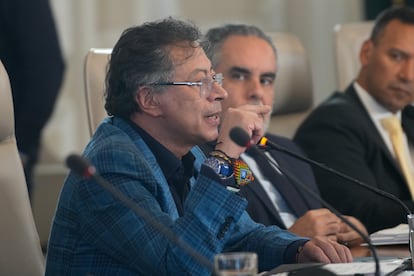

Last week, Colombian President Gustavo Petro was placed on a financial sanctions list by the United States Treasury Department. The measure, which also affects his wife, Verónica Alcocer, his son, Nicolás Petro, and Interior Minister Armando Benedetti, is based on alleged permissiveness toward drug trafficking. Although this is not the Clinton List — created in 1995 to sanction the Cali Cartel exclusively — the practical effects are the same: financial blockade, reputational isolation, and the risk of being excluded from the system. The big question now is what will happen to the accounts of President Petro and the other sanctioned individuals, since local entities are interconnected with the U.S. financial network.
A senior advisor to banking institutions with operations both in Colombia and abroad warned in a conversation with EL PAÍS — on condition of anonymity due to the sensitivity of the issue — that “there is a risk that Petro will be excluded from the national banking system.” This is not a legal consequence, but rather a structural reaction of the Colombian financial system. The Constitutional Court, in a 1999 ruling, established that inclusion on the Clinton List constitutes an “objective cause that justifies the bank’s decision” to terminate contracts with those sanctioned.
Although it is not mandatory, banks have the right to do so if they believe that maintaining a relationship with Petro, his wife, his son, and his minister jeopardizes their ties with foreign entities. “Most Colombian financial institutions maintain very important commercial relationships with U.S. banks,” the court explains. And if a Colombian bank maintains a commercial relationship with the sanctioned individual, it could be punished by the U.S. government for facilitating illicit operations, which would jeopardize the entire financial system of the Andean country.
Benedetti said on Caracol Radio this Monday that he feels “very hurt” by his inclusion on the list and claims that his credit card has already been blocked. “It’s one thing to prohibit you from going to see Mickey Mouse, and another to put you next to Osama Bin Laden,” he commented, alluding to the difference between losing your visa and being excluded from the global financial system. Petro reacted strongly. In his speech on Friday in Plaza de Bolívar, he asserted that he has no assets or accounts in the United States and that, therefore, the sanction does not affect him personally. “If I’ve never done business, I don’t have a dollar in the United States, there’s no account to freeze. I don’t even have the desire to do business in the United States,” he said.
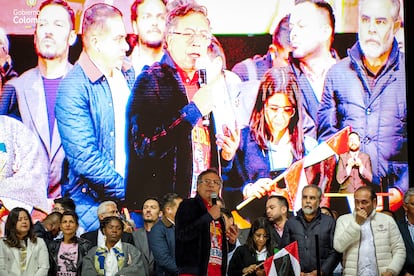
Petro continued: “They’re trying to bring a president to his knees,” but he failed to mention that his accounts in Colombia are at risk, as banks have carte blanche to freeze them if they want to avoid the risk of facing legal action from U.S. authorities. The decision would be controversial for the Colombian banking system, as it’s not just any citizen’s accounts that are being frozen, but rather those of the president of the Republic.
Off the financial map
Inclusion on the Office of Foreign Assets Control (OFAC) sanctions list doesn’t require a court ruling or conclusive evidence. “It’s an administrative process, not a legal one. It’s meant to get you off the financial map,” explains Oreste Sangiovanni, a lawyer and former president of the América de Cali soccer team, a sports club that experienced what it means to be on the Clinton List. “You have to find a way to pay your suppliers. You have nothing. No checking account, no credit, no access to loans. Basically, nothing to keep the company running. Being on that list kills trust. It’s a form of social death,” he tells EL PAÍS.
Sangiovanni led the process to remove the team from the Clinton List, a task that took almost 14 years and was only possible thanks to the support of Juan Manuel Santos’s government. As of June 8, 1999, the team operated without financial accounts, dispensed with multinational sponsorships, and was prohibited from any transactions with U.S. entities. This financial isolation brought the club to the brink of bankruptcy, condemning it to a decade of sporting and reputational crisis.
It wasn’t until April 3, 2013, that OFAC officially delisted América de Cali after an internal vetting process and diplomatic negotiations involving the then-senior presidential advisor for political affairs, Aurelio Iragorri, and the OFAC delegate in Bogotá, Mark Samara. “It was difficult until it was easy. I could tell you I didn’t sleep for a thousand and one nights,” Sangiovanni notes. The former club president recalls that, once the negotiations began, América was removed from the Clinton List within seven months. But he warns that case and President Petro’s are incomparable. “At the club, the symbiosis between the club and drug trafficking was proven,” he says.
Although any U.S. drug trafficking sanctions are often referred to in Colombia as the “Clinton List,” the measure against the president does not fall into that original category. In fact, it was issued under a more recent executive order, signed by Joe Biden in 2021, which allows for sanctions not only against drug traffickers but also against those who assist or facilitate their operations. “The Clinton List itself is just one of the variants. The rest have the same effects, but are based on different rules,” explains Santiago Ramírez López, a lawyer specializing in regulatory compliance. In these cases, neither a court conviction nor conclusive evidence is required: it is enough for the U.S. government to have a “reasonable basis” to link someone to illicit activities.
Being removed from the list is possible, but complex. The process is called delisting and can take years. It involves filing a request with OFAC, demonstrating that the listing was erroneous, or that the activities that led to the sanction are no longer being carried out. “The procedure doesn’t have a specific timeframe and can depend on many factors, including political ones. Ultimately, the decision rests solely with the U.S. Treasury Department,” Ramírez says.
Companies like the La Riviera perfumery have only managed to escape after lengthy direct negotiations with the Treasury. In Petro’s case, his defense is in the hands of American lawyer Daniel Kovalik, who told W Radio that the sanction is “politically motivated” and “has nothing to do with anything wrong that [Petro] has done.” Kovalik plans to file a formal objection with OFAC and has not ruled out a defamation lawsuit against U.S. President Donald Trump.
Sign up for our weekly newsletter to get more English-language news coverage from EL PAÍS USA Edition









































