
Brooks Ginnan, the model and actor who embraced their ectodermal dysplasia: ‘I equated beauty to nearly everything I was not’
Growing up with a genetic condition that affected their development made them hate their body, but celebrating it in films, music videos, and fashion shoots taught them to love it again
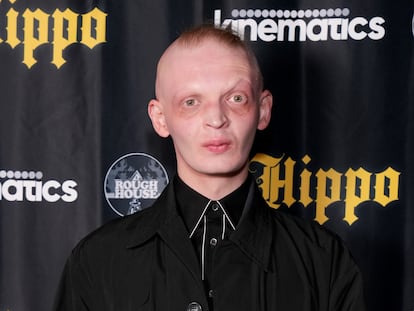
Anyone who’s been keeping up with the latest music releases in recent months will have noticed the recurring presence of the same actor in several music videos: a white, hairless, and unusual-looking youth who stands out from the moment they appear on screen.
Whether as a dressmaker in the haunted hostel in Sabrina Carpenter’s Tears, or starring alongside Winona Ryder as the gaunt-looking neighbor in the Punk Rocky music video by Rihanna’s husband A$AP Rocky, Brooks Ginnan makes each of their appearances memorable, and it’s precisely for this reason that artists seek out the model.
Ginnan, in addition to being a model, is a 29-year-old non-binary musician and actor. They have a rare physical condition called ectodermal dysplasia (ED), a genetic condition that affects the development of hair, teeth, nails, and skin. This genetic disorder gives Ginnan a distinctive physical appearance that has attracted the attention of designers, photographers, filmmakers, and musicians.
Ectodermal dysplasias are “a group of around 100 genetic disorders that affect the development of the ectoderm, the outermost tissue layer of the embryo,” explains the Association of People Affected by Ectodermal Dysplasia (AADE), which points out that “when a person has at least two types of ectodermal abnormalities, such as sparse hair and dental abnormalities, they are said to have an ED syndrome.” The AADE notes that “all ED syndromes are genetic, meaning they can be inherited or passed on to offspring,” although “it is possible for a child to be the first affected in a family.”
Ginnan’s early appearances in pop music videos for artists like Orville Peck (Big Sky), Ethel Cain (God’s Country), and Foster the People (Style) underscore the audiovisual world’s long‑standing fascination with the model.
Ginnan also appeared in the music video for Princess Castle (2019) by their ex-girlfriend, singer Jazmin Bean, who shares their aesthetic sensibilities, and their collaboration with rapper Playboi Carti for the Narcissist clothing line made waves, bringing out the worst in some of the artist’s young fans, who did not hesitate to flock to forums like Reddit to hurl cruel insults at the model.
Fortunately, the attention Brooks Ginnan now receives for their appearances in music videos by increasingly well‑known artists — such as Kesha’s Boy Crazy (2025) — or in films like Muzzle (2023), where they play a sex worker alongside actor Aaron Eckhart, has helped move public sentiment toward admiration. Their leading role in the music video for Don’t Rely on Other Men (2024) by rapper JPEGMAFIA, a former collaborator of Kanye West, was also well received.
In that video, Ginnan showcases their acting skills without their physical condition being the focus of the story at all. The model has said that they refuse to accept roles in which they are objectified or dehumanized.
“There’s an actor with the genetic condition I have who’s done mostly horror films,” they told The Fader in 2024. “I will say no to anything of that capacity. I don’t want to represent people who are born differently or are disabled in some capacity as something monstrous.”
Born in Danville, Pennsylvania, and raised in Albany, New York, Brooks Ginnan was aware of their physical difference from a young age. In a letter published in the U.S. magazine Dazed in 2019, they recounted how, during childhood, friends and classmates would ask why they “looked the way they did” or if they had cancer, adding that these questions were “quite scarring.”
Ginnan explained that, from an early age due to all the comments about their appearance, “I equated beauty to nearly everything I was not,” which triggered body dysmorphia and anxiety that they tried to alleviate through music and fashion. “I thought if I could not be physically beautiful, I could at least use clothes or creation to present myself the way I wanted to be perceived by others.”
Ginnan found a safe place in expressing their androgyny and in the sense of freedom that music provided, and which “began to inform” their sense of style, which drew inspiration from “British and French goth and new wave scenes.”
As a teenager, Ginnan was “extremely shy” and never imagined working in a field that required standing in front of a camera. Television and film also became sources of support, and in a recent conversation on the podcast Left Brain Right Brain they explain that, although productions like Twin Peaks and The Elephant Man, as well as David Bowie’s acting work, moved them from the start, it was characters like Mr. Floop in Spy Kids (2001) — played by Alan Cumming — that made them feel truly represented for the first time. Ginnan described them as “outsider characters that were very misunderstood [...] [and were] living in their own world.”
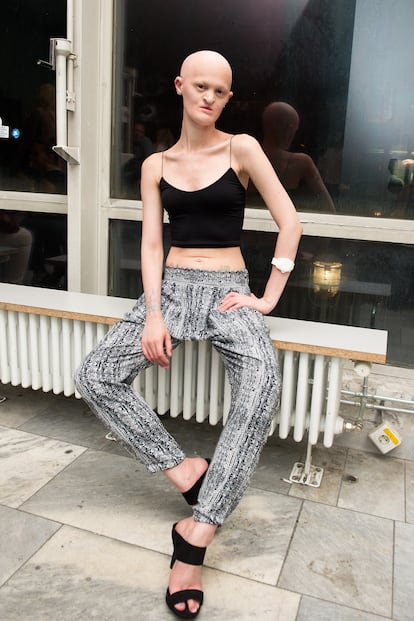
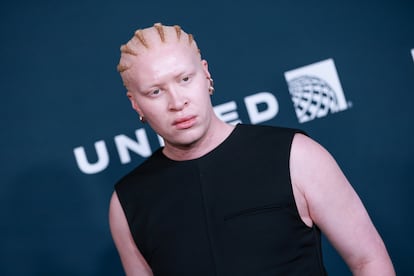
Ginnan wasn’t planning to pursue a professional career in fashion, but after doing some modeling work for friends during their university years, they gradually built their career, inspired by figures like Melanie Gaydos — who also has dysplasia — and Shaun Ross, until reaching their current status in the field.
For Ginnan, modeling means radical self-acceptance: “Being a model means embracing every part of my body that I grew up being taught to hate,” they explained in the letter. “To be able to use a body that is traditionally ‘other,’ both due to my genetic disorder and non-binary identity, feels like an act of defiance in a world that on first thought still has an incredibly narrow idea of what a model, or even beauty itself, should look like.”
The model said that “working in the fashion industry has brought me to a place of self-acceptance that I’ve never known before,” adding that “to be a voice for people born differently, whether with ectodermal dysplasia or otherwise, has been a dream come true.”
Although Ginnan acknowledged in that letter that the industry is evolving, they believed that is “still more traditional than anyone would like to admit,” and noted that they would like to see “more visibility for marginalized voices and identities in ways that are not simply tokenization, or inspiration porn,” i.e. telling stories of pain for pain’s sake, to sensationalize it and turn it into a spectacle without any real intent of normalization.
Ginnan has walked for designers such as Charles Jeffrey, has posed for magazines like Vogue and W, and has not only collaborated with acclaimed photographers like Tim Walker but has also helped bring attention to emerging photographers such as Rose Mihman and Kaio Cesar.
Ginnan’s collaborations have been as colorful as their vibrant shoot for Polyester Magazine or as dark as the 2024 music video for Inziva by the Turkish band She Past Away, an elegant production that pays homage to the pantomime character Pierrot.
Brooks Ginnan’s work breaks molds through the way the model actively controls the viewer’s gaze, rather than occupying the position of a passive subject or exotic “other.” Their central position in the fashion industry is a far cry from the dehumanizing representations that the entertainment industry has historically produced of bodies that challenge the established beauty canon. Their presence is also revolutionary because of this dual dissidence — both bodily and gendered — and simultaneously questions beauty standards, gender binarity, and the very notion of which bodies deserve to be styled, celebrated, and turned into fashion.
The rarity of their condition means that there are few public figures who speak about it from personal experience and help raise social awareness around this disorder.
U.S. actor Michael Berryman provides a precedent, though he worked in an era less aware of ableism. In films like The Hills Have Eyes (1977), One Flew Over the Cuckoo’s Nest (1975), and Deadly Blessing (1981), he was cast as unsettling, marginalized, or horror-associated characters, reinforcing the idea of his physical condition as strange or morbid. In all cases, however, Berryman participated voluntarily and always stood by his performances, so he cannot be seen as exploited for his appearance.
It’s clear that when actors like Gaten Matarazzo — who plays Dustin Henderson in Stranger Things and has a different variation, cleidocranial dysplasia — co-star in a series without their genetic disorder being the central focus of the story, culture is moving closer to normalization.
Sign up for our weekly newsletter to get more English-language news coverage from EL PAÍS USA Edition









































