
Rihanna: The star who made a hiatus her greatest strength
Since the release of ‘Anti’ in 2016, whose follow-up remains a mystery and one of the most anticipated albums, the artist has focused her energy on motherhood and building a business empire
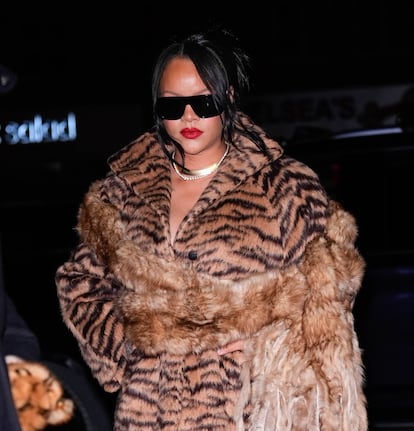

In the competitive and cutthroat music industry, where new stars rise and fall every season, staying relevant after a decade without an album is almost a miracle. But that’s what Rihanna has achieved. This week marks 10 years since Anti, her last album, and the self-imposed hiatus has done her no harm. On the contrary, she is now the fourth most-streamed artist on Spotify, with over 100 million monthly listeners, and her songs continue to be enjoyed both by the audience that experienced her creative hyperactivity firsthand and by a Generation Alpha that has never seen her live.
This is seen in the recent viral video shared by filmmaker Chloé Zhao on Instagram, showing the cast of Hamnet celebrating the end of filming to the rhythm of We Found Love, the anthem Calvin Harris produced for Rihanna in 2011. This is how her legacy works: while she has focused over the past decade on ventures more profitable than her own discography, the world keeps hitting play as if no time has passed.
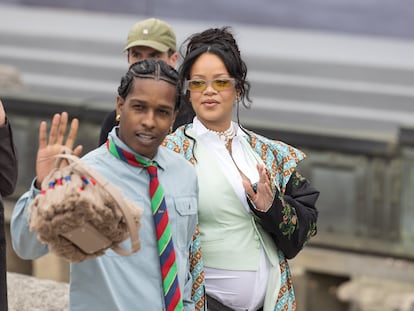
Rihanna is not Kate Bush, Enya, or Sade — three artists prone to disappearing without explanation. She hasn’t vanished entirely, but almost. Since Anti, she has released only eight songs, including collaborations — with Future, Kendrick Lamar, DJ Khaled, N.E.R.D., and PartyNextDoor — and three original tracks for film, two for Black Panther: Wakanda Forever and one for The Smurfs. For someone like her, this is unusual. Even more so when you consider how, early in her career, she spoiled her fans: between 2005 and 2012, she released seven albums in just eight years, at an almost annual pace — an output only interrupted by the slightly more than three years leading up to Anti.

That hyper-productivity had its reason. In a 2019 conversation with The New York Times, she recalled that when she was labeled a one-hit wonder, “that put a fire under my ass, and I just never stopped working.” She even remembered that when she held her first Grammy — she now has nine in total — she immediately started thinking about the future. “I have to think about the next thing,” she said.
“After Music of the Sun … doubt grew every album,” she told Harper’s Bazaar last year, reflecting on the media pressure and the self-imposed standards she set at the start of her career. “You actually think you have to have a number-one album to be successful or to think you made it. You feel like you failed if your album became anything less than number one. That was the era of music at that time.”
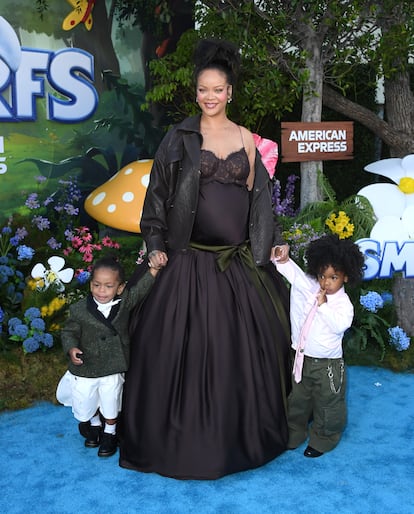
In fact, the reason she stopped frequenting recording studios and stages was that she began building an empire. The first move came in late 2014, when she took on the role of creative director for Fenty x Puma, but the decisive shift came in September 2017, when she partnered with LVMH — through its Kendo division — to launch Fenty Beauty, a makeup brand designed to provide something as basic as all skin tones. Its initial 40 foundations not only changed the conversation around inclusivity — they also sold like wildfire. In just 40 days, it generated around $100 million in revenue, a figure very close to the $110 million earned by the Anti World Tour, Rihanna’s last global tour, across 75 shows between March and November 2016.
But that was only the beginning. On one hand, the makeup line was followed in May 2018 by Savage x Fenty, her inclusive lingerie brand designed for all sizes and skin tones, which became a cultural phenomenon thanks to spectacular runway shows streamed on Prime Video, blending fashion, music, and a diverse cast. On the other hand, in May 2019 she shook up the industry by launching Fenty, a prêt-à-porter fashion, leather, and accessories house created from scratch in partnership with LVMH — the first new brand the conglomerate had developed since Christian Lacroix in the 1980s — making her the only woman of color to lead an LVMH brand. This last venture, which closed in February 2021 during the COVID-19 pandemic, was her only business setback to date, but by then her other two major lines were already operating at full speed.
Today, Fenty Beauty is valued at around $2.8 billion, and Savage x Fenty exceeds $1 billion. It was this diversification — not her music — that led Forbes to include her on its billionaire list in August 2021, with an estimated net worth of $1.7 billion; since 2023, her fortune has hovered around $1.4 billion. For a time, she was the richest singer in the world — until Taylor Swift claimed the title.
That business pivot was accompanied by a more personal one. In a 2019 conversation with Interview, Rihanna said she had begun to realize that “you need to make time for yourself, because your mental health depends on it. If you’re not happy, you’re not going to be happy, even doing things that you love doing,” a reflection that led her to incorporate something new into her schedule, “the infamous P,” or personal days.
This shift in mindset soon translated into concrete plans. In March 2020, in the British edition of Vogue, she expressed her desire to have “three or four kids,” even if she hadn’t yet found the right partner. She eventually did. Since rapper A$AP Rocky made their relationship public in May 2021 in GQ, the couple has welcomed RZA Athelston (May 2022), Riot Rose (August 2023), and Rocki Irish Mayers (September 2025). And, as Rihanna had hinted, they are reportedly planning a fourth. Her priorities, in short, have changed. Where she once juggled studio sessions and tours, she now divides her time between diapers and board meetings.
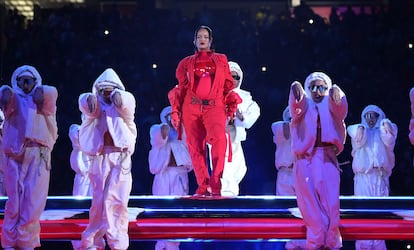
With her businesses running and her personal life in balance, the last frontier remains: music. Beyond occasional appearances — the Super Bowl halftime show and her performance of Lift Me Up at the Oscars, both in 2023, or the private concert she gave a year later at the pre-wedding of Anant Ambani, son of Indian billionaire Mukesh Ambani, for which she was paid $6 million — there is no sign of an album on the horizon. Fans’ patience with the long-awaited follow-up to Anti, her ninth studio album, is wearing thin, especially because Rihanna herself has sent mixed messages, and at this point, no one really knows where she stands.
In 2018, Vogue suggested that she was planning to record a reggae album, and the following year, in the same publication, she clarified that “it’s not gonna be typical of what you know as reggae.” In 2020, she rejected any constraints: I don’t want my albums to feel like themes. There are no rules. There’s no format. There’s just good music, and if I feel it, I’m putting it out."
Soon, the conversation shifted from sound to expectation. She has repeatedly admitted that Anti remains the work she is most proud of, and that if her new material doesn’t measure up, “then it’s not even worth it.”
In 2024, she acknowledged that she was “starting over,” revisiting old demos “with new ears,” and by 2025, she said she had finally figured out what she wants to do — without labels or pre-set styles — denying for the first time the supposed reggae shift: “It’s not going to be anything that anybody expects And it’s not going to be commercial or radio digestible.”
For the first time in her career, time isn’t against her. She might pull a Beyoncé and release an album without warning. Or, like Bruno Mars, she might wait for the ten-year mark for her comeback. Now she is the one setting the pace.
Sign up for our weekly newsletter to get more English-language news coverage from EL PAÍS USA Edition









































