
The US plan for Latin America: The Monroe Doctrine returns, reinterpreted by Trump
The new National Security Strategy aims to ‘restore American preeminence’ to the Western Hemisphere
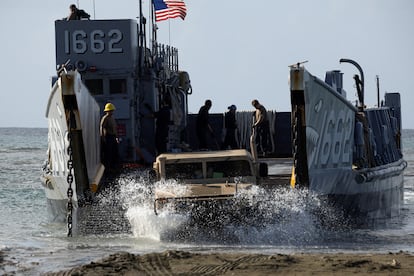

The Monroe Doctrine — which in the 19th century proclaimed “America for the Americans,” established the United States as the dominant power in Latin America and paved the way for an era of interventionism in the region — is alive and well. The new U.S. National Security Strategy, released on Friday, specifically declares the return of these principles “to restore American preeminence in the Western Hemisphere.” “This ‘Trump Corollary’ to the Monroe Doctrine is a common-sense and potent restoration of American power and priorities,” it states.
The National Security Strategy is an official document that establishes the geopolitical priorities of each president and is published in the first months of each administration. This second Trump administration’s strategy focuses on the Americas as its top priority. Controlling the region, it argues, is fundamental to protecting the U.S. homeland. The strategy has two objectives: guaranteeing border security, what it says is “the primary element of national security,” and — without stating it explicitly — countering China’s growing influence in what is once again being treated as the U.S.’s backyard.
“The United States must be preeminent in the Western Hemisphere as a condition of our security and prosperity — a condition that allows us to assert ourselves confidently where and when we need to in the region,” the text states.
To achieve this, the plan is to “enlist and expand” the alliance with partners in the region — either by strengthening existing ties or by attracting others by “bolstering our own nation’s appeal as the Hemisphere’s economic and security partner of choice,” the document states. According to the Trump administration, ideologically aligned allies will cooperate to advance U.S. objectives: controlling immigration, stopping the flow of drugs, and strengthening stability and security. “American policy should focus on enlisting regional champions that can help create tolerable stability in the region, even beyond those partners’ border,” in order to curb illegal immigration and tackle the cartels.
The document states governments, political parties, and movements “broadly aligned” with U.S. “principles and strategy” will be rewarded, although it does not name any of the potential beneficiaries. “But we must not overlook governments with different outlooks with whom we nonetheless share interests and who want to work with us,” it adds.
The strategy also envisions, among other things, a “realignment” to increase the U.S. military presence in the region, suggesting that the massive deployment in the Caribbean — which has continued growing since August — may be more long-lasting than some experts anticipated. It may not be limited to a mere possible operation in Venezuela.
The document calls for strengthening the presence of the Navy and Coast Guard to enhance surveillance against irregular immigration and drug trafficking and for “establishing or expanding access in strategically important locations.” It also mentions “targeted deployments,” including, “where necessary, the use of lethal force.”
This increased military muscle will be combined with “commercial diplomacy,” in which the U.S. will work with regional partners to identify strategic resources — a possible reference to raw materials such as rare earths or critical minerals, whose acquisition has become a major Washington priority — reinforce supply chains, and strengthen local economies so that they purchase more U.S. products and become an “increasingly attractive market for American commerce and investment.”
The Trump administration specifically targets China’s collaboration with Latin American countries in areas such as infrastructure development and control of strategic assets. “The terms of our alliances, and the terms upon which we provide any kind of aid, must be contingent on winding down adversarial outside influence—from control of military installations, ports, and key infrastructure to the purchase of strategic assets broadly defined,” states the document.
The text acknowledges that the influence of China and other countries “will be hard to reverse,” given the “political alignments between certain Latin American governments and certain foreign actors.” But it notes that, in most cases, the relationship between these countries and U.S. rival powers is not ideological, but merely commercial, driven by low costs and limited regulation. Among other measures, the document argues that Washington should utilize “U.S. leverage in finance and technology to induce countries to reject such assistance.”
“We will deny non-hemispheric competitors the ability to position forces or other threatening capabilities, or to own or control strategically vital assets, in our hemisphere.” the document states.
The extensive section dedicated to Latin America concludes: “The United States must also resist and reverse measures such as targeted taxation, unfair regulation, and expropriation that disadvantage U.S. businesses. The terms of our agreements, especially with those countries that depend on us most and therefore over which we have the most leverage, must be sole-source contracts for our companies. At the same time, we should make every effort to push out foreign companies that build infrastructure in the region.”
Sign up for our weekly newsletter to get more English-language news coverage from EL PAÍS USA Edition









































