
Petro, after his call with Trump: ‘Colombia can sleep peacefully’
The Colombian president welcomed the direct conversation between ideological adversaries
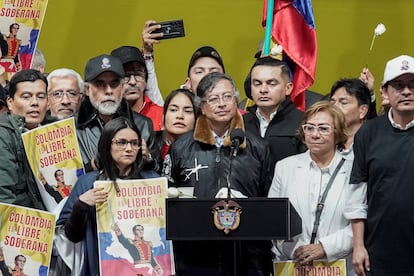

Colombian President Gustavo Petro had called for a protest on Wednesday afternoon, where he was expected to deliver a nationalist speech against his counterpart Donald Trump, who has threatened the Colombian leader on more than three occasions in the last month. But shortly before taking the stage to deliver his discourse in Bogotá’s central Plaza de Bolívar, Petro held a phone call with the U.S. president that completely changed the tone of his words. “Today I brought one speech and I have to give another. The first speech was quite harsh,” he said at the outset. “For 34 years, peace has been my priority,” he added, a reminder of the day he laid down his arms as a fighter with the M-19, a guerrilla organization that aimed to open up democracy in Colombia. “And I know that peace is found through dialogue. That is why I accept President Trump’s proposal to talk.”
Petro said that during the hour-long conversation with Trump he sought to touch on two issues high on the Republican’s agenda: drug trafficking and Venezuela. “I had to throw out the figures that I have repeated here,” he said. In other words, Petro told Trump what he has reiterated in several speeches: that his government has made a historic number of drug seizures and that it has extradited “more than 700 drug traffickers” to face justice in U.S. courts. “I told him the most important thing: that voluntary crop substitution is more successful than forced substitution with glyphosate,” he added, a contradictory statement given that Petro’s government recently decided to resume the controversial spraying of glyphosate, a potentially carcinogenic herbicide.
“Trump was deceived. Trump is not stupid,” said the Colombian president, who believes that elites on the Colombian right wing, allied with politicians in Miami, have deceived the Republican magnate by convincing him that Petro is a front man for Nicolás Maduro. Trump has even called the Colombian president a drug trafficker on several occasions. “There is no basis for this,” Petro repeated. “They told me I was Maduro’s front man. The extreme right there believed the theory that there is a Cartel of the Suns, and that I am the front man,” he added. “That bunch of lies told there convinced Trump that I have cocaine factories.”
Then there was the situation in Venezuela. “We talked about other issues on which there is still no agreement, such as that peace in Venezuela is peace in Colombia, and vice versa,” he told the audience. He added that in a conversation with Maduro, before Washington’s attack on Caracas last Saturday, they managed to talk about an attack on the ELN guerrilla group, which has a presence on the Colombian-Venezuelan border. Petro then revealed another important contact. “I also spoke two days ago with the current president of Venezuela, Delcy Rodríguez, and invited her to Colombia. We want to establish a tripartite dialogue, and hopefully a global one, to restore order in Venezuela,” he added.
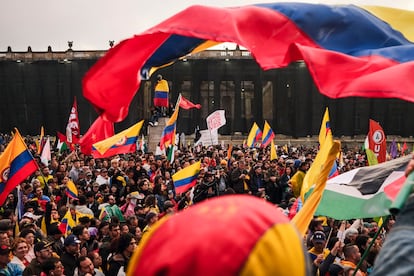
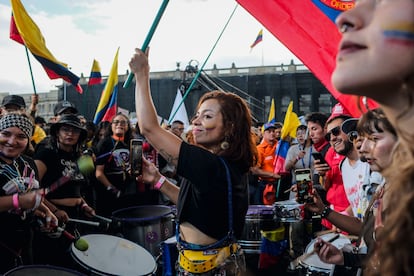
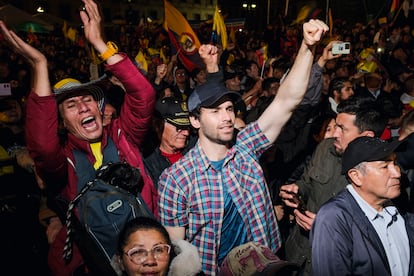
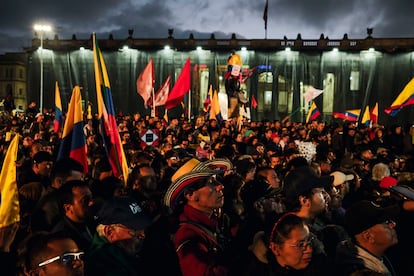
Petro’s combative tone was directed much more at Colombia’s political right wing than at the Republicans in the White House. He mentioned the brother of former right-wing president Álvaro Uribe, Santiago Uribe, who was recently convicted of paramilitarism. He also recalled that journalists and Supreme Court judges were persecuted during Uribe’s administration. He pointed out that, as a senator, he was one of those who repeatedly denounced the mafias from the legislature. “Colombian political sectarianism always leads us to civil wars,” he added. “That political group that seeks votes and wants to defeat us and bring down the government has already realized from the polls that we are the leading political force in Colombia,” he said, referring to the presidential elections coming up in the middle of the year. The left-wing candidate, Iván Cepeda, is leading in the polls.
Petro then took the opportunity to link his conversation with Trump to the months of failed talks he has held with various armed groups as part of his worn-out policy of total peace. “Dialogue is essential, directly. They criticize us for talking to violent people: talking is one thing, being partners is another,” he said. “If there is no dialogue, there is war. The history of Colombia has taught us that.” He ended his speech with a call for calm. “Colombia can sleep peacefully,” he said. “I will warn you if there is anything against it, hopefully in time.”
Sign up for our weekly newsletter to get more English-language news coverage from EL PAÍS USA Edition









































