
Trump and Petro will try to relaunch bilateral ties at a high-voltage meeting
The main challenge, according to aides of the Colombian president, was convincing him to take concrete proposals to Washington, avoid being provocative, and not let himself be provoked
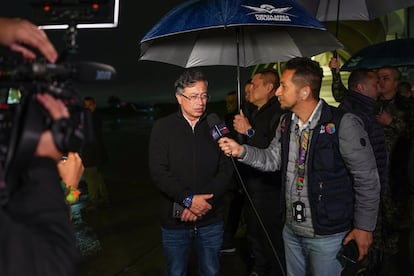
Zohran Mamdani or Volodymyr Zelenskiy? When U.S. President Donald Trump receives his Colombian counterpart, Gustavo Petro, in the Oval Office on Tuesday, will he heap reproaches upon him, as he did with the Ukrainian leader last year? Or will he shower him with praise, as he did with the New York mayor in December after months of mutual insults and criticism?
On the eve of the meeting, Trump appeared optimistic. Petro, he asserted during an event in the Oval Office, has been very friendly in the last month or two. “Somehow after the Venezuelan raid, he became very nice,” he told reporters, citing the U.S. military operation to capture Nicolás Maduro on January 3.
Tuesday’s meeting at the White House is one of the most delicate for the U.S. president in the past year. It is equally so for the Colombian president, whose legacy hangs in the balance. The immediate future of bilateral relations between Washington and one of its traditional allies in Latin America could depend on what the two leaders discuss at this meeting, despite their heated exchanges over the past few months. But given the volatility of both leaders and their willingness to speak their minds, the outcome is unpredictable.
This uncertainty has kept not only President Petro’s delegation on edge, but also a group of Colombians who have spent weeks preparing for what they consider a historic meeting. One of the people who has been working behind the scenes told EL PAÍS about the difficulty of the meeting, or more specifically, the difficulty of convincing the Colombian president of three key points: to be brief and not speak more than Trump, to avoid provocations, and to present viable proposals that are of interest to the United States and beneficial to Colombia.
Apparently convinced, Petro is expected to leave Washington with a strengthened anti-drug cooperation policy, which would translate into greater U.S. military and intelligence support. Also on the table is the possibility of joint operations against the National Liberation Army (ELN), the Colombian guerrilla group partly financed by drug trafficking in the border region with Venezuela.
The Colombian president also has a trump card to play: Venezuela. According to this source, Petro could offer his assistance for a potential democratic transition in that country — aligning himself with Secretary of State Marco Rubio’s agenda, which benefits Trump’s business plans — and assume political costs that the magnate is unwilling to bear. He could also explore a possible Ecopetrol stake in the neighboring country, at a time when Colombia needs Venezuelan gas. It is no coincidence that the president of the state oil company, Ricardo Roa, is in Washington, according to this source. Energy is also one of Petro’s favorite topics. Bilateral trade — 30% of Colombian exports go to the United States — is also high on the agenda, along with measures against irregular immigration.
Amid preparations, Colombia’s ambassador to the United States, Daniel García Peña, acknowledged to the press on Monday that in a meeting of this magnitude, “you never know what might happen.” “We know that the presidents have had differences and will continue to have them. The wonderful thing about international relations is that there will always be points of disagreement,” he stated. García Peña explained that preparations for the meeting began after the phone call on January 7, in which both leaders put an end to months of public clashes. That conversation, he said, marked a turning point and allowed them to steer the visit in the right direction with the goal of “ensuring it goes well for both countries.” It is highly likely that the ambassador will be the one chosen to accompany Petro into the meeting with Trump. He is the only member of the delegation who speaks English.
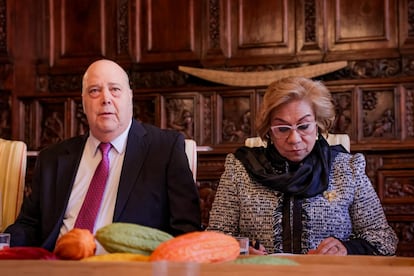
Even before discussing the content, the format of the meeting has been a subject of debate. For now — although in this White House everything can change at the last minute — the conversation in the Oval Office is scheduled to take place behind closed doors, as it did three weeks ago during the visit of Venezuelan opposition leader María Corina Machado. This wasn’t the initial plan, but sources within the Colombian delegation agree that this approach is the most beneficial for both presidents, as it reduces the temptation to put on a show for the audience and, consequently, to raise tensions and potentially derail it.
The U.S. presidential office has avoided describing the event as an official meeting, referring to it instead as a “visit.” Afterwards, Petro is scheduled to hold a news conference to report on the discussions.
Security will be a central subject. Colombian Defense Minister Pedro Sánchez summarized the purpose of the visit with a slogan: “Nations win, and criminals lose.” He highlighted the government’s achievements in the fight against drug trafficking, emphasizing record seizures, the destruction of illegal infrastructure, and extraditions.
The visit aims to seal a truce after nearly a year of open clashes between the two governments. Petro has accused Trump of being an “accomplice to genocide” in Gaza, while the U.S. president has gone so far as to call the Colombian a drug kingpin, adding threats of tariffs, the withdrawal of financial aid, and even warnings of possible military action against Colombia.
Tensions reached such a level that Petro feared an imminent attack against his country. Everything changed abruptly after the phone call on January 7, made at the Colombian president’s request. Before a group of journalists from The New York Times who were interviewing Trump in the Oval Office, the U.S. president radically altered his rhetoric and described it as “a great honor” to have spoken with his Colombian counterpart.
The deterioration of the bilateral relationship, however, had been brewing for some time. It began three years ago, under the administration of Democrat Joe Biden. In his first address to the United Nations General Assembly in September 2022, Petro directly challenged the anti-drug policies jointly developed by both countries, a cornerstone of cooperation since the signing of Plan Colombia in 2000. Although Bogotá and Washington agree on the need to combat drug trafficking, they disagree on the methods. Petro advocates for confiscation, demand reduction, and alternative economic projects for small-scale farmers, while the United States insists on eradication and supply control.
That speech at the UN opened a period of tension that was reflected in clashes with Republican congressmembers like Mario Díaz-Balart and María Elvira Salazar during a previous visit by Petro to Washington in April 2023. The escalation continued after Trump’s inauguration. Just days later, Bogotá refused to receive flights carrying citizens deported from the United States, triggering the first direct clash between the two leaders on social media. In September, Washington withdrew Colombia’s certification as a cooperating country in the fight against drugs for the first time in three decades.
A few days later, during the UN General Assembly in New York, Petro called on U.S. military personnel to disobey their president. In retaliation, the State Department revoked his visa, and the Colombian president’s name, along with those of several family members, was added to the so-called Clinton List, which restricted his financial activity. Beyond the political gains, Petro now hopes that Trump will lift these sanctions against him and members of his immediate circle.
The onslaught continued with the U.S. military campaign against alleged drug-running boats in the Caribbean, launched in September to pressure Venezuela. Petro accused Washington of “murder” after the death of a Colombian fisherman in one of the bombings. Trump responded by calling him a “drug trafficker” and cutting off U.S. aid. After the intervention in Venezuela, the U.S. president even hinted that he might carry out a similar operation in Colombia. By then, a secret commission of Colombians had already been trying for weeks to ease tensions. And then peace — or at least a semblance of it — was precipitated.
Sign up for our weekly newsletter to get more English-language news coverage from EL PAÍS USA Edition









































