
The Darién seeks to replace migrants with tourists
A year after the migrant route between Colombia and Panama fell into disuse, the towns that lived off migrants in transit are now advertising their beaches and lush rainforest
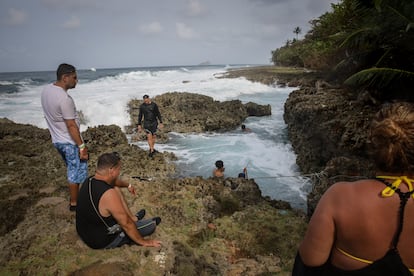

The first time Gabriel Pimentel crossed the Darién Gap was three years ago and he did so barefoot. He left from Falcón, Venezuela, with a small bundle on his back, several changes of clothes, two pairs of shoes, a waterproof pocket where he kept less than $300 and a university teaching certificate, a job that had earned him a monthly salary of less than $6. The sneakers he wore through the jungle that connects Colombia with Panama were given to a father who was traveling with three children because he had lost his boots en route. “There was always someone worse off than you,” he says. He never imagined that shortly after arriving in the United States he would turn around and cross the inhospitable jungle again to return to a Venezuela much more uncertain than the one he had left.
Donald Trump’s return to the White House changed everything. The tightening of asylum applications, border restrictions and the hunt for migrants by the Immigration and Customs Enforcement Service (ICE) discouraged practically 99% of the migrants who, just over a year ago, had been arriving in their hundreds of thousands. In 2023, this deadly route witnessed the passage of more than half a million immigrants of 70 different nationalities. “Today, the few who come are returnees,” says Maxibel Sánchez, a Venezuelan motorcycle taxi driver based in the far north of Colombia. “But what we want to see are tourists.”
The main challenge for the towns of Capurganá and Necoclí on the other side of the Gulf of Urabá is to change the image of the Darién to one of lush beaches and mountains as opposed to thousands of terrified people, with mud up to their knees and their feet in tatters. “The migratory dynamics have changed and we are gaining the trust of tourists,” explains Yimy Leiter Aguilar Mosquera, secretary of Chocó’s department of economic development and natural resources. “This area has much more to contribute; we have a great chance to show off its beauty to the world and the experiences to be had around nature and identity.”
The lush jungle has already forgotten the migrants’ passage. Many of the paths previously demarcated with machetes are now covered by infinite shades of green. Only a muddy flashlight, empty sugar packets and baby blankets remind us that this was once the most dangerous crossing in Latin America.
Pimentel, 25, does not recognize the Capurganá anymore. When he migrated in 2023, this small town of less than 2,000 was awash with “people of all colors” camping on the banks or huddling in humble hotel rooms. He remembers how the street vendors who now offer mango and sapote juices, advertised rubber boots and tablets to make the water drinkable. “We were their business,” he concludes. Behind him, two sun-reddened tourists pose for a selfie in front of giant white letters with the name of the community. “Cheese!” says one wearing braids and colorful crocs.
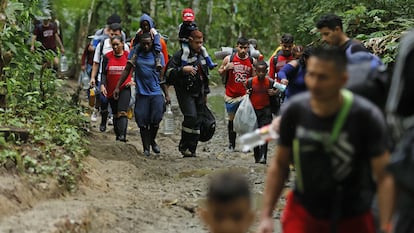
Rafael Méndez travels through the town in a ramshackle tuktuk. This vehicle used to be loaded with the luggage of dozens of migrants who needed to be taken to the beginning of the route. He earned around $180 per person. Similarly, Don Elber used his horses to take women to La Miel or El Paraíso, a few steps from Panama; Don Rafael Bello had his hotel full of families and Don Carlos never lacked clients for his boat trips. The contributions each of them made to the community action board subsidized Capurganá’s only paved road and the construction of the town park.
There was no lack of money, mainly because of the abusive prices the migrants were charged. The cost of a hotel room doubled from $25 to almost $50 and lunches cost $12. “It is true that some raised their prices, but it’s not like this community doesn’t need the money too. Our state has also abandoned us,” says Rafael, a local representative of the businessmen’s collective. “The migrants brought in money, the returnees bring nothing but garbage.”
The bonanza was short-lived. Trump’s immigration policy stopped the economic engine of Capurganá and Necoclí in its tracks. Only the savings of those who were making money off the migrants and the sun-faded posters of the International Organization for Migration remain. “Protect your identity documents from water and humidity... Do not give them to strangers,” one reads.
“I don’t want any American dream anymore”
On a morning at the end of November, in the immigration office of Capurganá, the only occupant is the guard glued to a fan. It’s almost noon and the one in Necoclí is still closed. It’s a far cry from a year back when there were endless lines of asylum seekers. Freymar Figueroa, 30, waits for his cell phone to finish charging at a clothing store. He is also returning to Venezuela after two years in the U.S. “I don’t want any American dream anymore. I just want to hug my mother,” he says through tears. His passage through Mexico was worse than crossing the jungle. “There was nothing they didn’t do to me,” he says with his eyes fixed on the sea.
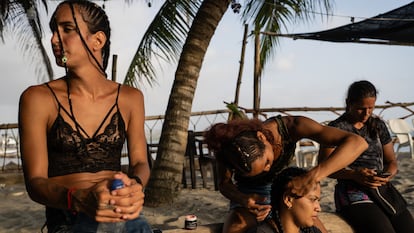
This territory belongs to the biogeographic Chocó, a region that academics say has 10% of the world’s biodiversity. Its richness is due to a number of reasons, including its access to both the Pacific Ocean and the Caribbean Sea, its status as a bridge between the north and south of the continent, the isolation provided by the Western Cordillera of the Andes, and the confluence of trade winds that make it one of the rainiest areas in the world. The Darién is a biologist’s dream, harboring as it does dozens of new species. “It is a great destination for scientific tourism,” says Saúl Hoyos, a Colombian biologist. Jaguars, toucans, colorful frogs and howler monkeys provide the soundtrack for a jungle that culminates in the crystal clear beaches of Capurganá.
Chocó is not the only region of Colombia that is betting on tourism. The country has positioned itself as the most visited in South America with 5.3 million foreign tourists during the first nine months of 2025 – a growth of 56%, indicating that people are gradually shelving the memory of the armed conflict that plagued the country for more than 60 years.
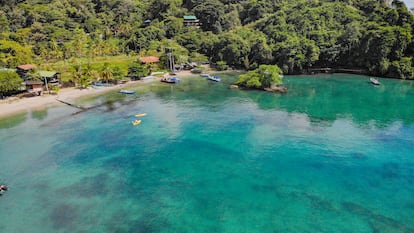
The midday boat is about to set sail in Capurganá. A handful of locals play ludo in front of the port, oblivious to the eagerness of tourists who, smeared in sun cream, confirm which boat they are storing their luggage in. They rush up, put on their life jackets and take their final photos in front of the majestic beaches. “I hope that everyone has found the relaxation they were seeking in Capurganá,” says the guide as the boat fills up.
Sign up for our weekly newsletter to get more English-language news coverage from EL PAÍS USA Edition









































