
Colombia cautiously prepares for a mass influx of Venezuelans following US attack
The government is working on a three-phase plan to address a potential humanitarian emergency
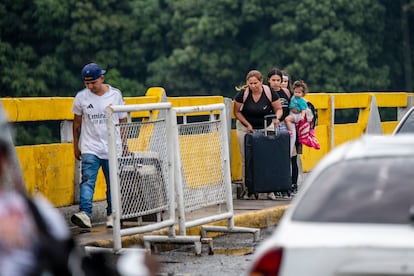

Given the uncertainty prevailing in Venezuela following the capture of Nicolás Maduro by the United States and the continued rule of Chavismo, Colombia is addressing the possibility of a new mass influx of people into its territory, which already hosts 2.8 million Venezuelans. The government of Gustavo Petro is currently considering a three-phase plan in the event of a potential migration emergency, according to a draft from the Foreign Ministry reviewed by EL PAÍS. Deputy Foreign Minister for Multilateral Affairs Mauricio Jaramillo stated Tuesday before the Permanent Council of the OAS that the situation in Venezuela following the attacks ordered by Donald Trump “could generate a massive flow of migration that would demand a significant effort in resources and capabilities to provide the necessary support and assistance in the receiving areas.”
The draft, prepared by the Directorate of Territorial Sovereignty and Border Development, details three stages in response to a potential migration emergency. The first stage occurs when the number of daily entries of Venezuelans reaches 73,000 and the percentage of non-returns falls below 0.01%. In other words, when the majority of those entering remain in Colombia. This initial stage will focus solely on identifying the needs of those entering, a task that can be handled by local and departmental capacities.
The director general of Colombia’s migration agency, Gloria Arriero, stated Tuesday that approximately 60,000 people are traveling daily to Cúcuta, the Colombian city with the highest influx of Venezuelans. Although Arriero indicated that there has not been a significant increase in recent days, she acknowledged that the situation could change at any moment. “Our officers at the mandatory checkpoints are reporting uncertainty among the people due to a very complicated situation that has affected Venezuela and is also affecting us,” she said at a press conference.
If these numbers begin to rise, the government will initiate the second phase, according to the draft. This will be deployed when 90,000 entries are registered daily, the rate of non-returnees reaches 15%, and the percentage of Venezuelans with irregular status who wish to remain in the country is between 5% and 15%. At this point, territorial capacity to handle the influx of people will be exceeded, and the government will consider a “possible declaration of emergency.” From then on, ministries will respond “according to their mission and capabilities,” and services such as lodging, food, and first aid will be activated.
Minister of Equality Juan Carlos Florián, who has been part of the Unified Command Post (PMU) in Cúcuta, stated that “we must be prepared to provide timely, decisive, and comprehensive assistance to those arriving in our country.” “At the moment, it is too early to say whether or not the number of migrants will increase, but we don’t know what will happen, for example, with illegal migration, and many people may be entering the country,” he explained in a conversation with journalists. The government announced over the weekend the deployment of 30,000 troops along the entire border — which stretches from the Caribbean Sea to the Amazon rainforest — to strengthen territorial security.
The third and final phase will be activated if the number of Venezuelans entering the country exceeds 120,000 per day, with a non-return rate greater than 25% and an irregular immigration status exceeding 15%. “This phase will overwhelm the State’s capacity and even exceptional measures,” the draft states. To address the situation, the government proposes “activating international cooperation” to cover the basic needs of the new arrivals. According to the document, the country has the support of the United Nations system and other partners who “have expressed their interest in assisting the Government [...] to address a potential humanitarian emergency.”
By the end of 2025, the number of Venezuelans in Colombia had reached 2.8 million, of whom 67% had received a foreign resident ID card or a Temporary Protection Permit (PPT), the most common mechanism used to regularize the immigration status of Venezuelans and which grants them access to basic services such as health, education, and employment. According to the Ministry of Labor, 71% of the Venezuelan migrant population was of working age in 2024, and their labor force participation rate was even higher than that of the rest of the country’s population (73.8% compared to 63.5%).
Several humanitarian organizations have denounced the mismanagement of Venezuelan migration during Petro’s administration. The Venezuelan program for Education-Action in Human Rights (Provea) published a report in October characterizing the presidency as having slowed the response to migration while dismantling certain mechanisms. The organization cites as examples the closure of the Border Management Office and the Single Registry of Venezuelan Migrants, an office under the presidency. “Currently, there is no general regularization mechanism for those who entered the country after the end of May 2023,” the report states.
The situation is also complex for human rights defenders. The attack suffered by activists Luis Peche and Yendri Velásquez in October highlighted the weaknesses in the security afforded to Venezuelan political exiles in Colombia.
Many have urged the government to strengthen protection and reception systems, and as the Foreign Ministry’s draft shows — it has been in development since early December, before the U.S. attack on Venezuela — it is also a concern for the administration, which fears, as happened a decade ago, that the border will overflow again.
Sign up for our weekly newsletter to get more English-language news coverage from EL PAÍS USA Edition









































