
Venezuelans live in fear and silence in a new country without Maduro
Uncertainty about the political future and fears of internal espionage are growing in the wake of the US attack
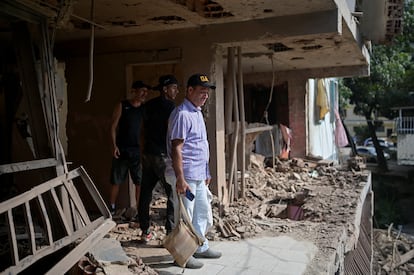

The morning after the January 3 attack, Venezuela awoke in silence. There were no shouts, no flags, no celebrations in the streets. Phones and social media were buzzing, but the curtains were drawn, and the few who ventured outdoors exchanged stunned glances without saying a word. The country awoke holding its breath: waiting, as it had so many times before. In supermarkets and gas stations, people spoke little and shopped quickly. Some secretly celebrated the arrest of Nicolás Maduro by the United States, toasting in hushed tones, sending audio messages that they promptly deleted. But the euphoria was short-lived. A few hours were enough to realize that perhaps there was nothing to celebrate. And the fear returned. Perhaps with even greater force. A thick silence filled the homes, cutting off conversations and leaving calls unanswered. People are afraid to talk on the phone, even in the privacy of their own homes—“we’re all tapped”—and even across the border. “It’s very difficult. You say something and they arrest you,” warns a Venezuelan who crosses into the Colombian city of Cúcuta every day for work.
Venezuela is on pause. While Chavismo rushes to consolidate its power, Venezuelans remain paralyzed. Afraid to go out into the street. To speak out. Of running out of food. Of running out of gasoline. Of getting bombed again.
Donald Trump’s pressure campaign against the Maduro regime and the controversial incursion into Venezuelan territory to extradite him to the United States, where he faces drug trafficking charges, has left Venezuelans—both inside and outside the country—exhausted. After Maduro’s removal, many sent audio messages to their families, which they immediately deleted, and went to bed thinking that, finally, change was imminent. That after almost three decades of Chavismo, they were turning the page.
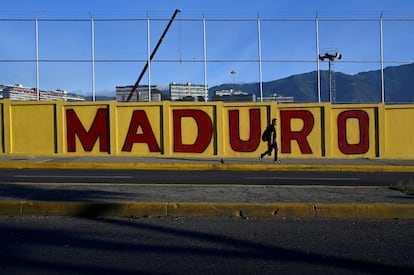
But, once again, change didn’t happen. And Delcy Rodríguez’s rise to power with Trump’s blessing has only sown confusion. Venezuela is entering, once again, uncharted territory, with many of its neighbors paralyzed and confined to their homes.
The last few hours have elapsed in silence and tension. In Mérida state, in the Venezuelan Andes, two people were arrested by local police for allegedly “celebrating” the capture of Nicolás Maduro and his wife, Cilia Flores. The state of emergency decree issued over the unrest allows for the detention of those who promote and support U.S. attacks. That is one more reason to stay home in a country that is accumulating prisoners for tweeting or sharing criticism on WhatsApp.
The bus terminal in Cúcuta, a Colombian city bordering Venezuela that is currently hosting dozens of journalists from around the world, is overflowing. In the dark, cramped waiting room, entire families are crammed together, laden with belongings. Some are arriving, others are departing. It’s nothing out of the ordinary. But behind the larger suitcases there are people who are leaving for good.
A petite elderly woman, her white hair streaked with purple, hurries from one counter to another. She asks that her family’s names not be published. Yesterday she evacuated her two granddaughters, two uncles, and three great-grandchildren from their home in Maracay, in northern Venezuela. “Grandma said, ‘Let’s go!’ and we all ran. Each of us grabbed our clothes, the few things we had, and we left. We’re going to Bucaramanga,” says one of the granddaughters while trying to get her baby to eat a piece of chicken. “We’re afraid of another attack because we live next to a military base. And, really, of everything in general,” adds the other. “We had thought about leaving before, but never like this, from one day to the next,” she says.
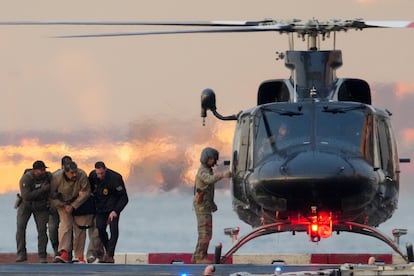
While Maduro faces U.S. justice, Chavismo is hastily changing its tune. Delcy Rodríguez was sworn in as acting president on Monday, and her brother Jorge assumed the presidency of the National Assembly. Diosdado Cabello, until now Maduro’s second-in-command, walked through the streets of Caracas that night wearing a bulletproof vest and accompanied by more than 20 heavily armed officers. “What is doubting?” he shouted at them. “Treason!” the uniformed men responded. It’s the current motto of Chavismo. There is speculation about changes in the military leadership, but for now, everything remains much the same as under Maduro.
No one is talking about elections. Not even Trump. His priority is oil, “fixing the country,” and then, perhaps, elections. It’s unclear what the terms would be, when they would be held, or how they would fit within the constitution. The last elections, in July 2024, according to the official records, were won by a wide margin by María Corina Machado’s party, but Maduro clung to power. Today, Machado, the hope of millions of Venezuelans, remains sidelined while the United States oversees this uncertain and unexpected transition.
In Caracas, three days after the attacks, a cautious return to normalcy is beginning to emerge. Businesses have reopened and public transportation is running. The rush to stockpile supplies has subsided and the lines at supermarkets have disappeared. Movement is slow, as on a holiday. The return to classes, scheduled for January 12 before the attack, remains on.
In working-class neighborhoods, however, tension persists due to the deployment of the colectivos: armed civilians who control the territory for the regime, often in alliance with the security forces. Control is everything: ensuring that services function, preventing merchants from price gouging, and keeping opposition members identified, monitored, and silenced. “You can’t say anything because they’ll grab you and make you disappear,” says a resident who wishes to remain anonymous. “The day of the attack, they unleashed the colectivos, and they’re everywhere; they’re the government’s shadowy hand.”
In the 23 de Enero neighborhood, a working-class area and historical stronghold of Chavismo right across from Miraflores Palace, residents have witnessed these groups handing out weapons to other civilians. The same has been reported in Antímano and Carapita. “They carry them around like it’s nothing, men who probably don’t even know how to shoot,” says a resident from the west of the city.
What sounds like a confession reached EL PAÍS in a hushed audio message from the phone of a Venezuelan woman exiled in Colombia. “More things are coming, according to my information. It might not be today or tomorrow, but another attack is coming,” she warns. It’s the information jungle of social media: one day they warn of new bombings, another—like this Monday night—of an alleged plan by Diosdado Cabello to stage a coup against Delcy Rodríguez. With no journalists working freely—at least five were arrested on Monday in Caracas—and no authorized foreign press, Venezuelans are glued to their screens, devouring news, both true and false.
When they leave home in the morning, those chats are empty. Automatic deletion is activated, or they deliberately delete each message, fearful that the military or armed groups will ruthlessly search their phones. They even delete Maduro stickers. “I’d go to jail for this,” says a young Venezuelan man who works at the Cúcuta bus station soliciting passengers. On his screen, an AI-generated video appears showing Trump celebrating Maduro’s capture with a ridiculous dance.
Sign up for our weekly newsletter to get more English-language news coverage from EL PAÍS USA Edition









































